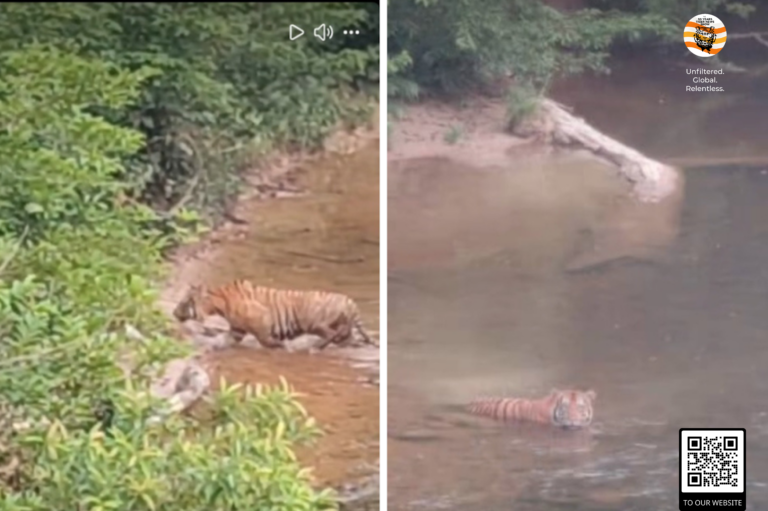
Art competition work can sometimes do what official speeches rarely manage: make the Malayan tiger feel present, fragile and culturally unavoidable, as reported by The Star. The 9th MyTiger Values showcase drew 3,213 submissions from 341 schools and learning institutions across Malaysia, from primary pupils to university students, including private and international schools, students with disabilities and learners under the Integrated Special Education Programme. That reach matters. A national tiger cannot survive only inside policy papers, patrol files or campaign slogans. It also needs a generation willing to see it before it disappears from forests and then from public conscience.
Art competition Gives The Tiger A Public Voice
The project, organised by Maybank Foundation with Kakiseni, asked students to interpret Maybank’s Tiger values through visual storytelling while raising awareness of tiger conservation. Winning works are now shown at Stadium Merdeka in Kuala Lumpur, covering drawings, photo imaging, illustration and sequential art. Thirty-six young Malaysian artists are featured, with winners across primary, secondary and university categories sharing RM55,500 in prizes. The platform can be limited, even corporate, but it can still move the tiger into public imagination rather than leaving it as a distant conservation statistic.
Corporate language deserves caution. Values can become branding. Tigers can become mascots. But when young people draw extinction pressure, habitat loss, climate action, integrity or responsibility, an Art competition can teach that the Malayan tiger is not just a logo or national ornament. It is a living predator under siege, and the adults applauding these children should remember that applause is not protection.
Art Must Not Replace Protection
Malaysia’s Malayan tiger crisis is not caused by a shortage of artwork. It is caused by habitat destruction, prey loss, poaching, trafficking, weak enforcement, political hesitation and an economy that too often treats forests as negotiable. Paintings do not stop snares. Exhibitions do not patrol corridors. Student creativity cannot compensate for government failure. An Art competition becomes meaningful only if it points beyond the gallery wall and toward the field where tigers are actually lost, trapped, traded, or quietly erased by weak protection.
Still, awareness has value when it refuses to become decoration. The strongest student work can challenge adults who have normalized decline. Children should not have to remind institutions that the Malayan tiger is not a bank symbol, tourism icon or convenient national image. Malaysia needs children who care, but it also needs adults who act before those children inherit only memory, merchandise and museum language. Any Art competition that raises tiger awareness should make that discomfort sharper, not safer, because polite tiger awareness often lets powerful adults leave unchanged.
Young Artists Deserve A Living Tiger
Students quoted in the article spoke about art as a voice for change and about children playing a role in protecting nature and the Malayan tiger. That sincerity deserves respect. It also deserves honesty. If Malaysia invites children to imagine tiger protection, then adults must connect that imagination to measurable field support: anti-poaching patrols, habitat protection, community engagement, prey recovery and public pressure against wildlife crime. An Art competition can open a door. What happens after that door opens is the real test for every institution using the tiger as symbol, value, or cultural emblem.
The exhibition is open to the public until June 7, with no ticket purchase required. Free access helps widen the conversation, and that is good. Families, teachers, students and casual visitors can see the work without another commercial barrier. But the Malayan tiger needs more than admiration framed on gallery walls. It needs Malaysia to make the animal harder to kill, harder to trade and harder to erase from the land. Culture matters because it shapes what people value. Real tiger culture should lead beyond symbolism, toward protection strong enough that today’s young artists can grow up in a country where the tiger still lives outside their drawings. That is the standard every Art competition must face.
Source: The Star, Malaysia
Photo: The Star, Malaysia