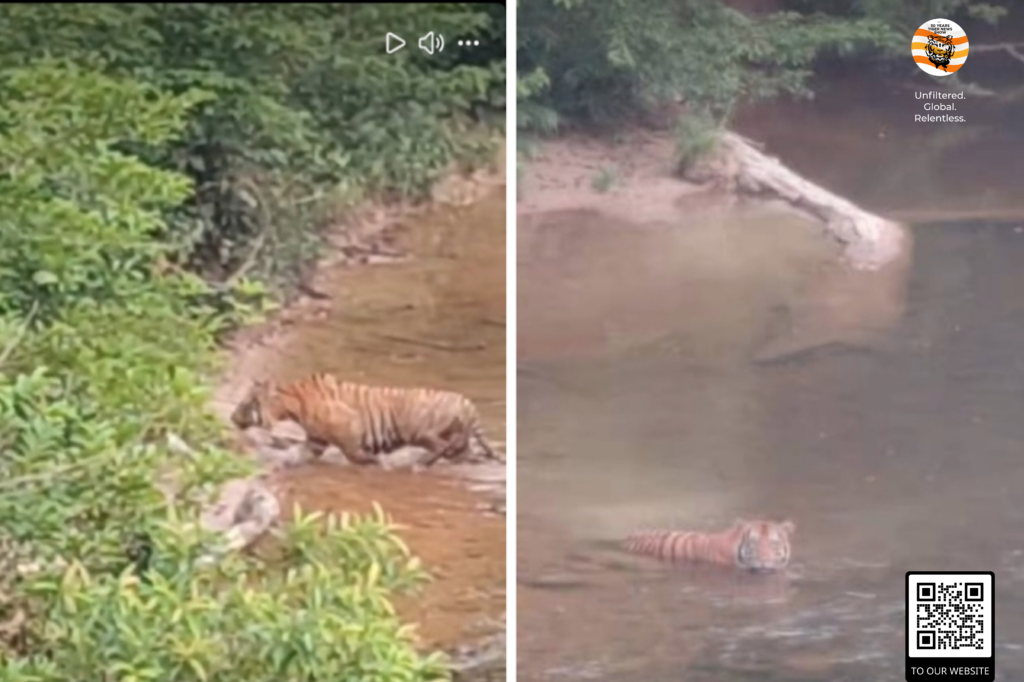
Gua Musang authorities have confirmed a report of a Malayan tiger sighting near the Sungai Relai Bridge in Kelantan after a video of the animal circulated on social media, as reported by Malay Mail. Perhilitan director-general Datuk Abdul Kadir Abu Hashim said investigations by the Gua Musang district office found that the tiger was believed to have merely crossed the area before returning to its natural habitat. Checks at the location did not find the animal, and no reports of disturbance involving residents had been received.
The article states that Abdul Kadir advised the public not to approach or disturb wildlife if encountered and to report such incidents through Perhilitan’s hotline. He added that Perhilitan would continue monitoring the area to ensure public safety and support ongoing conservation efforts for the Malayan tiger. The reported sighting involved no confirmed attack, no resident disturbance, and no animal found during inspection. The official explanation was simple: the tiger crossed, moved on, and returned to habitat.
Gua Musang Shows The Wrong Priority
This situation in Gua Musang is exactly the problem. A Malayan tiger crosses an area, apparently returns to natural habitat, and the institutional response still centres on public reporting, monitoring, and the possibility of control. Malaysia’s tiger authority should be asking a better question: what corridor was this tiger using, and how can that route remain open, safe, and undisturbed?
Gua Musang should not be treated as a stage for panic every time a tiger moves. Tigers move because forests are fragmented, prey shifts, roads interrupt habitat, and remaining individuals must navigate human-dominated edges. If the tiger was only crossing, the goal should be safe passage, not building a file that could later justify capture.
Crossing Is Not A Crime
A tiger moving through its landscape is not misbehaving. It is surviving. The Malayan tiger is already close to being lost, and every living individual matters. When authorities frame sightings mainly as public safety incidents, they risk turning natural movement into suspicion. That is how coexistence gets poisoned before anything actually happens.
No one should approach or disturb a tiger. That part is correct. But people should also be told why the animal belongs there, why movement routes matter, and why capture is not conservation unless there is immediate, proven danger. The default must change. A tiger crossing land should trigger habitat protection first, not capture readiness.
Perhilitan Must Protect Movement, Not Just Monitor It
Monitoring can help, but monitoring without corridor protection is only watching decline in real time. The authorities should identify the crossing route, assess road risk, reduce disturbance, warn communities calmly, and prevent crowds from searching for the animal. If the tiger returned to habitat, that is good. Let it stay wild. Let it remain unseen. Let the forest hold what little is left.
Malaysia keeps speaking about Malayan tiger conservation while its landscapes remain broken by roads, plantations, settlement pressure, and years of weak political courage. Asking people for information is easy. Securing the path a tiger needs is harder. That harder work is what real protection looks like.
The Tiger Needs Space, Not A Trap
The public can help by staying away, refusing to share location details carelessly, reporting only through proper channels, and not turning sightings into social media bait. But the heavier responsibility belongs to the state. If officials know tigers are crossing near Gua Musang, then the response should be mapped corridors, rapid road-safety action, anti-poaching patrols, and quiet protection.
The Malayan tiger does not have enough numbers left for bureaucratic reflexes. Every wrong capture, every disturbed crossing, every viral video, and every blocked corridor matters. This animal appears to have done exactly what a tiger should do: move through, avoid people, and return to habitat. Malaysia should reward that with space, not suspicion. This is where political failure becomes visible. Gua Musang should be a lesson in protecting tiger movement before authority turns survival into a problem.
Source: Malay Mail, Malaysia
Photo: Malay Mail, Malaysia