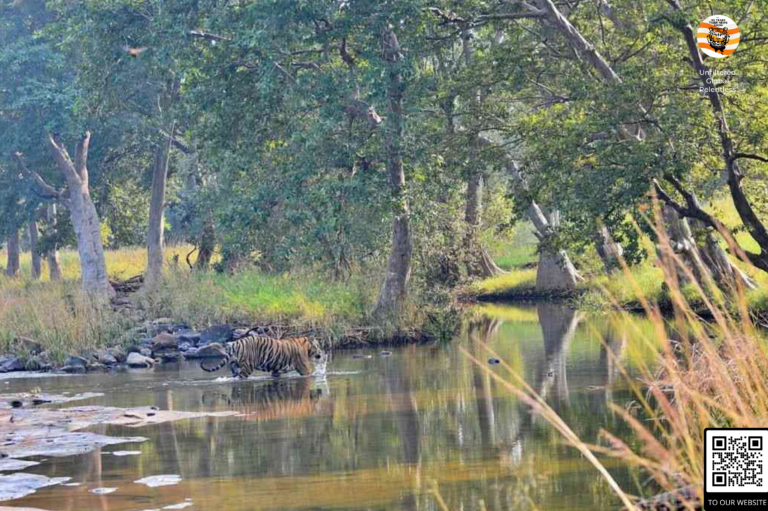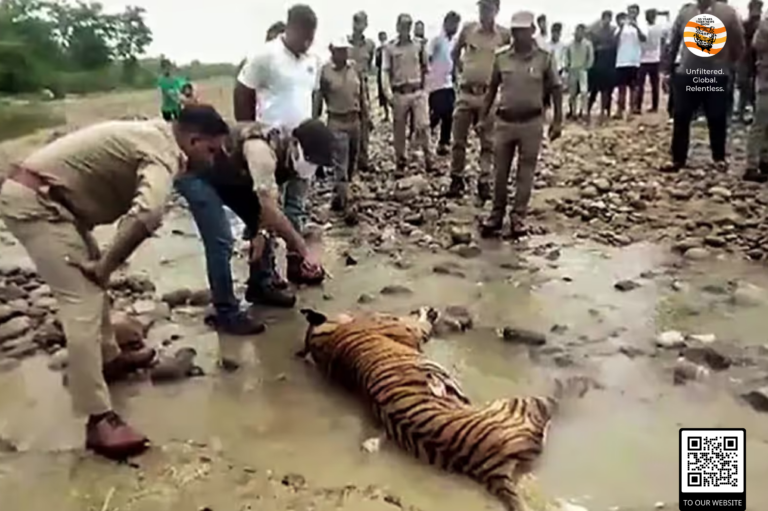
The ‘Wanderer’, a sub-adult male tiger that entered Telangana from Maharashtra last November and moved across multiple districts, is feared to have been shot dead by hunters near the border areas of Nizamabad and Jagtial districts, as reported by Deccan Chronicle. The article says the last evidence of the tiger’s presence came in mid-April, when a cattle kill was reported in the Bheemgal mandal forest area of Nizamabad district. Sources claimed the tiger was shot dead and that poachers left no traces.
The article states that Telangana’s chief wildlife warden said the Forest Department had no information confirming poaching. He said inspections were conducted, villagers were questioned, and no evidence was found. Officials suspect the tiger may have moved toward forests in Jannaram in Mancherial district and said protocols are being followed without disturbing the animal if it is still alive. Other sources told the paper the Wanderer had “disappeared” and alleged organised poaching, also claiming earlier tiger and leopard disappearances in the Kamareddy-Nizamabad region.
The Wanderer Needed Safe Passage, Not A Chase
This is the same story again: a tiger walks because a young male tiger must find territory, and human systems treat movement as a problem. The department reportedly tried to catch him earlier, including by bringing in private wildlife rescuers. That instinct says everything. Instead of securing corridors, reducing panic, protecting livestock, and quietly allowing movement, the response leaned toward capture.
A dispersing tiger is not a criminal. He is searching for space in a landscape sliced by districts, farms, roads, villages, and weak protection. If Wanderer is alive, he needs undisturbed passage. If he is dead, Telangana must stop hiding behind uncertainty and investigate like a tiger’s life matters.
Rumours Are Not Enough, Silence Is Worse
The official position is that there is no evidence of poaching. That must be stated fairly. But absence of evidence is not proof of safety, especially when sources claim hunters were careful not to leave traces. Organised poaching does not announce itself. It thrives where investigations are shallow, rumours fade, and departments prefer no carcass to no accountability.
If this tiger vanished after moving through 14 districts, the answer cannot be casual reassurance. Telangana needs camera-trap verification, patrol records, informant work, forensic attention to cattle-kill zones, and a serious check of local hunting networks. A missing tiger is not paperwork. It is a warning flare.
Organised Poaching Must Be Treated As Organised Crime
The most disturbing claim is that this may be a first-of-its-kind organised poaching case in Telangana, with allegations of earlier missing tigers and several leopards killed in the same region. These are allegations, not convictions. But they are serious enough to demand a full criminal investigation.
Tiger poaching is never just a bullet. It is intelligence, demand, weapons, transport, buyers, silence, and money. If gun-wielding hunters killed a wandering tiger, then the killers are only one layer. The network behind them must be exposed. Every missing tiger strengthens the trafficking machine if officials fail to follow the trail.
Telangana Must Prove The Tiger Still Matters
The tragedy here is the possibility that the Wanderer survived half a state only to be failed at the edge of safety. He crossed Mancherial, Nirmal, Nizamabad, Kamareddy, Jagtial, Rajanna Sircilla, Siddipet, Yadadri Bhongir, Karimnagar, Peddapalle, and more because instinct kept pushing him forward. Human systems should have protected that journey.
If the Wanderer is alive, Telangana must prove it with evidence and protect his route. If he was killed, the state must find the shooters and the buyers behind them. Either way, this cannot disappear into rumour. This is where tiger trafficking begins: one tiger gone, no body, no answers, and humans pretending uncertainty is enough. Wanderer deserved a forest, not a final silence.
Source: Deccan Chronicle, India
Photo: Deccan Chronicle, India