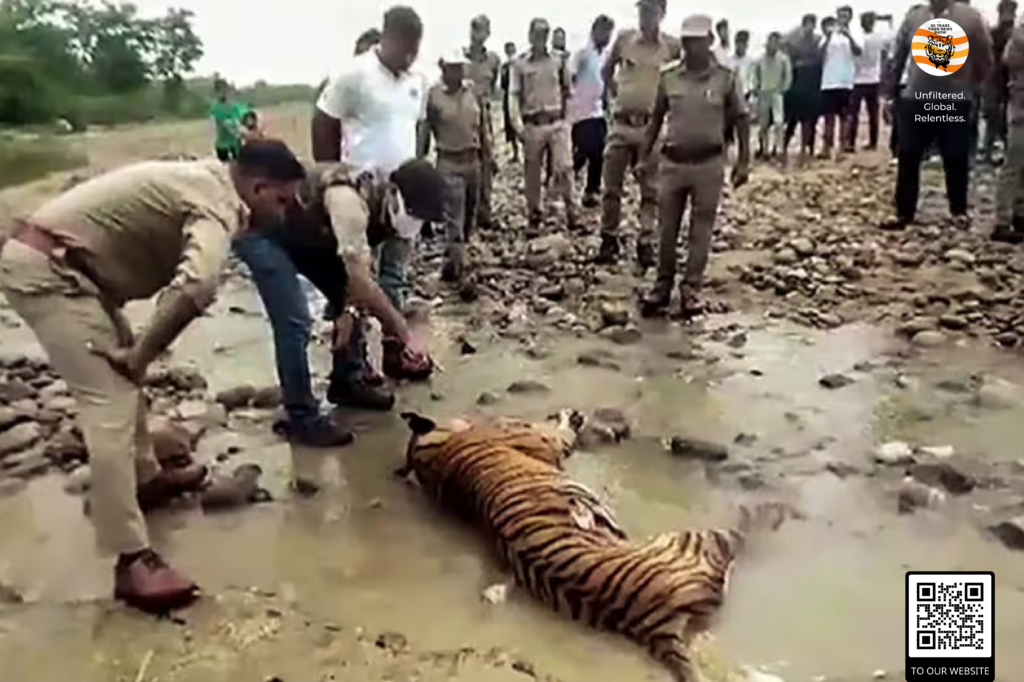
Mutilated remains of a Royal Bengal tiger were recovered from a sandbar along the Gabharu River in Assam’s Sonitpur district on June 11, raising suspicion of poaching, as reported by India TodayNE. Forest officials said the carcass was found near Kochgaon under Thelamara Police Station limits. Its tail and all four legs had been severed. Divisional Forest Officer Biswa Jyoti Das said the body appeared to have been dumped in the river after valuable body parts were removed.
The article states that the carcass seemed to have drifted downstream several days after the tiger’s death. Forest, police, veterinary, and wildlife officials reached the site, conducted a post-mortem examination, and collected samples for forensic analysis. The tiger measured about five feet in length. After examination, the carcass was cremated on the banks of the Gabharu River under wildlife disposal protocols. Authorities have opened an investigation and are awaiting forensic results to establish the exact circumstances of death.
Mutilated Bodies Are Not Accidents
This is what tiger trafficking looks like before it becomes a seizure report. A tiger is killed, stripped, cut, dumped, and left for the river to hide the crime. ‘Mutilated’ does not describe only the body. Mutilated also describes the collapse of protection around an animal that should never have reached this condition.
The missing tail and legs point to intent, not confusion. Officials are right to wait for forensic confirmation, but the pattern already carries the smell of trade. Poachers do not take body parts because they hate tigers. They take them because illegal markets reward the killing. Somewhere beyond that sandbar, someone expected profit.
The River Became A Disposal Route
Dumping a tiger in water is not only cruelty. It is evidence management. Rivers move bodies, destroy traces, complicate timelines, and help criminals gamble on delay. If the carcass drifted downstream after several days, investigators are already working against time, water, decomposition, and whatever trail the killers tried to erase.
That makes the investigation urgent. The crime scene is not only where the Mutilated tiger was found. It is wherever the tiger was killed, wherever the parts were removed, whoever moved the carcass, and whoever expected to receive the body parts. A sandbar is only the last visible point in a much longer chain.
Assam Must Follow The Parts
Too many tiger cases stop at the carcass. That is not enough. The severed parts matter because they are the route into the trafficking network. Investigators need forensic evidence, informants, phone records, transport links, local hunting intelligence, market connections, and cross-district coordination. A tiger missing its legs and tail is not an isolated forest incident. It is a commercial crime scene.
Assam must treat this Mutilated tiger as organised wildlife crime until proven otherwise. Every delay helps the buyers. Every weak investigation tells poachers that dumping a body in a river is enough. That cannot stand. The tiger’s remains should become the beginning of a manhunt, not the end of a report.
Poaching Feeds On Weak Consequences
The brutality is easy to condemn. The harder question is whether the system will answer with enough force. A five-foot tiger was reduced to parts, and the rest was discarded like waste. That should trigger more than routine procedure. It should trigger raids, surveillance, intelligence work, and public pressure for arrests.
Poachers act when risk is low and reward is high. If body parts can be removed and the carcass hidden in a river, then the network believes it has room to operate. The state must close that room. Mutilated wildlife should not become another headline that fades before the people behind it are named, charged, and convicted.
A Tiger Was Turned Into Evidence
The tiger in Sonitpur is now evidence of what humans keep doing to the wild. Not conflict. Not fear. Not misunderstanding. This is extraction from a dead animal for illegal value. The language should stay clear because the crime is clear in its cruelty.
For tigers, the trafficking machine begins exactly here: in remote places, with missing parts, silent buyers, and bodies left where water can carry them away. Assam’s duty is to stop that machine from swallowing this case. This is where tiger trafficking must be fought with forensic seriousness and rage held under discipline. A Mutilated tiger demands answers, arrests, and consequences strong enough to make the next poacher afraid.
Source: India TodayNE, India
Photo: India TodayNE, India