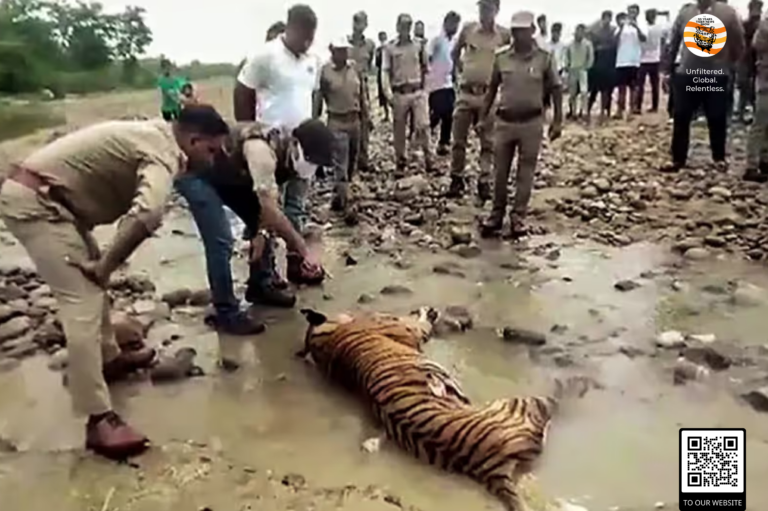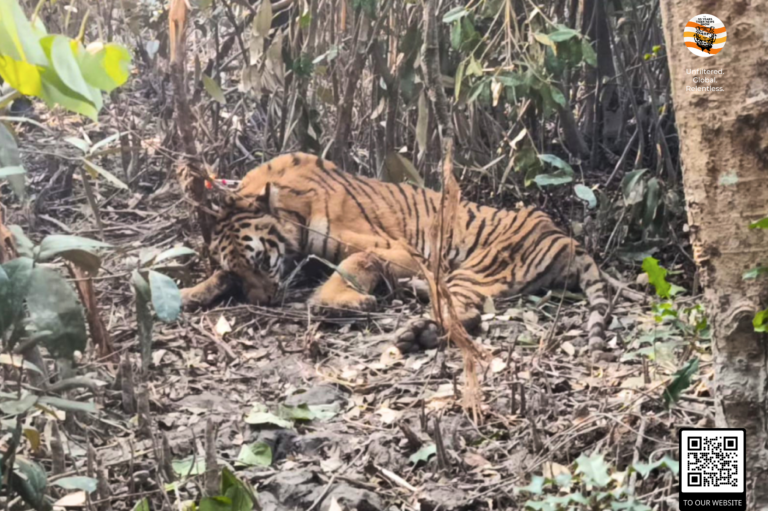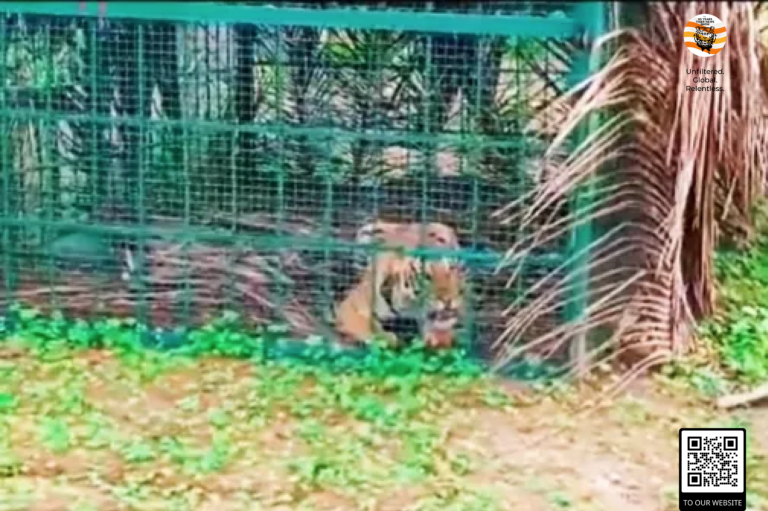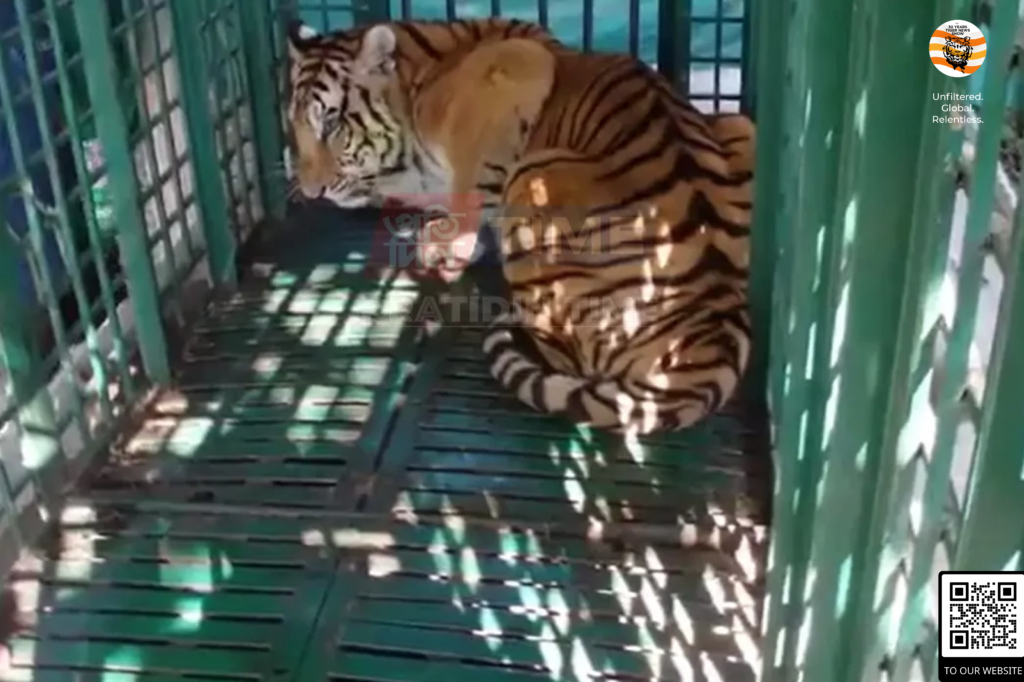
Bamun Gaon, a village near the Agoratoli range of Assam’s Kaziranga National Park, reported repeated livestock attacks before the Forest Department captured a tiger on June 8, as reported by Pratidin Time. The tiger was trapped after entering human settlements and killing domestic animals, causing fear among residents living on the park fringe. After capture, the animal was shifted to the Kaziranga Wildlife Rescue and Rehabilitation Centre for treatment and observation.
The article states that veterinarian Bhaskar Choudhury found the tiger severely injured, weakened by prolonged starvation, and carrying multiple injury marks across its body. Preliminary examination suggested the injuries may have come from a territorial fight with another tiger. Officials also found broken canine teeth, which likely prevented the animal from hunting and feeding effectively. Wildlife experts believe the tiger moved toward Bamun Gaon and nearby villages because livestock became easier prey after its ability to hunt wild animals declined.
Bamun Gaon Shows Why Blame Comes Too Fast
This is where the usual human story breaks down. A tiger kills cattle, fear spreads, and the animal becomes the problem. But Bamun Gaon shows something deeper: the tiger may have been starving because injury and broken canines made wild hunting difficult. That changes the meaning of the conflict.
A tiger that cannot grip, kill, tear, or feed properly will struggle in the forest. Cattle become easier targets not because the tiger has become “bad,” but because humans have placed slow, unprotected livestock near tiger habitat. The animal is not choosing conflict as cruelty. It is choosing survival while physically failing.
Broken Canines Can Change Everything
Canines are not decoration. For a tiger, they are essential hunting tools. Damage to them can reduce the ability to hold prey, deliver a killing bite, and feed normally. Combined with injuries from a territorial fight, that can push a tiger into hunger, weakness, and risky movement toward villages.
The Bamun Gaon case should therefore be treated as a medical and ecological problem first, not as a simple capture success. If officials only remove the tiger, they may quiet the village temporarily, but they do not address why the animal entered livestock zones, how long it was injured, and whether earlier detection could have prevented escalation.
Capture Should Not Mean A Life Sentence
The Forest Department is right to treat the animal and assess its condition before deciding the next step. But the next step must not automatically become permanent confinement in a sanctuary. That may be necessary if the tiger cannot hunt, feed, or survive independently after recovery. But it should be a last resort based on evidence, not the default institutional convenience.
If rehabilitation can restore strength, movement, and feeding ability, officials should examine whether a carefully monitored release is possible. If the broken canines make wild survival impossible, then a spacious, welfare-first semi-wild setting may be needed. But captivity should never be presented as a neat solution to conflict created by injury, livestock exposure, and weak prevention.
Villagers Need Safety, Tigers Need Options
The fear in Bamun Gaon is real. Families cannot be expected to absorb repeated livestock losses without support. Fast compensation, secure cattle shelters, night restrictions, early alerts, and community reporting systems matter. These are not luxuries. They are the tools that prevent anger from becoming retaliation.
But protecting people should not mean writing off the tiger. A starving injured animal needs treatment, not punishment. Authorities should study whether more tigers are being pushed into fringe conflict by territorial pressure, prey conditions, injury, or human settlement patterns near Kaziranga. Every conflict case carries information if the department bothers to read it.
Bamun Gaon Needs A Better Answer
The right response is not denial, panic, or permanent removal by habit. The right response is diagnosis: what happened to the tiger, what recovery is possible, what risks remain, and what landscape changes can prevent the next case. Bamun Gaon should become a lesson in early intervention, not another story where the animal suffers last.
Human-tiger conflict is rarely solved by cages alone. It is solved by planning before desperation enters the village edge. This tiger lost hunting ability, entered livestock zones, and ended up trapped. Now Assam must prove that human-tiger conflict can be handled with science and compassion. Bamun Gaon deserves safety, but the tiger deserves more than capture as the final answer.
Source: Pratidin Time, India
Photo: Pratidin Time, India