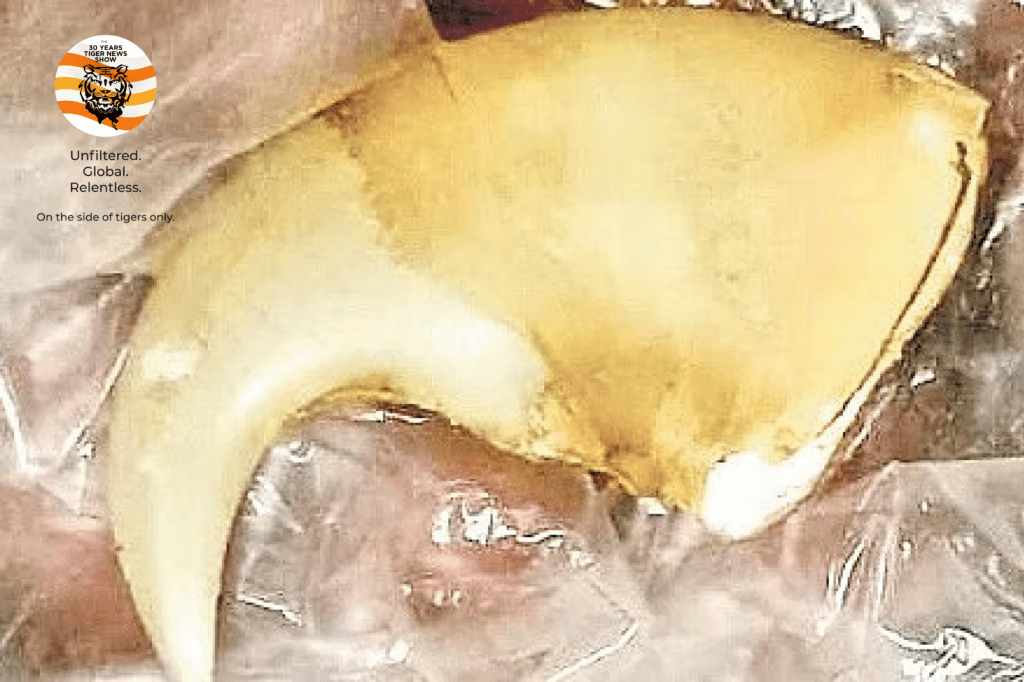
Haridwar has become another hard reminder that tiger poaching is not random cruelty but organised extraction, as reported by The New Indian Express. The Uttarakhand Forest Department has asked a court for custody of prime accused Aamir Hamza, also known as Miyan, after two two-year-old tigers were allegedly poisoned in the Shyampur range and mutilated for claws. Their carcasses were found on May 18 and 19. Officials suspect a buffalo carcass was laced with toxic agricultural chemicals, left as bait, and used to kill animals that should have been protected before traffickers reached them. This was not a forest mishap; it was targeted violence.
Haridwar Poisoning Points To A Wider Trade
The case is already beyond one arrest or one recovered weapon. Investigators say an axe allegedly used to sever claws has been recovered, along with the poisonous substance used to prepare the bait. Divisional Forest Officer Swapnil Aniruddh said statements from other arrested accomplices indicate that the missing claws are believed to be with Hamza. The department now wants remand to locate those claws and follow other leads. That is essential, because claws do not disappear into folklore. They move into demand, secrecy, buyers and profit. Every missing part is a possible route into trafficking.
The alleged method matters because it shows planning. A buffalo carcass laced with poison is not impulse violence. Haridwar investigators believe the gang waited until the tigers consumed the tainted meat, died, and could then be cut for body parts. That sequence belongs to the commercial logic of wildlife trafficking, where a living tiger is converted into claws, bones, skin or teeth for people who still think possession is power. The cruelty is obvious. The system that allows such confidence is worse, because it tells offenders the forest can be used as inventory.
Missing Claws Are Not A Small Detail
The missing claws are evidence, not decoration. Officials say custody of Hamza is needed to recover them and identify further links. If the claws are found, investigators may be able to trace handlers, buyers and any wider network operating in the region. Haridwar makes every missing claw a warning that demand is still alive and waiting. If they are not found, the trade has already achieved part of its purpose: removing tiger parts from the forest and pushing them deeper into criminal channels. That is why remand matters, and why the investigation cannot stop at the man now before the court.
The case also exposes the familiar gap between protection on paper and protection on the ground. After the case surfaced, Forest Minister Subodh Uniyal inspected the site and called for a detailed investigation and strict action. The department then suspended Shyampur Range Officer Vinay Rathi, a forester and a forest guard over alleged negligence. In Haridwar, suspensions are not justice, but they do acknowledge that failure sat inside the system before the tigers died. For tigers, late accountability is still late, and administrative damage control cannot replace prevention.
Reactive Enforcement Is Not Protection
The state’s response must now move past visible outrage. Technology, field intelligence, informant networks, patrol discipline and chemical-source tracking all matter in landscapes where poison can kill faster than paperwork can move. Agricultural chemicals are common, but their use in a tiger killing should trigger serious questions about access, surveillance and local intelligence. A protected landscape cannot depend on luck, delayed discovery or post-mortem damage control. Prevention must become daily discipline, not a slogan after death. Haridwar needs enforcement that reaches before the bait is placed, not after carcasses prove the warning was real.
This case of Haridwar should not be treated as an isolated forest offence. Poisoned bait, missing parts and multiple alleged accomplices point toward a chain. Someone prepared the bait. Someone knew where tigers moved. Someone allegedly cut the claws. Someone expected those claws to have value. Each role deserves pressure, and each failure deserves scrutiny. The case belongs inside the global machinery of tiger trafficking, where body parts keep moving because governments fail to make wildlife crime terrifying enough.
Two young tigers are dead. Anything less than a full network investigation in Haridwar would be another deliberate gift to the trade.
Source: The New Indian Express, India