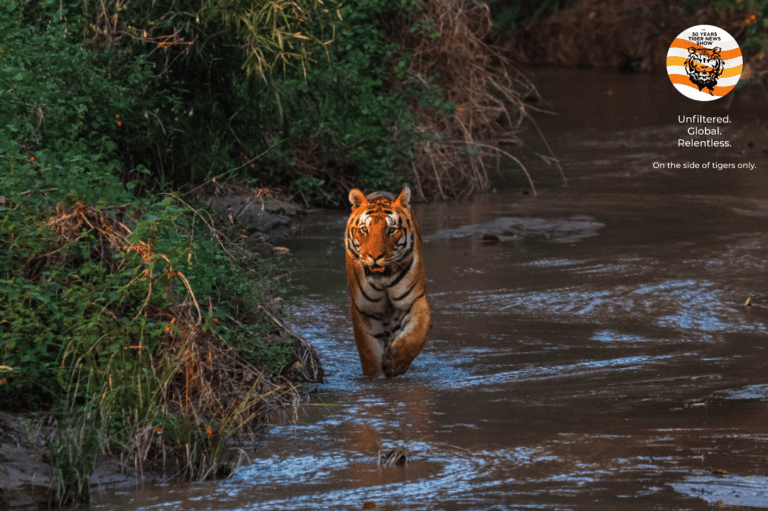
A male tiger was found dead in the forests of Sathyamangalam Tiger Reserve (STR) in Tamil Nadu this week, likely killed in a territorial fight with another tiger. The discovery, while tragic, is also a reminder that not every tiger death signals human failure. Sometimes, nature writes its own rules—and survival is earned, not granted.
The carcass was discovered during a routine patrol in the Ekkathur forest area of the Kadambur range. Forest staff immediately alerted higher officials, and a team led by Range Officer Sivasankaran and forest veterinarian Sadhasivam conducted an inspection. According to DT Next, the tiger’s remains were disposed of following strict NTCA protocol after post-mortem examination. Visceral samples from the heart, liver, and kidney have been sent for laboratory analysis to confirm the cause of death.
Sathyamangalam
Preliminary observations suggest a violent encounter between two males over territory—a natural behaviour in tiger ecology. As Sivasankaran explained, “We suspect the animal died in a territorial fight, which is a normal occurrence in the forest. The tiger population in this region may also have increased.”
In the context of India’s expanding tiger numbers, such events are both expected and ecologically meaningful. Male tigers, by instinct, defend their range fiercely. Each clash reinforces natural selection—the survival of the fittest. For conservationists, the line between tragedy and progress can be thin: when tiger densities rise, infighting is part of the cost of success.
Sathyamangalam’s role in this dynamic is crucial. Situated along the Western Ghats–Nilgiri corridor, the reserve acts as a bridge between Tamil Nadu and Karnataka’s tiger populations, linking Mudumalai and Bandipur with BRT Wildlife Sanctuary. This landscape-level connectivity has been one of India’s biggest conservation victories, turning once-fragmented habitats into a living network of forests where tigers roam, compete, and breed freely.
Nature’s balance, not human interference
Unlike the cases that dominate headlines—poaching, poisoning, or road strikes—this death in Sathyamangalam stems from nature’s own hierarchy. Such incidents do not indicate management failure but rather an ecosystem doing what it must. In healthy populations, competition is a biological regulator, maintaining genetic diversity and population control without human involvement.
However, these events also underline the importance of sound Conservation Practices. As tiger populations grow, so must the landscape’s capacity to sustain them. The forest department’s quick response—securement, post-mortem, and adherence to NTCA protocol—shows the professionalism that India’s frontline teams have achieved. Yet the long-term test lies beyond protocols: ensuring that space, prey, and corridors remain intact so that such fights do not occur under spatial stress.
The instinctual behaviour that caused the death in Sathyamangalam mirrors the resilience that has brought India’s tigers back from near collapse. In 1973, when Project Tiger began, the species teetered on extinction. Today, India holds over 70 percent of the global wild population. That success, however, comes with complexity: more tigers mean more competition, and competition is nature’s way of maintaining balance.
The real measure of coexistence
Conservationists caution against seeing every tiger death as a crisis. The difference between a poached tiger and a territorial casualty is the difference between human failure and ecological order. Learning to read that difference is what mature conservation looks like.
Still, the tiger’s death in Sathyamangalam raises subtle questions. Is the habitat large and rich enough to absorb this growing density without pushing younger males into fatal encounters? Are surrounding corridors open and protected? If tigers are fighting over space, India must ensure that the space itself is not shrinking.
In that sense, every such event is both loss and lesson. Nature, left intact, has its own checks and balances. Our role is to make sure those systems have room to function.
The death in Sathyamangalam exposes the raw order of the wild. Tigers live by rules older than civilization—territory, dominance, survival. When space tightens, only strength decides who stays. That’s not tragedy; it’s ecology in motion.
What matters is whether India keeps the space wild enough for such fights to remain natural. If corridors close, if buffer zones shrink, infighting becomes desperation, not balance. That’s when nature’s system turns into a human-made trap.
A healthy tiger landscape doesn’t avoid conflict—it absorbs it. Sathyamangalam has proved that the species can still live by its own laws. It’s the human side that must evolve next: to protect habitat, enforce restraint, and let natural order run its course without interference or sentimentality.
Source: DT Next – India
Photo: Times of India