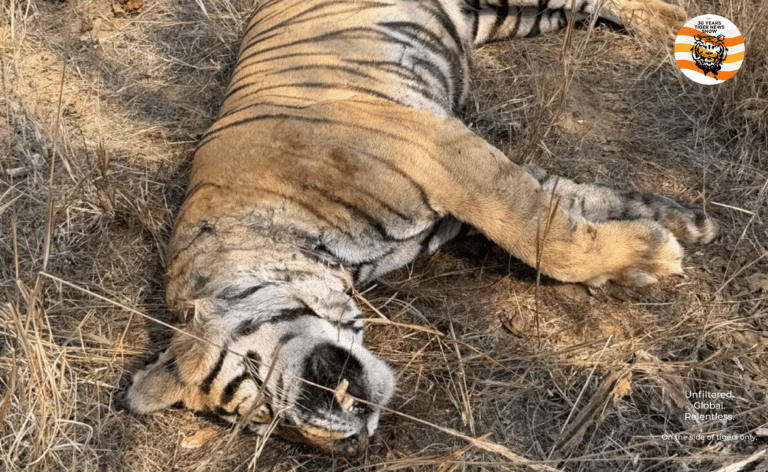
Framing is the danger in China’s state-media story about ecological cooperation with Russia, as reported by CGTN. The article presents captive Amur tigers under the caption “wild prey hunting training” in northeast China’s Heilongjiang Province. That sounds clean, scientific and hopeful. It also hides the uglier truth: tiger farming dressed as conservation. Why? Because this photo was taken in a Chinese tiger farm.
CGTN is not an independent wildlife outlet. It is a Chinese state-controlled international broadcaster, built to project official narratives outward. When state media shows groups of tigers and calls it training, readers should ask what is being softened.
Tigers are solitary animals. A crowd of captive tigers is not wilderness. The article reports real cooperation: Amur tiger recovery, Amur leopard recovery, wildlife passages, protected areas and migratory bird work. China says its stable wild Amur tiger population has risen to around 70, with wild Amur leopards around 80. Those figures deserve scrutiny, not automatic applause. Framing becomes dangerous when genuine wild recovery is placed beside captive tiger imagery, because the line between free animals and managed breeding systems starts to blur.
Framing Captivity As Training Is Dangerous
The article also shows a tiger at Siberian Tiger Park, then says Russian Academy of Sciences members visited Heilongjiang’s Siberian Tiger Park in July 2025 to study systems for rewilding and releasing captive tigers. That is the hinge. Captive tiger facilities do not become clean conservation because state media calls them training sites. China has long faced concern over tiger farms, captive breeding and the risk that captive tiger parts sustain demand. If the same machinery is presented as rewilding infrastructure, the world should demand proof, transparency and independent oversight.
“Hunting training” sounds better than “captive tiger management.” “Rewilding system” sounds better than “breeding facility.” That is why language matters. The article does not confront the danger that captive tiger systems can support trade, normalise possession and keep tiger bodies inside human economic imagination. Instead, it folds captive tigers into a diplomatic story about shared ecological futures. Framing works by choosing the softest term for the hardest reality. It makes confinement look like preparation for freedom.
State Media Makes The Risk Larger
CGTN’s framing role makes this worse. A state broadcaster does not merely describe. It projects policy confidence. When China’s global media arm normalises captive tiger “training,” it helps turn a controversial practice into a respectable image. That image can travel. Other governments, breeding centres and wildlife businesses can copy the language and claim fenced tigers are future conservation assets. Tigers behind barriers become candidates. Feeding exercises become training. Facilities with welfare and trade concerns become part of a green diplomatic narrative. Framing gives the wrong system a cleaner face.
The article highlights 290 wildlife passages along the eastern border and a 2025 China-Russia pledge to strengthen protection of Amur tigers and leopards. Real corridors matter. Cross-border habitat matters. Wild cub survival matters. But no corridor achievement should be used to cleanse captive breeding narratives. Wild tigers need habitat, prey, genetic exchange and freedom from trade demand. Captive tigers need strict welfare rules, separation from commerce, public audits and sceptical science. A grouped captive tiger scene is not a restored population.
The danger is the neat emotional arc: China and Russia cooperate, big cats recover, captive tigers prepare for release, and the green banner covers the dirt. Real conservation asks who audits facilities, where animals go, what happens to bodies, and whether release claims are ecologically credible. This is where captive tiger cruelty hides behind language. Framing tiger farming as hunting training is not harmless optimism. It is political cover for a system that should make every serious tiger defender deeply suspicious.
Source: CGTN, China
Photo: CGTN, China