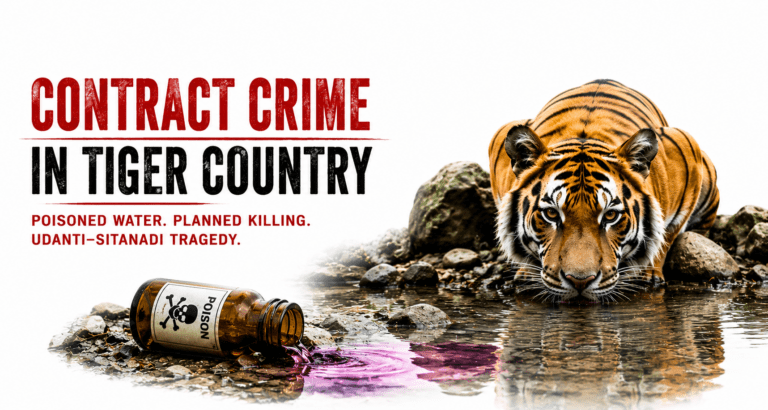
IBCA, the International Big Cat Alliance, is being presented as India’s new global platform for big cat conservation, but its weakness is visible before its first major summit, as reported by The Hindu. China is unlikely to join, Saudi Arabia has confirmed membership, Brazil has not formally entered, and officials say 95 countries are expected at the June 1-3 meeting. The alliance currently has 24 member countries, three observers and several range countries. That sounds large enough for ceremony. It does not sound strong enough for survival. Tigers have heard this language before. They usually die after it fades.
The failure of IBCA is not difficult to predict. International tiger cooperation already failed its own test after the St. Petersburg summit. Countries such as Vietnam, Malaysia, Indonesia, Cambodia, Bangladesh and Laos made promises that did not become lasting recovery, enforcement or habitat protection. Some watched wild tiger populations collapse. Some hid behind weak governance, trafficking pressure or convenient silence. The pattern is old: governments gather, declarations rise, photographs are taken, and forests remain exposed. If countries failed to protect tigers under tiger-specific commitments, there is no serious reason to believe a broader big-cat umbrella will suddenly produce discipline.
IBCA Cannot Save What Governments Abandon
The new alliance covers seven big cats: tiger, lion, leopard, cheetah, puma, jaguar and snow leopard. That breadth looks grand from a podium, but it also makes responsibility easier to dissolve. Tigers need protection from snares, poison, trade networks, shrinking corridors, prey loss and governments that choose development pressure over habitat. Lions, jaguars and snow leopards face different threats, different landscapes and different politics. A global alliance can talk about all of them. It cannot force courage into countries that have already shown they prefer promises without sacrifice.
The article says IBCA members have no financial commitments. That is not a detail. It is the obituary line. Countries will be expected to coordinate action, improve habitats and prey, support protection, conservation, innovation, research, development and capacity building, and share information. Expected. Not required. Not funded. Not enforced. The tiger crisis has never lacked polite verbs. It has lacked consequences. A voluntary alliance with no real financial obligation is already built for evasion. It gives weak governments a place to stand beside strong language while doing almost nothing when cameras leave.
Leadership Optics Will Not Hold Forests
IBCA also begins with China likely outside the door. That matters. China has an estimated 50-70 wild Amur tigers, mostly near the Russian border, while the South China tiger is regarded as functionally extinct in the wild. India, by contrast, had about 3,167 wild tigers in 2022 and holds well over 95 percent of Asia’s wild tiger population outside Russia. India has earned conservation authority through its tiger numbers and reserve network. But authority becomes theatre when leadership is measured by hosting summits instead of forcing outcomes. The danger of this IBCA is obvious: India looks like a global biodiversity leader while the alliance remains too soft to change anything.
This is how conservation failure survives. It does not always arrive as open hostility to wildlife. Sometimes it comes dressed as cooperation, with polished banners, expert panels and careful diplomatic language. Everyone can support big cats in principle. Almost nobody wants the cost: land protected from extraction, corridors defended from infrastructure, trafficking networks punished, tourism restrained, and governments embarrassed when they fail. Wild tigers do not need another room of agreement. They need countries willing to lose money, votes and convenience for their survival.
IBCA will matter only if it becomes something it is not built to be: binding, funded, monitored and painful for countries that fail. Without transparent national commitments, public scorecards, independent audits, money and consequences, it will become another polished monument to political will that never arrived. India may want to lead the world on big cats. But leadership without enforcement is performance.
For tigers, performance has always been fatal.
Source: The Hindu, India
Photo: 30 Years Tiger News Show