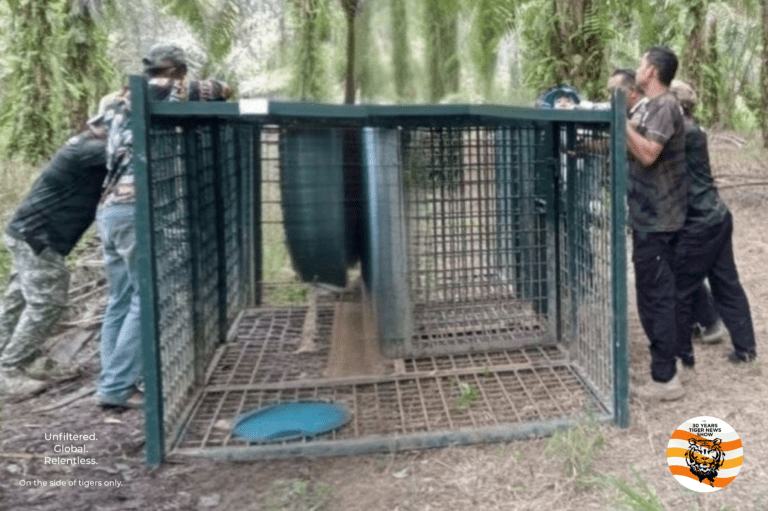
A nine-month-old tiger was captured in Sitapur, Uttar Pradesh, nineteen days after its mother was taken from the same forest block. Officials called it a “rescue.” In reality, the abducted tiger cub was removed because the state had no better plan for coexistence.
The capture ended a month-long operation launched after a farmer’s death on 22 August triggered local panic. The forest department deployed cages and baits across the Maholi range. The tigress was tranquilised on 20 September in Narni village and sent to the Gorakhpur zoo. On Wednesday night, the cub was caught and will now be transported to meet her. Two other cubs remain unaccounted for.
According to Hindustan Times, officials described the operation as a safety measure for villagers. Yet the pattern is familiar: every time panic rises, forest staff capture the animal instead of securing the landscape. This is classic human–tiger conflict driven by missing prevention, not “problem tigers.”
Abducted tiger cub
The abducted tiger cub is the product of failed prevention. Uttar Pradesh still lacks buffer fencing, early-warning systems, and community mediation teams. Conflict is treated as an emergency, not a predictable outcome of habitat loss. Once cages appear, the debate ends; the tiger loses by definition.
Wild cubs of this age are still learning to hunt. Separation halts that process permanently. Even if reunited in a zoo, their behaviour will change—nerves replace instinct. NTCA guidelines demand removal only as a last resort, but such rules are ignored whenever politics outweighs ecology.
Human–tiger conflict management in India remains reactive and localised. District officials act under pressure from crowds, while senior officers measure success by quick captures. The forest department avoids explaining why farmland reaches the forest edge or why livestock compensation takes months. Fear fills the gap left by governance.
Bureaucracy over biology
Removing tigers to calm protests is policy theatre. It silences tension but deepens ecological damage. Each relocation breeds more dependence on intervention, less on prevention. The abducted tiger cub case mirrors similar failures in Pilibhit, Dudhwa, and Katarniaghat, where trapping has replaced territorial mapping and early-response planning.
Such cycles also waste manpower. Field units spend weeks chasing individual tigers while illegal grazing, firewood cutting, and encroachment continue unmonitored. The forest’s integrity erodes quietly while headlines celebrate another “rescue.”
Structural reform, not sedation
The Sitapur operation exposed every missing layer of prevention. Early-warning systems were absent, livestock sheds unprotected, and compensation delayed. The forest department moved only after panic and loss.
Future policy must reverse that order: prepare before panic, not after. Buffer fences, trained rapid-response staff, and transparent conflict reporting should be standard practice, not exceptions. Funding must go to coexistence units, not cages.
Until that structure exists, states like Uttar Pradesh will keep losing control of both the narrative and the forest—one capture, one frightened tiger family at a time.
Source: Hindustan Times – India
Photo: Hindustan Times – India