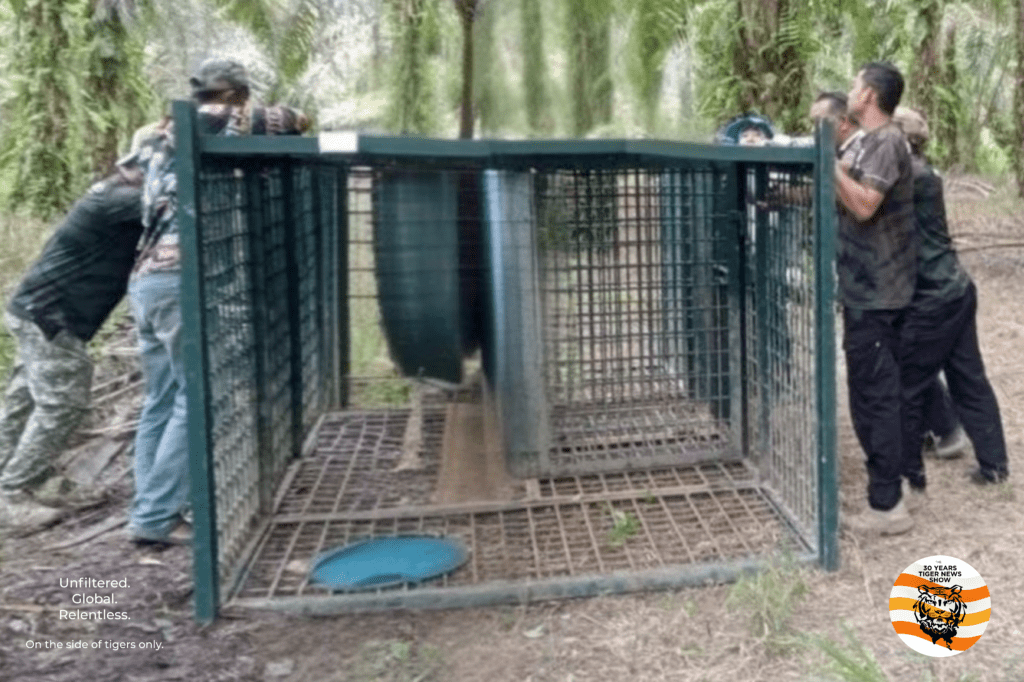
A trap. That is Malaysia’s answer after a cow was reportedly killed near Kampung Orang Asli Sungai Mok in Rompin, as reported by New Straits Times.
Malaysia’s wildlife department, Perhilitan, installed a cage with a goat as bait after traces of a tiger were found. Officials said the move should ease fear among about 800 Orang Asli residents. Fear is real, and livestock loss matters. But one dead cow cannot justify treating one of the last Malayan tigers as the disposable problem in a landscape humans, palm oil expansion and weak governance have already broken.
That’s the real fear: that Malayan tigers go extinct. Not the fragile egos of farmers that know their cries for help are always rewarded.
Trap Policy Punishes The Tiger
The animal has reportedly been seen around Kampung Sungai Mok and Felda Selendang Tiga since last year, and villagers say nine freely roaming cows have been killed this year in oil palm plantations. That does not prove a tiger problem. It proves a palm oil and livestock-management problem. Plantations have pushed into tiger country, broken forest edges, exposed cattle and turned surviving tigers into so-called conflict animals.
Malaysia should be building warnings, compensation, night rules, proper enclosures and rapid response. Instead, officials reach for capture because the tiger is easier to blame than the plantation economy around it.
After that failure becomes public, inevitably, The Malayan trap culture makes the tiger the first target after livestock loss, even when the report describes no human attack. Perhilitan advised residents not to go out at night, especially in oil palm plantations, and told them to keep livestock in proper enclosures, use noise-making devices and light bonfires near cattle sheds. Those measures should come before fear hardens, not after a cage appears. Malaysia knows the Malayan tiger is close to collapse. Still, the visible state response is bait, confinement and removal. That is not coexistence. It is official surrender with a wildlife department label.
And it should just close down the palm oil plantations until the threat is gone. After all, it’s the least Malaysia can do after converting such a large amount of tiger habitat into palm oil grounds.
Malaysia Needs Prevention, Not Cages
Malysia’s trap deployment may comfort people briefly, but it will destabilise territory, remove a breeding animal, and leave the same conflict conditions waiting for the next tiger. A livestock-killing tiger in plantation country requires better prevention, not automatic removal.
India is far from perfect, but it has learned that conflict management must include compensation, alerts, rescue teams, local protocols and pressure on human behaviour. Malaysia should learn from that scale of experience instead of repeating the cheapest cage-based reflex. The country has too few tigers left for lazy habits.
After policy delay has done its damage, and officials still choose spectacle, Trap baiting with a goat is a grim symbol. One animal is tied into the machinery of fear to lure another animal into captivity because people failed to secure cattle, control plantation edges and defend remaining tiger habitat. Residents deserve safety, but safety does not require sacrificing every tiger that appears near plantation livestock. Malaysia needs compulsory livestock protection, fast compensation, trained patrols, camera alerts, corridor protection, palm oil accountability and plantation responsibility. A tiger seen near cattle should trigger prevention first. Capture should be exceptional, evidence-based and reserved for verified human danger.
Malaysia Creates Its Own Downfall For Malayan Tiger
After warnings, fear, weak prevention and official delay, predictably, Trap after trap will not save Malaysia’s villages or its tigers if the surrounding land-use failure remains untouched. Oil palm edges, free-roaming cattle, weak enforcement and poor planning are not solved by a cage. They are hidden by one. Each removal tells communities that the tiger will be taken away if fear rises loudly enough. That message is lethal for a species already near disappearance.
Malaysia is not managing conflict. It is teaching people to expect the forest’s rarest predator to lose whenever palm oil landscapes produce predictable conflict.
After all of this, with Malaysia already running out of wild tigers, politically and morally, A trap is the wrong symbol for a country that should be defending its last tigers. Every cage matters now. Every removal matters. Real human-tiger conflict work keeps people safe while keeping tigers wild: livestock enclosures, night rules, compensation, alerts, corridors and trained response.
Malaysia is not losing tigers because tigers enter villages. Malaysia is losing tigers because palm oil plantations have pushed deep into tiger country. That is the root failure.
And with it, Malaysia’s actions will get the Malayan tiger into oblivion, sooner than later.
Source: New Straits Times, Malaysia
Photo: New Straits Times, Malaysia