Slwoly but surely, International Tiger Day 2026 becomes recognized in the world. It once was introduced in 2010 as a global awareness moment for wild tigers. The day, also called Global Tiger Day, falls on July 29 and began after the 2010 St. Petersburg Tiger Summit, where tiger-range countries promised to reverse collapse and raise attention for wild tiger survival. Most countries failed miserably but Global Tiger Day started to get a position in the global calendars.
Awareness was the point. Awareness is not the problem. We raise it every day and so do others.
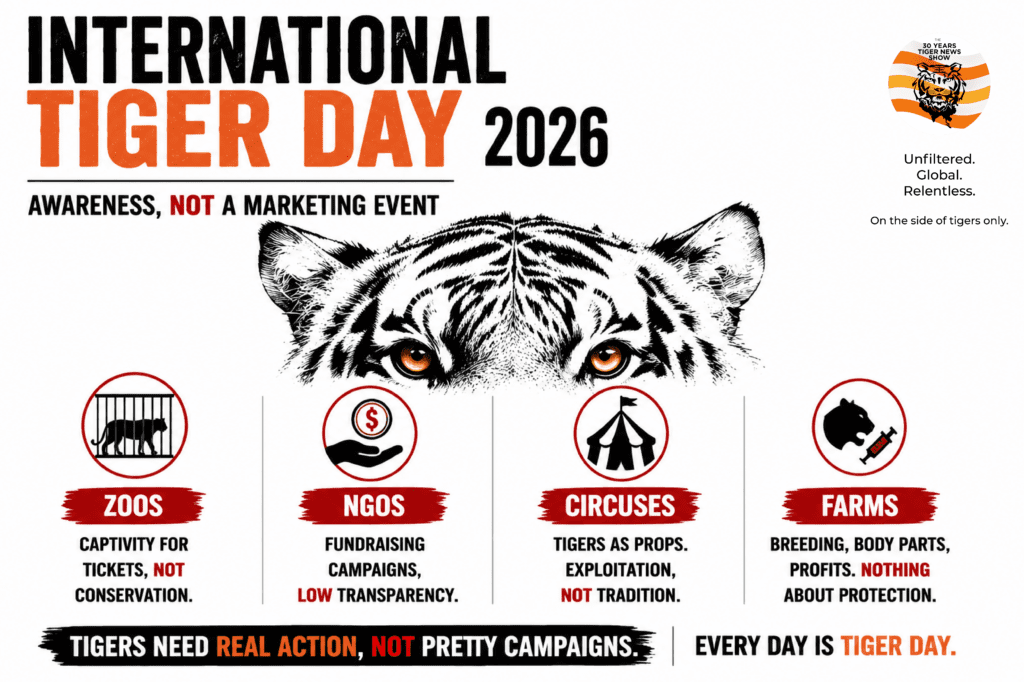
The problem is what too many zoos, NGOs, brands and content machines do with the date. They convert tiger suffering into campaigns, footfall, donations and soft-focus applause. That abuse should make every tiger defender cautious, angry, and alert before the next wave of branded concern arrives.
International Tiger Day 2026 was not created so a zoo could sell family tickets beside a pacing captive cat with zoochosis, or so an NGO could recycle hollow slogans without naming governments, traffickers and industries.
The usual phrases will return: save forests, roar for tigers, survival in our hands. Fine. But tigers do not need another annual slogan. They need less extraction, fewer cages, more and safer corridors, stronger enforcement and an end to human systems that turn them into products.
Awareness without pressure becomes decoration, and decoration is exactly what cynical fundraising likes when captive tigers are used as emotional bait for visitors and donors. That is the trap.
International Tiger Day 2026 Needs Honesty
The original idea came from alarm. Around a century ago, far more tigers lived across Asia. Some even say there were more than 100,000. Today, only a few thousand remain, battered by poaching, habitat destruction, illegal wildlife trade, climate pressure and conflict. The day should say that plainly, but its yearly marketing often avoids the most uncomfortable part: humans keep finding ways to monetise tigers while claiming to love them. zoos use captive tigers as ambassadors while selling captivity as education. Circus people call exploitation tradition. Tiger farms in China and elsewhere turn bodies, breeding and spectacle into industry, then hide behind language about education, rescue, breeding, research, or national pride.
If a zoo uses the date, one question comes first: International Tiger Day 2026 should force it to explain why a solitary apex predator is still behind glass or bars for public entertainment. If an NGO asks for money, it should show exactly where that money goes, which wild population benefits, and whether it challenges the policies killing habitat. Governments posting tiger photos should answer for roads through corridors, mines beside reserves, weak penalties and delayed prosecutions.
Comfort is not conservation when the animal is still being used.
Awareness Without Pressure Is Performance
Schools, colleges, zoos, NGOs and environmental groups often organise awareness campaigns, seminars, drawing competitions and eco-club activities. Some education may help. But children drawing tigers does not offset adults destroying tiger country. International Tiger Day 2026 must not become a harmless school-calendar event while tiger bones move through trafficking routes, forest edges burn under development pressure and captive breeding facilities pretend to be conservation.
The tiger is already one of the most overused symbols on Earth. Symbolism has not saved it from snares, cages, poison, starvation, collision, electrocution and political cowardice.
India, Nepal, Bhutan, Russia and Even China have had real conservation gains, but even success is uneven and fragile. The St. Petersburg promises were not kept equally. Several tiger-range countries failed their own commitments, like Bangladesh, Malaysia, Laos, Vietnam, Cambodia, Myanmar and Indonesia. Some lost all of their tigers, some hid decline, and some still tolerate markets or habitats where recovery cannot happen. And they will all celebrate International Tiger Day 2026 as if nothing else happens.
International Tiger Day 2026 should expose that gap instead of painting every participant as part of one noble movement, like i.e. the Global Tiger Forum is doing. Tigers do not benefit when weak actors stand beside strong actors under the same bright banner while money keeps flowing through sentimental campaigns. It should make that hypocrisy harder to hide, not easier to package.
For us, every day is International Tiger Day because every day humans profit from the animal’s image while the real animal loses ground.
The correct response is not another sweet post. It is to reject tiger marketing that hides captivity, trade, weak governance and fundraising fog. This is where tiger perception becomes dangerous: people think they know the tiger because they see the icon everywhere. The truth is harsher.
International Tiger Day 2026 only matters if it names the systems abusing tigers.