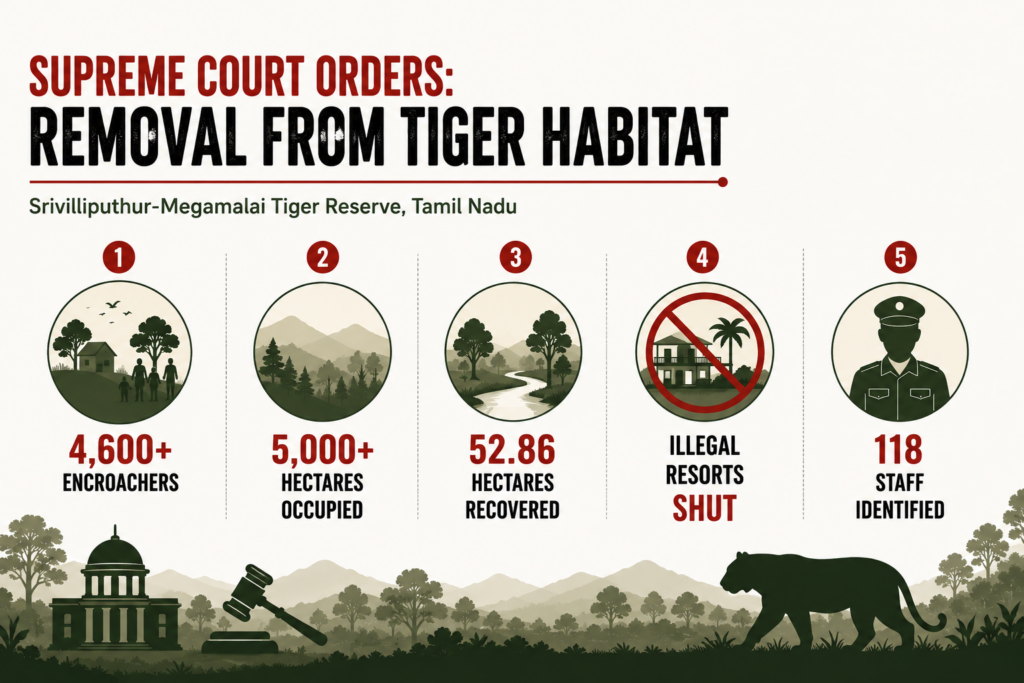
Removal is finally being forced into the centre of a tiger landscape where illegal occupation, resorts and government-backed comfort have sat inside forest land for far too long, as reported by LiveLaw. The Supreme Court issued stringent directions for the Srivilliputhur-Megamalai Tiger Reserve in Tamil Nadu after noting more than 4,600 encroachers occupying over 5,000 hectares of reserved forest land. Only 66 encroachers had been relocated, and only 52.86 hectares had been effectively recovered. For a reserve forming the upper catchment of the Vaigai River and crucial wildlife habitat, those figures are not progress. They are tolerated damage.
Removal Must Mean More Than Paper Orders
Justices Vikram Nath and Sandeep Mehta found the pace of action grossly inadequate for the ecological significance of the area. Even in the 66 relocated cases, the State acknowledged that taking over cultivation, buildings and other assets had not been fully completed. Illegal use remained in suspended animation, a polite legal phrase for a familiar political habit: letting forests lose while governments pretend processes are moving.
The Court ordered Tamil Nadu to prepare a comprehensive, division-wise encroachment eviction plan within one month. It must include timelines, officer-level responsibilities, rehabilitation, legal action against wilful violators and post-eviction ecological restoration. Removal without restoration is only land management theatre, especially when old occupation patterns can return through delay, sympathy, pressure or political convenience. Real recovery means ensuring reclaimed forest is not reoccupied, traded, regularised or converted into the next excuse.
Illegal Comfort Has No Place In Habitat
The order refuses to legitimise illegal occupation through state services. The Court criticised government-supported facilities operating in encroached forest settlements, including public distribution outlets, Anganwadi centres, schools and other public utilities. Such facilities effectively legitimised occupation and discouraged voluntary relocation. All government establishments, public utilities and unauthorised infrastructure within forest areas of the tiger reserve must be discontinued, relocated, dismantled or removed within six months.
Removal must also reach tourism that should never have fed from forest illegality. Illegal resorts, commercial establishments and tourism-related infrastructure in the Megamalai area and other forest lands must be made non-operational immediately. Electricity connections and unauthorised transmission lines must be disconnected and removed. Structures are to be dismantled under Central Empowered Committee supervision, with minimum disruption to the forest.
Public Servants Must Face Consequences
The order names a disgrace that should shame any administration claiming to protect wildlife. One hundred eighteen serving and retired government employees have been identified as encroachers in the reserve. Removal from forest land must punish insiders too, because forest theft by public servants is not ordinary encroachment. It is betrayal from inside the machinery meant to uphold law.
The Court also demanded action against officials and department heads who commenced, facilitated, approved or permitted illegal infrastructure works in forest areas, especially within Megamalai Wildlife Sanctuary and Agasthyamalai Biosphere. The order must reach structures, insiders and enablers together, because human convenience was protected longer than tiger habitat. Conservation speeches mean nothing when public power allows private occupation to harden inside a reserve.
Boundaries Must Stop Being Negotiable
The Court froze new non-forestry activity or diversion proposals across the Agasthyamalai landscape until encroachments are removed and infrastructure is dismantled or dealt with under law. Removal requires survey, demarcation, geo-referencing and digitisation of the boundaries of Kalakkad Mundanthurai Tiger Reserve, Srivilliputhur-Megamalai Tiger Reserve and Kanyakumari Wildlife Sanctuary within six months. Boundaries cannot be bent by pressure, politics or convenient forgetfulness.
Monthly compliance reports must go to the Central Empowered Committee, with quarterly status reports before the Supreme Court. If Tamil Nadu fails, the Committee may recommend paramilitary assistance for eviction of encroachments. That warning shows how far political tolerance has gone. Tiger reserves do not need sympathy while resorts, public utilities and illegal settlements harden around them. They need enforcement that makes occupation temporary, recovery measurable and corruption expensive. Removal is now the test. This ruling belongs inside the pattern of political failure, where governments betray tigers whenever illegal human comfort outweighs habitat. The forest needs action, not another decade of delay.
Source: LiveLaw, India
Photo: LiveLaw, India