
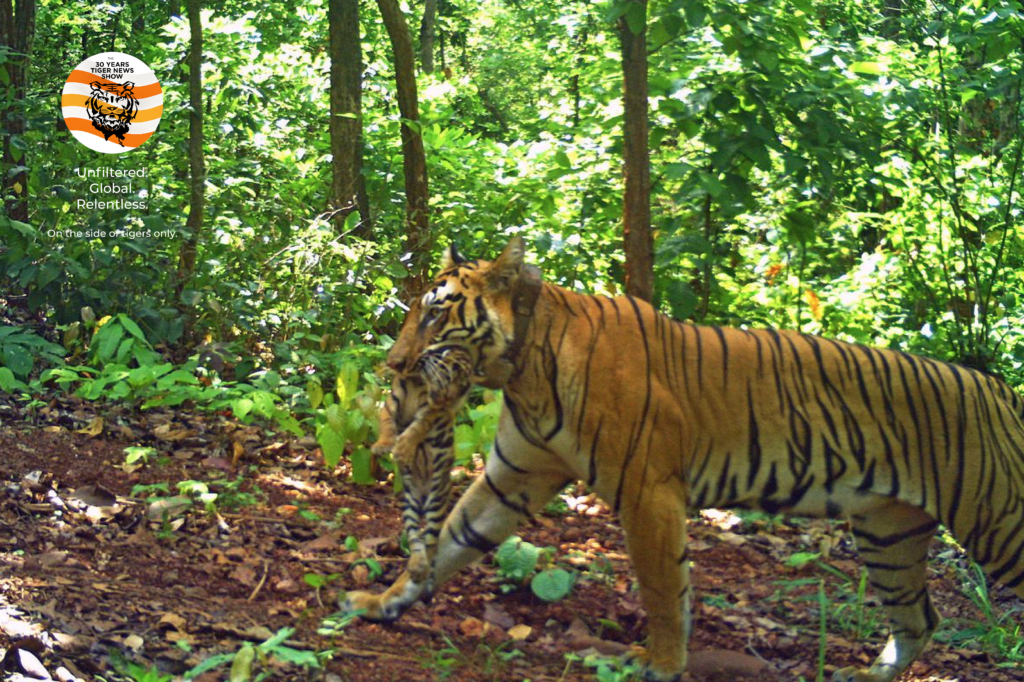
Zeenat, maybe one of the most remarkable tiger stories of this decade, has given Similipal Tiger Reserve the kind of conservation news that deserves real gratitude, as reported by The Hindu. The tigress, translocated from Maharashtra’s Tadoba-Andhari Tiger Reserve to Odisha, has given birth to four cubs. For Similipal, where genetic diversity has been a serious concern because many tigers display pseudo-melanism linked largely to inbreeding, this is more than a beautiful image. It is a meaningful step in a difficult conservation effort that asked a wild tigress, several forest departments and field teams to carry heavy risk.
Zeenat Has Already Survived A Hard Journey
The story is joyful, but it should not be made too simple. Zeenat did not arrive in Similipal and settle without trouble. After 10 days of acclimatisation in the core area, she moved out while trying to establish territory, crossing into Jharkhand and then West Bengal in December 2025. That movement put the forest departments of Odisha, Jharkhand and West Bengal on alert.
For the tigress, it was instinct. For the people tracking her, it was a tense test of coordination, patience and restraint.
She was eventually tranquilised and captured in West Bengal on December 29, 2025. After medical examination, she was returned to Similipal under National Tiger Conservation Authority directions. A special enclosure was then created in southern Similipal, with strict monitoring by forest officials. Zeenat’s four cubs now show why patient conservation work matters, even when the process looks messy from outside.
4 Cubs Strengthen A Larger Effort
Odisha Chief Minister Mohan Majhi announced that special measures had been taken to ensure the safety of the mother and cubs, and that their movements were being continuously monitored. That is exactly what this stage requires. New cubs are not a press release achievement alone. They need quiet habitat, minimal disturbance, careful surveillance and field staff who understand that celebration must never become pressure.
Zeenat and another tiger, Jamuna, were introduced under NTCA supervision to improve genetic diversity in Similipal. The reserve’s pseudo-melanistic tiger population has made that objective especially important. Bringing outside genetic lines into a landscape is not a casual intervention. It requires planning, soft-release management, veterinary readiness, monitoring technology and the ability to respond when a tiger chooses her own route through the map.
Similipal Needed This Success
This birth also matters because Odisha’s earlier attempt at tiger introduction in Satkosia failed painfully. One tiger brought from Madhya Pradesh died after falling into a poacher’s trap, while another was sent back after facing hostility from people inside the reserve forest. That history should make everyone more humble. Translocation is not magic. It can fail when protection, local acceptance, habitat security or conflict management are not strong enough.
Zeenat’s case does not erase those lessons. It proves they must be applied carefully. The southern part of Similipal, with denser forest cover, a major portion of core area and no anthropogenic pressure, offered a better setting for continued acclimatisation. Forest officials have said the tigress would remain under observation before release into the wild. That slow approach is not weakness. It is responsible conservation.
Hope Must Stay Careful
We love this story because hope did not arrive cheaply. It came after long movement, capture, return, enclosure work, monitoring and the strain of keeping one tigress safe enough to become a mother. Zeenat carried her cubs through Similipal, and the photographs touched people because they showed something rare: a conservation plan producing life instead of loss.
Now the next duty begins. The cubs must be protected from disturbance, disease, poaching, conflict and human curiosity. Field teams deserve credit, but they also deserve time and space to keep doing the hard work without turning the family into spectacle. This is where conservation practices must be judged by outcomes, not slogans. Zeenat has given Odisha four living reasons to stay disciplined, grateful and careful.
Source: The Hindu, India
Photo: The Hindu, India