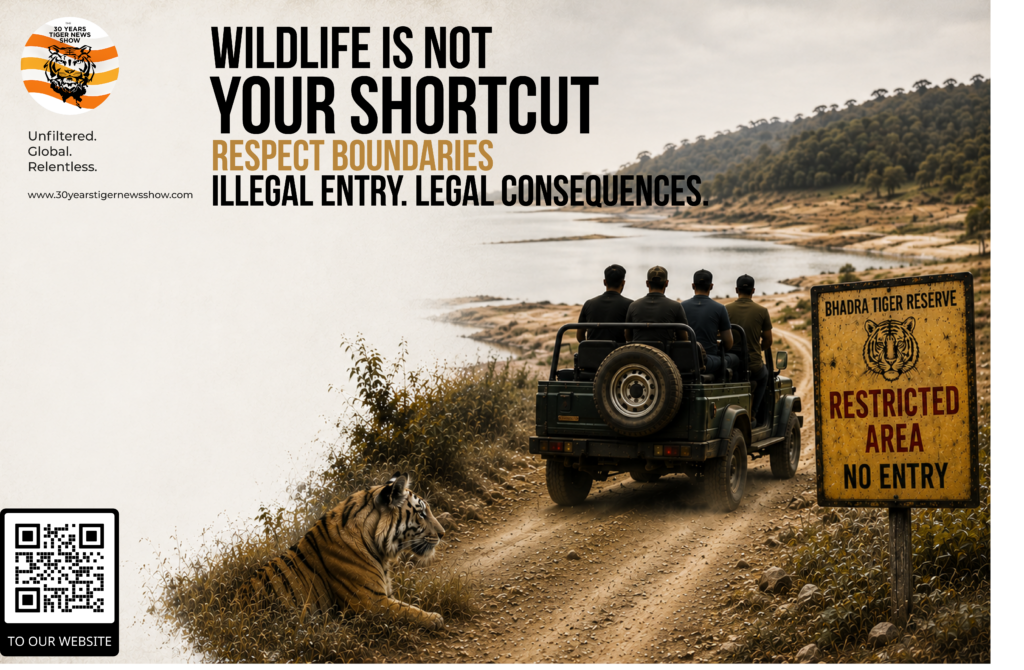
An illegal entry into Bhadra Tiger Reserve has led Karnataka forest officials to book four men after a video showed them driving an open jeep through a restricted area near the Bhadra dam backwaters, as reported by The New Indian Express.
The men had been travelling towards Maridibba village, where the road is open for local use, but they allegedly detoured into the core of the tiger reserve after reduced water levels made parts of the backwater area motorable. Access became possible, and restraint disappeared.
Restricted Roads Are Not Adventure Routes
The forest department moved after the video circulated widely. Officials caught one accused and began searching for the other three. The reserve director said the video has been kept as evidence while the case is investigated. Preliminary information indicated the men were residents of Bhadravathi town. Illegal entry of this kind is not a small mistake or a harmless thrill. A core tiger reserve is not scenery waiting for private entertainment. It is protected space because tigers, elephants and other wildlife already live under pressure from roads, noise, people and shrinking habitat.
The route to Maridibba village exists for local residents, not for open-jeep trespass. That distinction is basic, yet it is where many conservation failures begin. A road meant for necessity becomes an invitation for entitlement. A temporary dry patch becomes a shortcut. A restricted landscape becomes content. Then, when wildlife reacts, humans pretend the animal caused the danger.
Illegal Entry Turns Habitat Into A Stage
Forest officials said the men did not enter from the regular side, but from the territorial division side in NR Pura Range. In the video, they were seen near the dam site provoking a herd of elephants. They shouted, screamed and instigated an animal that mock-charged towards them. Illegal entry becomes worse when paired with deliberate harassment. This was not merely being in the wrong place. It was choosing to disturb animals inside a landscape that should stay quiet.
People drive into protected areas as if warning signs, reserve rules and animal stress are inconveniences written for someone else. Elephants are not props. Tigers are not background atmosphere. Core habitat is not a film set for people chasing attention. When animals respond defensively, the same public often demands control, capture or blame. That double standard is rotten.
Bhadra Needs Enforcement, Not Excuses
Bhadra Tiger Reserve’s core areas must be treated as non-negotiable. Illegal entry weakens the authority of every boundary drawn to protect wildlife. If one vehicle can slip in because backwaters recede, others will try. If videos bring attention without consequence, imitation follows. Enforcement must be swift, visible and painful enough to remove the thrill from trespass.
The forest department was right to file a case and keep the video as evidence. The remaining accused should be found and questioned. But enforcement should not stop with these four men. Vulnerable access points near territorial divisions, village roads and exposed backwater stretches need stronger monitoring. Seasonal changes in water levels should trigger patrol adjustments, not surprise.
Tourism Pressure Begins With Permission Creep
This incident also speaks to a wider disease around tiger landscapes. People want access, proximity and spectacle, then call it appreciation. Illegal entry is the crude version of a larger pattern where protected habitats are slowly converted into human experiences. Every extra road, every casual detour, every tolerated violation chips away at the idea that wildlife needs space beyond human convenience.
The men in the jeep may face legal action, but the deeper question is whether society still understands the meaning of a core reserve. It is not a playground beside a dam. It is not a shortcut to a village. It is not a private safari for poor judgment. It is tiger habitat, elephant habitat and shared forest life under pressure from every edge. The price of being seen is already high for wild tigers, as explained in Tigers, Tourism, And The High Price Of Being Seen. Illegal entry makes that price higher, and animals are forced to pay first.