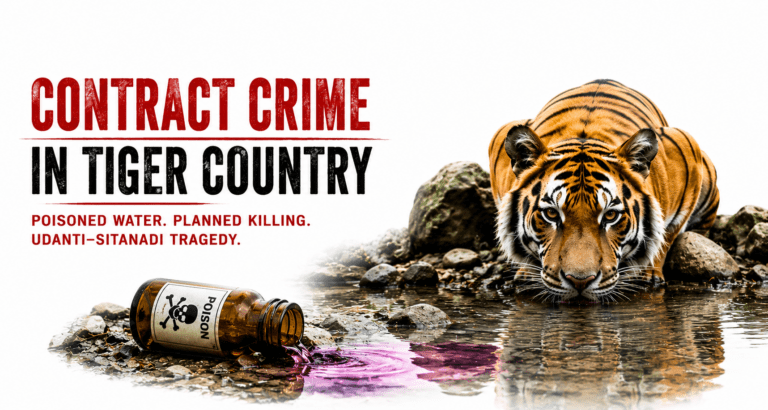
Gothangaon is not an ordinary forest edge where tiger risk can be treated as a distant rumour, and the death of 65-year-old Shobha Haridas Rahate shows the cost of entering known tiger country, as reported by NDTV. She was killed in compartment number 775 of the forest range in Gondia district after going to collect tendu leaves on Sunday morning. Her death deserves empathy. But empathy cannot erase the obvious question. Why enter such terrain when dominant tigers and resident tigresses with cubs are known to move through it? Poverty explains pressure. It does not make danger disappear. That is the basic warning in Gothangaon.
This range has a reputation among tiger watchers for roaming dominant males such as the Surya Tiger and for tigresses raising cubs in the wider landscape. That matters because a tiger with territory, prey, cubs or cover is not waiting for human permission to behave like a tiger. Shobha Rahate’s daughter-in-law and others reportedly raised an alarm after the attack, and the tiger fled into the thicket. The range then became the site of the usual response: a Rapid Response Team from Navegaonbandh, camera traps, and a cage installed to capture the animal. Humans enter tiger space, tragedy follows, then the tiger becomes the target.
Gothangaon Is Not A Casual Workplace
Officials said people across parts of Gondia district are collecting mahua flowers and tendu leaves because these forest products form a large part of their income cycle. That economic reality must be taken seriously. Forest-dependent families should not be mocked for needing income, and Shobha Rahate should not be reduced to a careless statistic. Yet the article also states that venturing into dense forests triggers such attacks. This is where governance matters. If seasonal livelihood pushes people into high-risk tiger areas, authorities cannot simply issue compensation after death and cages after panic. Prevention must come before the thicket closes.
Gothangaon also saw this incident just one day after 47-year-old Sunita Chandrakumar Hatwar from Bondgaon Surban was injured in a tiger attack. Two attacks in two days should force immediate scrutiny of collection routes, warnings, group movement, patrol intelligence and temporary closures. A tiger landscape with known resident animals is not a casual open-access workplace. Anyone entering alone, ahead of others, or without strict coordination steps into a biological reality that will not bend for human income cycles. This is not blaming the dead. It is refusing to pretend that danger was invisible before it became fatal.
Human Need Cannot Override Tiger Reality
Gothangaon will not become safer because paperwork arrives after a funeral. Immediate compensation of Rs 50,000 was given to Shobha Rahate’s family, with the remaining amount to follow after formalities. Compensation is necessary, but it is not coexistence. Compensation arrives after a life is gone and after the tiger is at risk of being trapped, relocated or labelled dangerous. Once a tiger is branded a “maneater,” there is rarely a clean way back. Fear hardens quickly, political pressure rises, and the animal’s behaviour is judged through human grief rather than ecological context. Tigers pay for the absence of prevention with freedom, and sometimes with life.
Sharper rules are needed during tendu and mahua collection seasons. In Gothangaon, entry into dense tiger-use zones should be restricted when movement is known, and forest staff must communicate risk clearly, repeatedly and locally. Groups need route discipline, timing controls, escort systems, emergency response and honest enforcement. If people resist every warning and enter the most dangerous pockets anyway, they risk themselves and the tiger. The forest department cannot manage coexistence by waiting for screams, calling response teams and placing cages after the attack. That is not planning. That is aftermath management dressed as control.
The lesson is harsh because the loss is real. Shobha Rahate should be mourned, but the tiger should not be prosecuted for existing in tiger territory. For Gothangaon, strong community engagement means protecting livelihoods without pretending every forest compartment is safe for collection. This is tiger ground. Entering it without strict respect for that fact is not bravery. It is a gamble that can kill a person and condemn a tiger.
Source: NDTV, India
Photo: NDTV, India