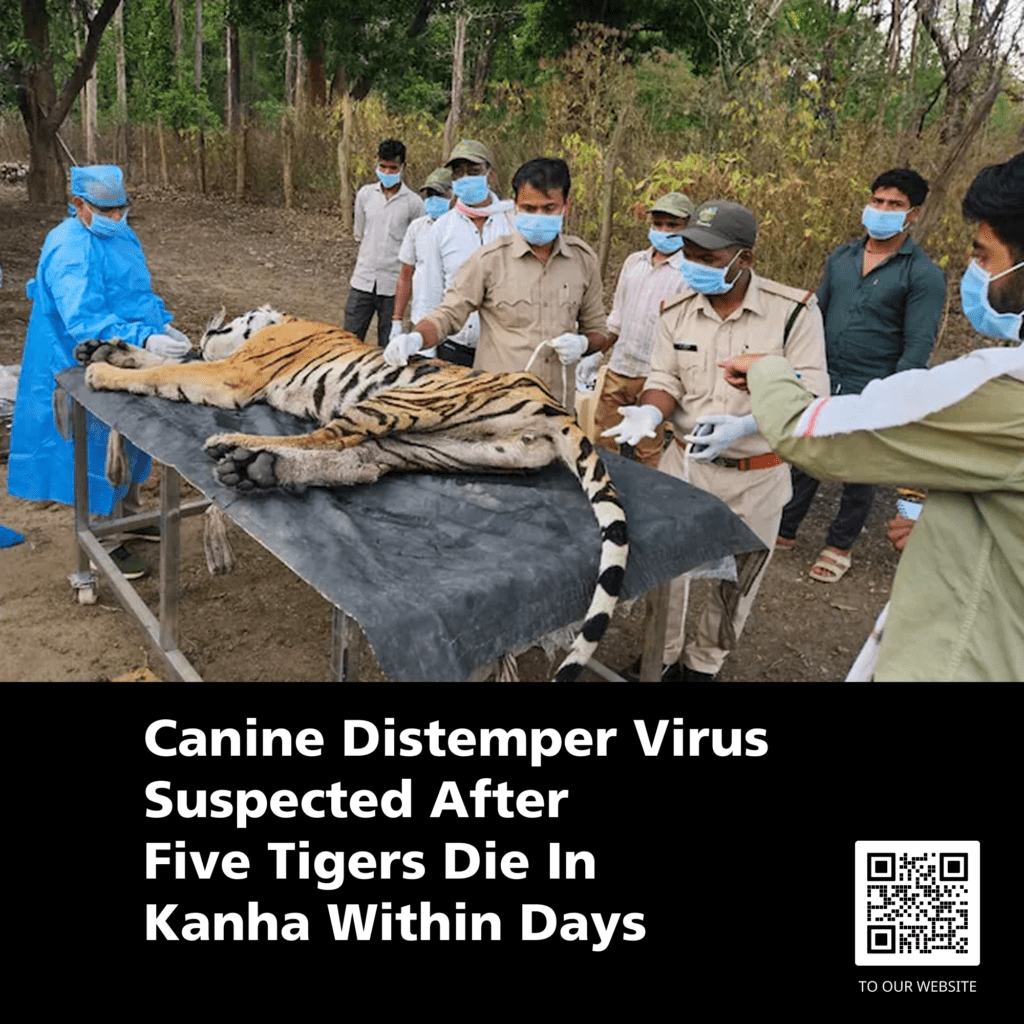
Do you know about the Canine Distemper Virus? Well, now you do. 5 tigers are dead in 9 days in Kanha. A tigress and her four cubs gone, one after another, as reported by NDTV. The sequence is clear. One cub found on April 21. Another on April 24. A third on April 26. By April 27, the tigress and her last cub were weak enough to be captured and moved into quarantine. Both showed signs of recovery. Within a day, both were dead.
This kind of pattern doesn’t leave much room for coincidence. It never does.
The suspicion now points to Canine Distemper Virus. But we already know it’s not a suspicion.
Canine Distemper Virus Moves Quietly
Initial findings indicate severe respiratory damage across all five animals. That fits the profile. Canine Distemper Virus is known to attack the lungs, then move into the nervous system. It doesn’t always show itself immediately. Animals weaken, stop feeding, lose coordination. By the time symptoms are obvious, the infection is already deep.
The Canine Distemper Virus spreads through contact. Often through domestic or feral dogs.
That part is not new. It has been known for years. The virus has already caused large-scale mortality in wild carnivores elsewhere, including lions in Africa and Amur tigers in Russia. It does not stay contained once it enters a system with enough hosts.
In Kanha, there are more than 120 adult tigers and over 40 cubs. That density is usually seen as a success. In a disease situation, it becomes a vulnerability.
This Did Not Start Inside The Forest
The virus may show up inside the reserve, but it doesn’t originate there.
Canine Distemper Virus moves in from the edges. From villages where dog populations are high and vaccination is inconsistent. From areas where feral dogs move freely between human settlements and forest edges. From spaces where wildlife and domestic animals overlap more than they should.
These conditions are not hidden. They are part of how most reserves function on the ground.
Buffer zones exist, but they are not sealed. There is movement, daily. Livestock, dogs, people, all crossing the same boundaries that tigers use.
That overlap is where disease crosses over.
Known Risk, Weak Response
Canine Distemper Virus is not an unknown threat. The pathway is well understood. So are the basic control measures: vaccination of domestic dogs, monitoring of carnivore health, reducing feral dog populations near core areas.
The problem is not knowledge. It is consistency.
Vaccination drives happen, but not everywhere and not continuously. Dog populations are counted in some areas and ignored in most others. Monitoring depends on available staff, terrain, and timing. And yes, it is uneven.
That unevenness is enough. A virus does not need full access. It needs one opening.
The Warning Was There
There was an early signal. Around April 17, footage reportedly showed one cub in weak condition. A search was initiated. The cub was not located.
A few days later, the first carcass was found.
That gap matters. It shows how quickly situations can move beyond reach. Even in a reserve like Kanha, early detection is not always enough. Terrain, timing, and limited real-time tracking all play a role.
Once deaths begin, response becomes reactive.
What Happens Next
Samples have been sent for detailed analysis. Officials have ruled out starvation. The prey base remains stable, and other tigers in the reserve are actively hunting. That narrows the field.
If Canine Distemper Virus is confirmed, the focus shifts immediately to containment. Increased monitoring, possible testing of other carnivores, and renewed attention to dog populations around the reserve.
But containment is not the same as prevention.
The conditions that allow the virus to enter do not disappear with one response cycle. They require long-term control, coordination beyond forest departments, and consistent follow-through.
More Than One Family
The loss of one tigress and four cubs is not just a number. It is a complete line removed in less than ten days. In a high-density reserve, that may not shift total numbers immediately, but it affects structure, territory, and future breeding.
What matters more is what it signals.
Disease does not make noise the way poaching does. It does not leave behind traps or weapons. It moves through gaps in systems that are already known to exist.
The Kanha case is one of those moments where those gaps become visible.
It adds to the ongoing reality of tiger deaths that are rarely sudden, and almost never without context.
Source: NDTV, India
Photo: NDTV, India