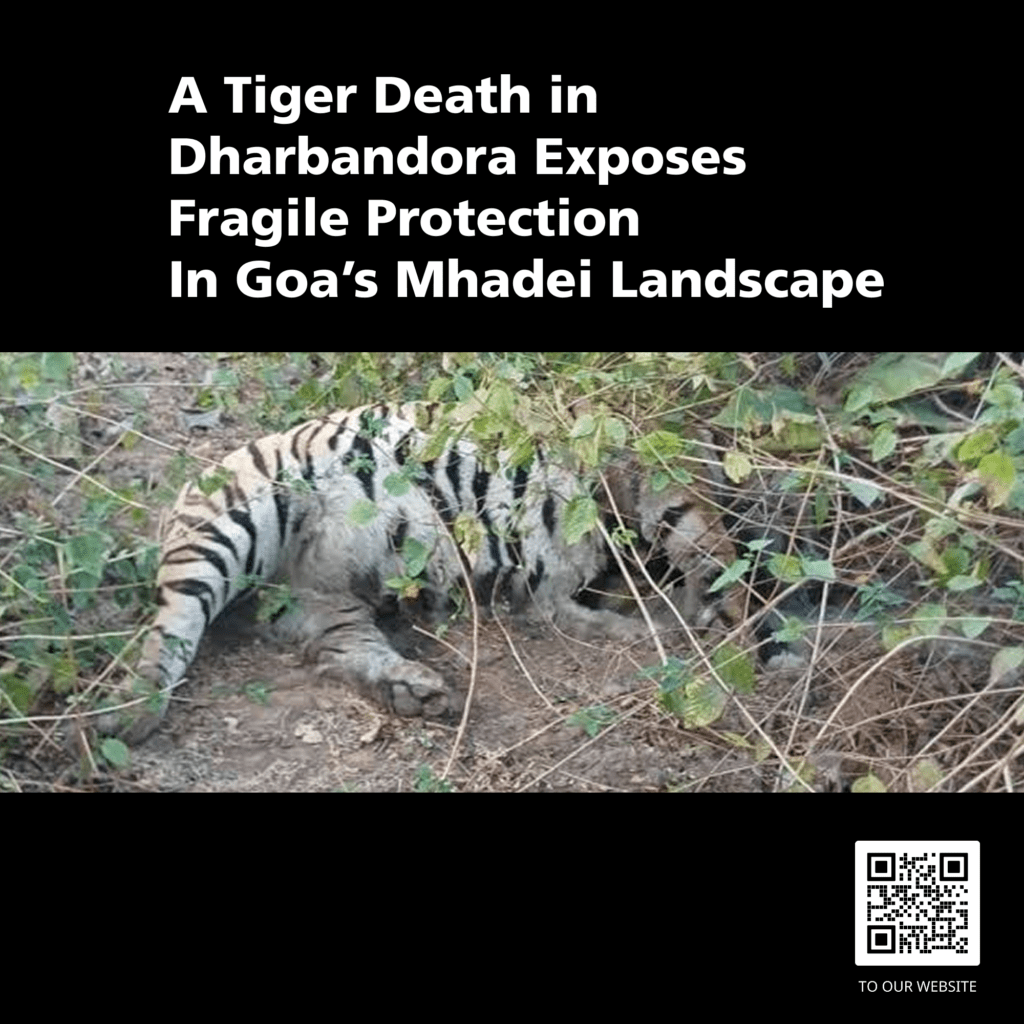
A Dharbandora tiger was found dead in Sakorda, Goa, raising immediate concern and deeper questions about protection in one of India’s most contested tiger landscapes, as reported by Goemkarponn. Forest officials have begun standard procedures, including site inspection and post-mortem, but key details remain unknown. No confirmed age, no sex, no cause. Just another tiger lost before the system could act.
Sakorda does not lie inside Mhadei Wildlife Sanctuary. That distinction matters. But it sits within the broader forested belt that connects Mhadei to neighbouring tiger habitats in Karnataka. This is not random terrain. It is functional tiger movement space, whether officially recognised or not.
Dharbandora Tiger And The Cost Of Delay
When a tiger dies in a landscape that is ecologically active but politically under-recognised, prevention is already weakened. The forests of Dharbandora form part of a wider corridor system linking Mhadei with Kali Tiger Reserve and other Western Ghats habitats. Tigers moving through this belt depend on continuity, not boundaries drawn on paper.
Goa has long resisted formally declaring Mhadei as a tiger reserve. Concerns around mining, infrastructure, and local resistance have slowed that decision. The result is a fragmented approach: tigers are acknowledged, but the level of protection does not match their presence.
The Dharbandora tiger moved through that gap.
A Corridor Without Status
Without formal recognition, corridors remain exposed. Monitoring is limited, enforcement is inconsistent, and threats such as electrocution, poisoning, or accidental encounters are harder to prevent. Tigers using these areas are effectively unprotected compared to those inside designated reserves.
The lack of confirmed cause in this case keeps all possibilities open. That uncertainty is not reassuring. It reflects how little visibility exists in landscapes that fall outside strict protection zones.
Corridors are often described as secondary to reserves. In reality, they are what keep populations alive. Without them, tigers become isolated, and isolated tigers do not last.
What This Death Signals
The post-mortem of this Dharbandora tiger will eventually provide a technical answer. It may identify disease, injury, or human-linked causes. But the larger issue will remain unchanged. A tiger has died in a landscape known to support movement, yet still waiting for full recognition and protection.
Goa’s forests are no longer in question. Tigers are already there. The only uncertainty is whether policy will catch up before more bodies are found.
This dead Dharbandora tiger is not just another case. It is a warning from a corridor that still exists in reality, but not yet in law.
Source: Goemkarponn, India
Photo: Goemkarponn, India