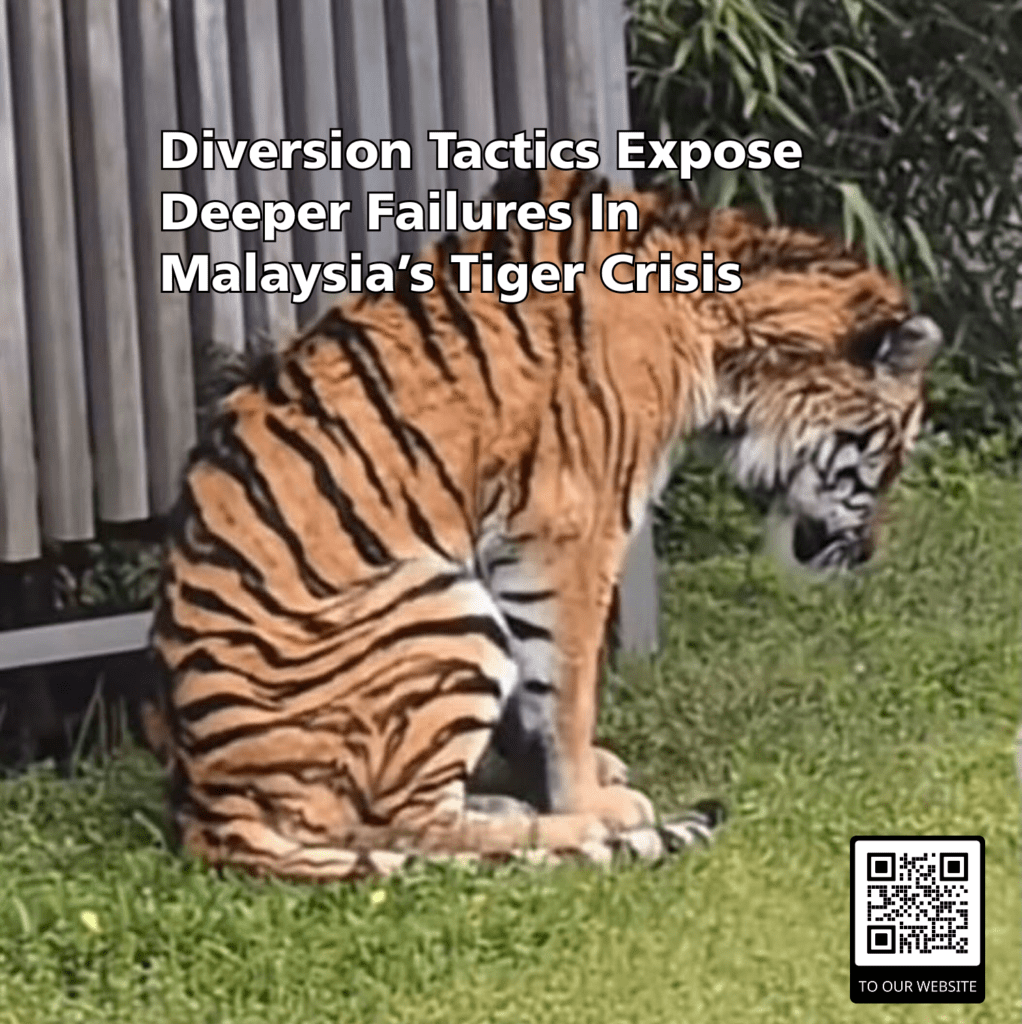
Diversion defines the response from the Department of Wildlife and National Parks (Perhilitan), Malaysia’s federal wildlife authority, as attention shifts to a tiger in Osaka in Japan instead of the collapsing reality at home, as reported by Bernama. A viral video showed a sick and emaciated tiger in Tennoji zoo, wrongly identified online as a Malayan tiger. Perhilitan quickly clarified that the animal is an Amur tiger, not native to Malaysia. The correction is factually accurate. But the speed and emphasis of that response reveal something else. When institutions move faster to protect image than to confront decline, the issue is no longer misinformation. It is priorities.
A Convenient Narrative Shift
Diversion becomes visible when the focus turns outward instead of inward. Malaysia’s wild tiger population is in steep decline, with numbers reduced to a fraction of what they once were. Poaching networks continue to operate. Snares remain widespread. Habitat fragmentation accelerates across key landscapes. These are not hidden problems. They are documented and persistent. Yet the public narrative is redirected toward a misidentified tiger abroad.
Correcting misinformation matters. But the scale of response must match the scale of the problem. A single mislabelled tiger in Japan does not threaten Malaysia’s conservation credibility. The disappearance of its wild tigers does. The imbalance in attention and this diversion raises questions about what is being avoided.
Perhilitan And The Control Of Perception
Diversion is not only about facts but about framing. Perhilitan’s statement emphasised the risk of negative perceptions caused by misinformation. That concern is valid. Public trust is fragile. But perception cannot be protected while reality deteriorates. When messaging focuses on external narratives while internal failures persist, credibility erodes further.
The department stressed that no Malayan tigers are held at the Osaka facility and that the animal shown does not belong to Malaysia. These clarifications are necessary. Yet they do not address the core issue: the rapid decline of Malayan tigers within Malaysia’s own borders. Conservation is not measured by correcting labels abroad. It is measured by survival in the wild.
The Reality Behind The Numbers
Diversion cannot mask the biological reality. Malayan tigers are critically endangered, with estimates suggesting fewer than 150 individuals remain in the wild. This is not a marginal decline. It is a collapse. Poaching remains the primary driver, fueled by illegal wildlife trade networks that continue to exploit weak enforcement.
At the same time, habitat loss and fragmentation reduce the ability of remaining tigers to disperse, hunt, and reproduce. Infrastructure projects and land conversion isolate populations into smaller pockets. In such conditions, recovery becomes increasingly difficult. These pressures are structural, not incidental. They require sustained, visible intervention, not reactive communication.
Messaging Versus Accountability
Diversion becomes most problematic when it replaces accountability. Addressing a viral video may help manage public perception in the short term. It does not address why tigers are disappearing. It does not dismantle poaching networks. It does not restore habitat connectivity. Without these actions, messaging risks becoming a substitute for progress.
Perhilitan’s reminder to verify information before sharing is reasonable. Misinformation can distort understanding. But the greater distortion comes from allowing narrative management to overshadow measurable outcomes. Conservation credibility depends on results, not statements.
A Pattern That Extends Beyond Malaysia
This diversion reflects a broader pattern in conservation communication, where institutions respond quickly to reputational threats while slower, systemic issues remain unresolved, like the destruction of the palm oil industry in Malaysia. This approach may reduce immediate criticism, but it deepens long-term mistrust. When the public sees energy directed toward image control rather than field action, confidence declines.
This dynamic is not unique to Malaysia. It appears across regions where conservation agencies face pressure to demonstrate success while managing limited resources and complex challenges. Yet the outcome remains the same. Without transparent acknowledgment of failure, meaningful correction becomes unlikely.
Refocusing On What Matters
Diversion must end where responsibility begins. The focus must return to protecting the remaining Malayan tigers in their natural habitat. This requires stronger enforcement against poaching, removal of snares, restoration of corridors, and investment in long-term monitoring. It also requires clear communication that reflects reality, not selective narratives.
The episode in Osaka does not define Malaysia’s conservation record. The state of its wild tiger population does. Redirecting attention outward may offer temporary relief, but it does not change outcomes on the ground.
Source: Bernama, Malaysia
Photo: Bernama, Malaysia