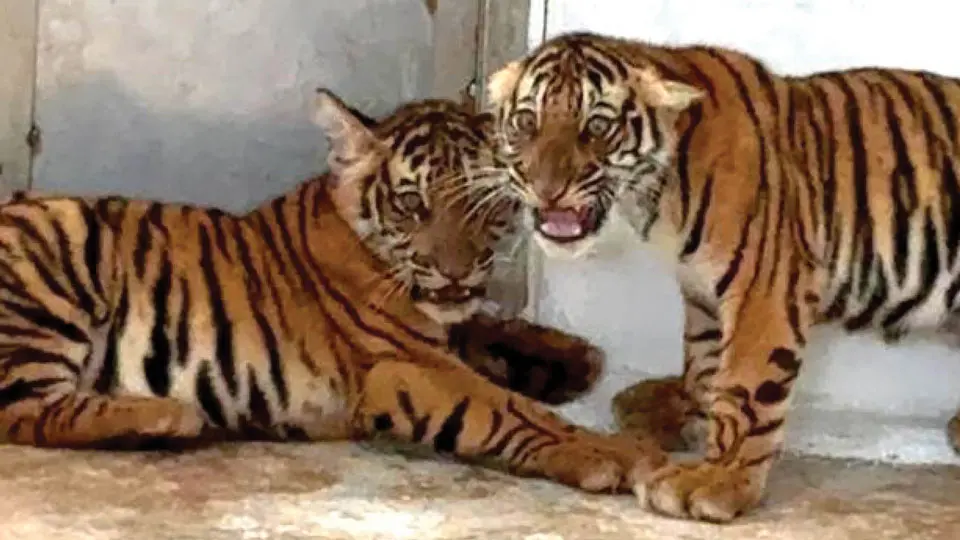
A tiger family has been reunited after a tense rescue operation near Hunsur, but reunited does not automatically mean saved, as reported by Star of Mysore. Four cubs are now back with their mother inside a rehabilitation enclosure, and the Forest Department has celebrated the outcome. Yet the fundamental question remains unanswered: will this family return to the wild that shaped them, or has the reunion simply placed them on a soft path toward captivity disguised as care? Tigers deserve clarity, not a holding pattern shaped by human fear.
A Family Reunited Built On Human Panic, Not Ecological Necessity
The tigress was captured after she approached maize fields in Gowdanakatte, triggering the usual wave of alarm that turns any tiger sighting near farmland into a perceived crisis. Her four cubs, missing at the time, were located only after the mother was already confined. For wildlife staff, the immediate priority was safety, but the deeper issue is why a healthy tigress and her cubs ended up separated in the first place. Forest edges around Hunsur have thinned for years, and when habitat is carved into fragments, tigers inevitably enter human-dominated spaces.
Once confined at the Mysuru Zoo’s rehabilitation centre, the tigress reacted sharply to human presence. Staff placed the cubs in an adjoining enclosure, fearing that scent contamination from handling could cause rejection. The process was slow, because any misstep could have turned reunited into tragedy. Through scent cues and gradual exposure, maternal behaviour eventually returned. On camera, the tigress sniffed, accepted, and nursed her cubs, offering a moment of relief. But that relief is temporary unless the end goal is freedom.
Reunited, But Still Behind The Bars Of Human Fear
The emotional power of the reunion hides a harsher truth: every hour spent in captivity makes it harder for this family to return to the wild. Tigers do not adapt to confinement; they endure it. And endurance always leaves scars. The mother had lived free for eleven years. Now she and her cubs move inside an enclosure that cannot replicate the complexity, danger, and learning that define a tiger’s survival. Cubs raised under human scent, even indirectly, face challenges when reintroduced. Their hunting instincts, spatial awareness, and independence depend on exposure that captivity cannot provide.
Forest officials have not announced whether the family will be released. Without a clear plan, reunited becomes the first step toward a lifetime of containment. India’s conflict protocols often lead to permanent captivity for tigers that come too close to farmland, even when the animal’s behaviour is normal. The line between rehabilitation and quiet removal is thin, and the public rarely learns which side of that line a tiger family falls on.
Hell Or The Wild: The Decision That Defines Their Fate
The next days will determine whether being reunited reunion becomes a success story or a tragedy disguised as one. Release requires more than opening a gate. It requires assessing whether the tigress retains her hunting strength, whether the cubs can learn rapidly enough, and whether corridor connectivity can support their movement without pushing them back toward conflict zones. These conditions are rarely met when landscapes are shrinking and political urgency favours human convenience over ecological reality.
If the family remains confined, their future becomes a slow unravelling — the psychological and physical erosion that captivity inflicts on large carnivores meant for vast, unpredictable territory. That would be hell for a species built for freedom. If they return to the wild, they must enter a landscape increasingly fractured by farms, roads, and settlements, yet still the only place where their instincts make sense. To release them is to honour their nature; to keep them is to erase it.
The Forest Department must now decide whether these family being reunited to the landscape that shaped them or remains confined in a space that cannot meet their instincts. Release demands monitoring, corridor security and the freedom for the tigress to resume hunting naturally, while captivity would confine her to a life far removed from the world she understands.
Such outcomes hinge entirely on whether their habitat remains strong enough to support them, and whether Karnataka is willing to prioritise the broader conservation practices that give tigers a chance to survive in the long term. For this mother and her cubs, the true measure of success will be whether their future leads them back into the wild rather than into a life defined by fences and permanence.
Source: Star of Mysore, India.
Photo: Star of Mysore, India.