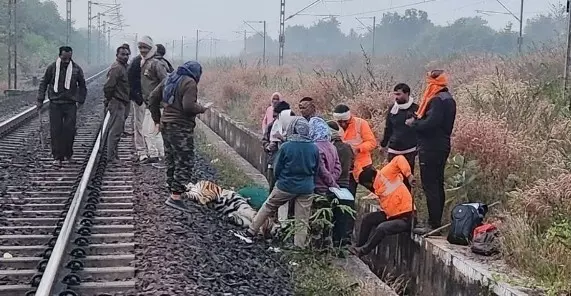
The railway line between Balharsha and Gondia has now become a killer track, a place where tigers die with horrifying predictability, as reported by The Federal. Nineteen (!) tigers have been killed on these rails in just three (!) years, and the latest tragedy near Sirpur only adds another corpse to a system collapsing under institutional neglect. Indian Railways has become a state-run killing machine for tigers, not because tigers fail to adapt, but because the country refuses to redesign its infrastructure around the wildlife it claims to protect.
A Death Route Built By Negligence, Not Accident
The tiger killed near Sirpur belonged to the Tadoba landscape, moving naturally toward Kawal Reserve when it attempted to cross the tracks. It never reached the other side. High-speed trains continue to barrel through known tiger corridors even after court orders demanded explanation and reform. Instead of action, authorities offer silence. While some routes in Madhya Pradesh have implemented underpasses and overpasses, the Balharsha–Gondia line has received little more than paperwork, excuses and stalled files.
The result is a predictable slaughter. On this same line, another tiger died between Sindewahi and Alewahi, and yet another near Wihirgaon. The pattern is not occasional misfortune but structural violence against wildlife. Tigers are territorial animals forced to disperse as populations rise in Maharashtra’s reserves. Every dispersing tiger must navigate a landscape where human infrastructure blocks the way and trains kill anything that hesitates. The killer track does not simply cut across the forest; it cuts into the future of India’s tiger population.
A Landscape Where Movement Means Death
Including the latest collision, 19 tigers have died on this killer track. Twelve other animals have also been killed this year in Chandrapur alone: sloth bears, leopards, sambars and even a wild boar. This is not a forest edge issue; it is a transportation corridor slicing directly through a region known for wildlife movement. The negligence is staggering. Underpasses exist along the Balharsha-Chanda Fort-Gondia section, but many are blocked by vegetation, debris or neglect. Wildlife cannot use paths that humans refuse to maintain.
The Wildlife Institute of India recommended specific mitigation structures across critical points, from Gondia-Wadsa to Chandrapur-Rajura. Not one has been implemented on the killer track. Engineers know what works. Examples exist. Funding exists. What does not exist is urgency, accountability or political will. Indian Railways chooses speed over survival, convenience over coexistence. Tigers die because the nation allows the tracks to remain unmodified.
Tiger Conservation Cannot Survive Infrastructure Designed To Kill
The Tiger Task Force, expert committees and regional conservationists have warned for years that railway and road systems will become the next major drivers of tiger mortality. That future is already here. The dispersing tiger killed on this killer track near Sirpur was performing the most natural behaviour possible: movement across territory. Movement is how genetic diversity is protected. Movement is how tiger landscapes remain connected. When movement equals death, conservation collapses.
Every tiger killed on this killer track represents more than a life lost; it represents the removal of genetic potential, the weakening of future breeding, the destabilisation of territories and the permanent erasure of an apex predator from a landscape that needs it. Yet the systems responsible refuse to act. This is not a tragedy of nature but a failure engineered by humans.
How Many More Tigers Must Die Before India FINALLY Acts?
The Maharashtra High Court demanded a report. Nothing came. Forest officials have begged for underpasses to be cleared. Nothing changed. Conservationists filed a Public Interest Litigation. Still nothing. When the institutions charged with protecting wildlife refuse to respond, the death toll becomes a policy statement.
The killer track remains open, fast and lethal.
India celebrates its tiger numbers, but numbers mean nothing if tigers cannot move safely. A nation that claims pride in its wildlife must redesign infrastructure that kills wildlife. The railway line between Balharsha and Gondia is not just unsafe; it is incompatible with conservation. Protecting dispersal routes is not a favour to tigers; it is the foundation of their survival.
These deaths expose the deeper truth that tiger conservation in India will not be decided inside reserves but along the boundaries, corridors and crossings where infrastructure and ecology collide. Ensuring safety here demands political courage and long-term planning consistent with the principles of effective conservation. If India refuses to redesign this corridor, the killer track will continue to write the obituary of every tiger that attempts to cross it.
Source: The Federal, India.
Photo: The Federal, India.