Illegal hotels inside or around tiger landscapes are not a tourism problem; they are a direct attack on protected habitat, as reported by OMMCOM News. The National Green Tribunal has issued notices after a petition alleged large-scale hotel and resort construction inside Jharkhand’s Netarhat eco-sensitive zone and around Palamu Tiger Reserve. The case concerns construction in and around Palamu, Betla National Park, Netarhat and the Mahuadanr Wolf Sanctuary.
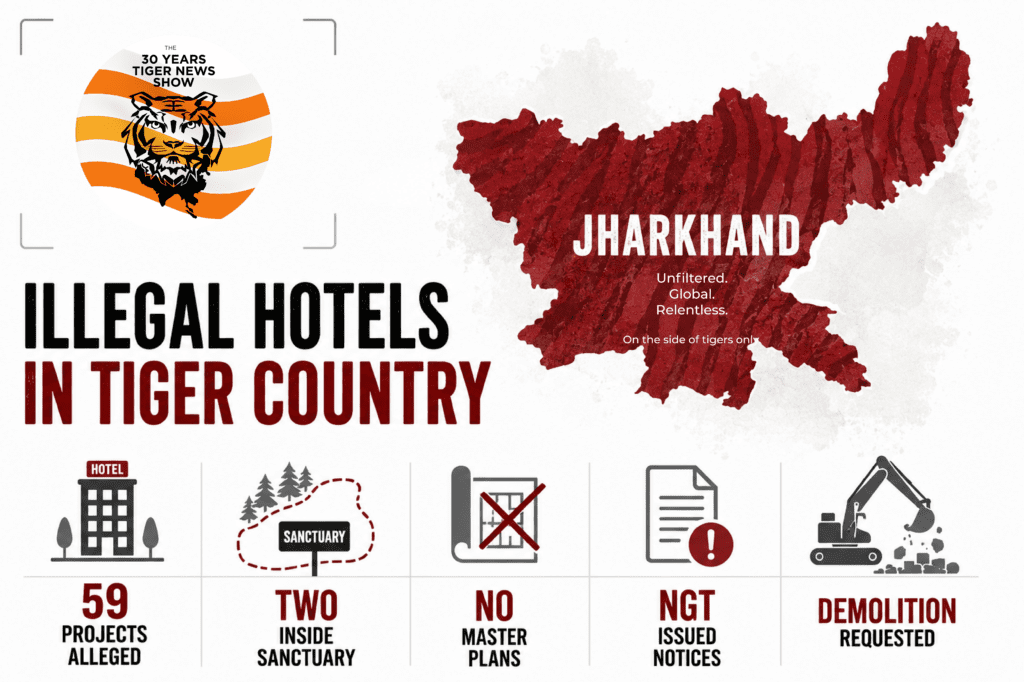
Around 59 hotels and resorts are reportedly under construction within the eco-sensitive zone, with two allegedly inside Palamu Wildlife Sanctuary. If those claims are confirmed, demolition should not be controversial. It should be the starting point.
Illegal Hotels Are Not Soft Violations
These structures do not arrive quietly. They bring access roads, lights, sewage, water extraction, noise, waste, traffic, staff movement, visitor pressure and permanent human presence into landscapes meant to give wildlife breathing room. Calling this “construction activity” is too gentle. A hotel inside an eco-sensitive zone is a commercial claim over land that should be governed by ecological limits, not a private shortcut for investors who discovered forest edges. If owners built without obeying mandatory environmental rules, they should face demolition, fines and wildlife-crime penalties strong enough to make the next developer hesitate. Therefore, illegal hotels are never harmless when they turn tiger country into real estate.
The petition says no zonal master plan, tourism master plan or monitoring committee has been put in place, even as construction continues. That is the governance vacuum businesses exploit.
Palamu Needs Law, Not Permission After Damage
The NGT’s eastern bench found the petition fit for hearing and issued notices to the National Tiger Conservation Authority, the Chief Secretary of Jharkhand, concerned officials and the Field Director of Palamu Tiger Reserve. Responses are due within a month, with the next hearing scheduled for July 8. That process matters, but process must not become shelter. If the sites are illegal, they should not be regularised later with paperwork. Illegal hotels should be removed, not rescued by delay.
Palamu is not empty scenery waiting for resort branding. It is one of India’s tiger landscapes, already carrying pressure from fragmented habitats, human activity and weak political attention. They turn protected land into a business opportunity and then ask the forest to absorb the cost. Tigers, prey animals, wolves and other wildlife do not need boutique rooms, weekend traffic or resort lighting at their boundaries. Protected areas cannot keep absorbing commercial appetite.
Owners And Officials Need Consequences
The petitioner has asked for an immediate ban on illegal constructions, demolition of structures (illegal hotels) built in violation of rules, accountability for officials and appropriate action. That is the correct direction. Illegal hotels should not be treated as investments that accidentally crossed a line. If a person knowingly builds in a restricted ecological zone, that person is choosing profit over wildlife protection. The law should reflect that choice, and punishment should reach beyond cosmetic notices.
Fines should not be symbolic. They should recover ecological damage and illegal commercial gain. Owners should be penalized. Repeat offenders should be prosecuted. Officials who allowed construction to continue without required plans, monitoring or enforcement should also be questioned. They make a tiger reserve look protected on paper while concrete rises in the forest’s face.
Demolition Is The Real Test
India often waits too long before calling environmental damage what it is. By the time tribunals intervene, delayed scrutiny often means illegal hotels may already be visible, advertised or politically connected. That is why demolition matters. If they remain standing, the message to developers is simple: build first, fight later, profit if the system tires. If they are removed and penalties are serious, the message changes.
Palamu needs political will that does not blink when tourism money appears. It needs mapped limits, active monitoring, public disclosure and immediate enforcement against violations. Real political will means protecting tiger landscapes before court notices become necessary. These structures in eco-sensitive zones are not development. They are habitat theft with reception desks.
Tear them down, restore the land, and make owners pay enough to warn every predator of profit circling India’s forests. And don’t forget to jail all those politician and government employees that have contributed by this corruptiveness.
Source: OMMCOM News, India
Photo: 30 Years Tiger News Show