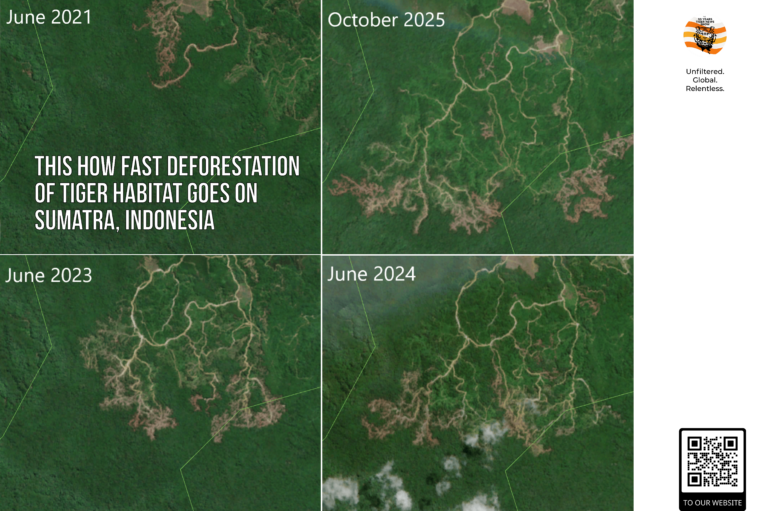
Apple has moved into one of Indonesia’s most contested forest landscapes, and the choice is not accidental. Apple has partnered on conservation efforts in the Bukit Tigapuluh landscape in Sumatra, an area that remains one of the last functional corridors for the Sumatran tiger, as reported by Tempo. In Bukit Tigapuluh, forest loss follows a single, well-documented pattern: logging opens access, palm oil plantations follow, and tiger habitat disappears.
The partnership focuses on the deployment of technology. Apple is providing monitoring tools, digital infrastructure, and server support designed to strengthen patrol capacity, improve wildlife monitoring, and detect illegal activity inside the forest. In Indonesia, illegal logging is rarely an end in itself. It is the enabling step that clears land for plantation expansion and permanently fragments wildlife corridors.
Bukit Tigapuluh Is Not A Symbolic Forest
Bukit Tigapuluh is not a distant conservation abstraction. It is a working landscape where tigers still move between forest blocks, where indigenous communities rely on intact ecosystems, and where industrial pressure has steadily advanced for years. The remaining forest exists not because it is safe, but because resistance has not fully collapsed.
Any intervention in Bukit Tigapuluh operates within that reality. There is no competing deforestation driver here. The clearing of this landscape is tied directly to palm oil expansion, supported by permissive land-use decisions and weak enforcement. Preventing deforestation in Bukit Tigapuluh therefore means obstructing the plantation model that has reshaped much of Sumatra.
Apple’s role is framed as technical support, but technology in this context is not neutral. Monitoring tools expose where forests are being cut, when access roads appear, and how habitat connectivity is being severed. In landscapes like Bukit Tigapuluh, visibility threatens the systems that rely on quiet conversion.
What Apple Is Saying, And What It Means
Apple’s position was articulated by Lisa Jackson, the company’s Vice President of Environment, Policy, and Social Initiatives. Her statement emphasized ecosystem restoration and protection of communities and wildlife. The language is measured, corporate, and careful. Palm oil is not mentioned. Deforestation is not named directly.
Yet in Bukit Tigapuluh, those omissions do not soften the implication. Supporting conservation in this landscape means confronting the only force actively dismantling it. There is no version of forest protection here that does not interfere with plantation expansion. Apple may avoid naming the industry, but the geography does not.
By choosing Bukit Tigapuluh, Apple steps into a space where environmental damage is not theoretical or historical. It is ongoing. Every hectare lost reduces corridor functionality and increases the likelihood of conflict, isolation, and eventual local extinction.
Climate Commitments Meet Ground Reality
Apple positions the partnership within its broader climate commitments, including its net-zero carbon goals. Such pledges are now standard among multinational corporations. Their credibility depends on where they are applied. Carbon accounting disconnected from active deforestation zones offers reassurance without consequence.
Bukit Tigapuluh is a test case. If Apple’s involvement strengthens monitoring while remaining silent when violations are exposed, the effort risks becoming documentation rather than deterrence. Technology can reveal patterns, but only political and economic pressure disrupts them.
The imbalance remains stark. Plantation interests operate with scale, capital, and political cover. Conservation teams operate with limited resources and constant pressure. Apple’s contribution does not rebalance that equation on its own, but it shifts the information landscape in a way that extractive industries historically resist.
Technology Is Not A Shield, But Silence Is A Choice
Apple is not claiming to save tigers. It is not presenting technology as a solution to deforestation. Those distinctions matter. Servers do not stop permits. Monitoring does not cancel concessions. But refusing to act in known deforestation zones is also a decision.
In Indonesia, forest destruction persists through normalization and delay. The absence of scrutiny is its most reliable ally. By supporting conservation operations in Bukit Tigapuluh, Apple reduces the space for plausible deniability, even if it avoids public confrontation.
This engagement does not resolve the structural forces threatening tiger habitat. It does not reverse decades of policy failure. But it places Apple on one side of an existing conflict, whether the company names it or not.
Bukit Tigapuluh’s future will be determined by whether forest protection is enforced or surrendered. Any attempt to halt deforestation here inevitably intersects with the dynamics long documented in how timber greed destroys tiger corridors.
Source: Tempo, Indonesia
Photo: Apple, USA