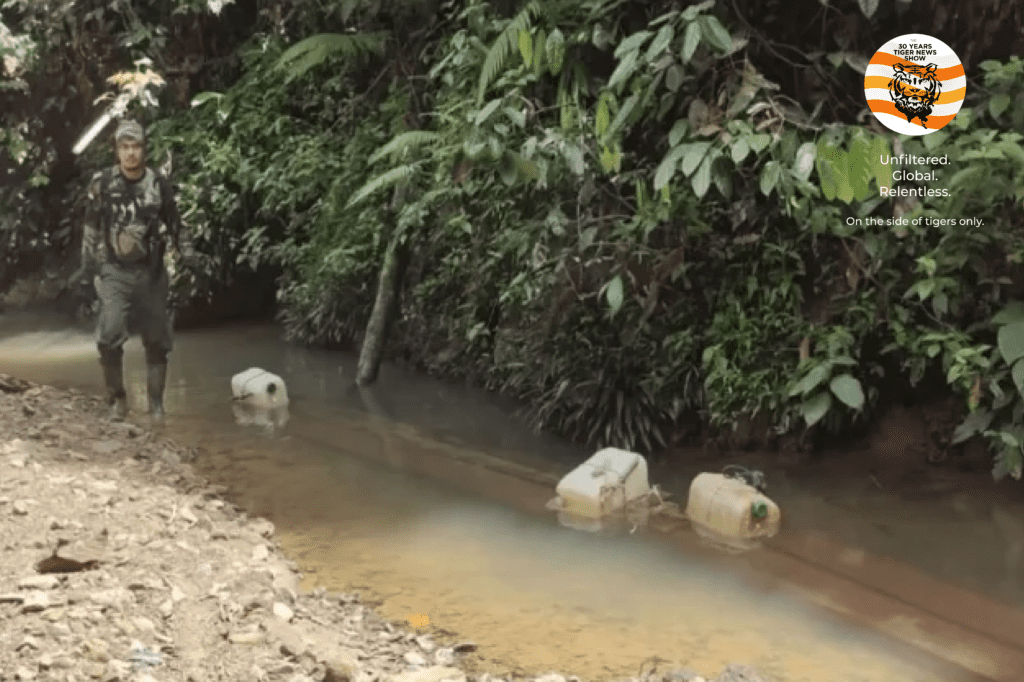
TNBT (Bukit Tiga Puluh National Park) is again being described as a vital Sumatran tiger habitat after Indonesian forestry officers caught a suspect moving processed timber rafts out of Bukit Tiga Puluh National Park in Riau, as reported by RRI. Authorities say the May 12 operation found milled timber, a motorcycle, a mobile phone and a handheld transceiver, now being analysed to trace routes, receivers and possible financiers. Good. Follow the network. But Indonesia should not pretend this is a clean enforcement story. The same state that now condemns illegal logging allowed Riau to become an industrial palm oil landscape wrapped around shrinking forest remnants.
Illegal logging inside TNBT is a crime, but it is also a symptom of a province already surrendered to extraction. Riau has become shorthand for the Indonesian government’s failure to defend tiger country from plantations, timber pressure and commercial land hunger. Officials can arrest one field suspect and speak about syndicates, but the larger habitat crime is visible from the air: forest broken into fragments, plantations pushing against protected areas, wildlife forced into shrinking edges. That is where the hypocrisy begins. Indonesia points at illegal timber rafts while the legal economy around them has spent decades making the forest easier to cut.
TNBT Cannot Survive As An Island
The Forestry Ministry says investigators are looking beyond the field operator to the source of the wood, transport routes, buyers and beneficiaries. That shift is necessary because timber crime is rarely one man with a raft. It needs orders, transport, communication, storage, money and protection. The seized transceiver and mobile phone may matter more than the planks themselves if they expose the chain behind the cutting. But the park will not be saved by criminal cases alone if the surrounding land remains dominated by palm oil and weakened forest connectivity.
The park is described as a vital sanctuary for the critically endangered Sumatran tiger. That is true, but sanctuaries do not exist in isolation. Tigers need prey, cover, water, dispersal routes and undisturbed forest edges. In Riau, those conditions have been degraded by the same development model Indonesia continues to tolerate and profit from. Palm oil did not merely appear beside tiger habitat. It expanded through political permission, weak enforcement and a national willingness to trade forests for export growth. Now officials speak of protecting biodiversity while the landscape around this park tells the opposite story. TNBT is being praised as habitat while Riau’s political economy keeps treating habitat as something to be trimmed, entered and monetised.
Palm Oil Made This Crisis Predictable
Indonesia’s enforcement language is sharp when the suspect is poor, local and visible. It becomes softer when the discussion turns to the industries that reshaped Riau. That double standard with TNBT is lethal for tigers. Illegal loggers should be prosecuted. Syndicates should be dismantled. Financiers should be exposed. But any government serious about Sumatran tigers must also confront palm oil as the root pressure that normalised forest loss, opened access, fractured corridors and pushed wildlife into conflict. Without that honesty, TNBT becomes a symbolic island surrounded by the machinery that keeps eating Sumatra.
Forestry officials said illegal timber harvesting disrupts the forest, habitat, ecological balance and public interest. They are right. But the same sentence applies to every plantation-driven cut, drainage, road and encroachment that made tiger habitat smaller long before this raid. Indonesia cannot separate illegal timber crime from the legalised destruction around it. One is the knife. The other is the hand that weakened the body first.
Protecting TNBT requires more than analysing seized phones and timber routes. It requires naming the economy that made Riau hostile to tigers. It requires restoring buffers, defending corridors, prosecuting buyers, auditing timber flows and stopping plantation expansion from swallowing the last ecological space. This is where timber greed and palm oil hypocrisy meet. Indonesia cannot claim a renewed conservation commitment while Riau’s forests remain sacrificed to growth. The Sumatran tiger does not need speeches about public interest. It needs the government to stop protecting the industries that made the forest disappear.
Source: RRI, Indonesia
Photo: RRI, Indonesia