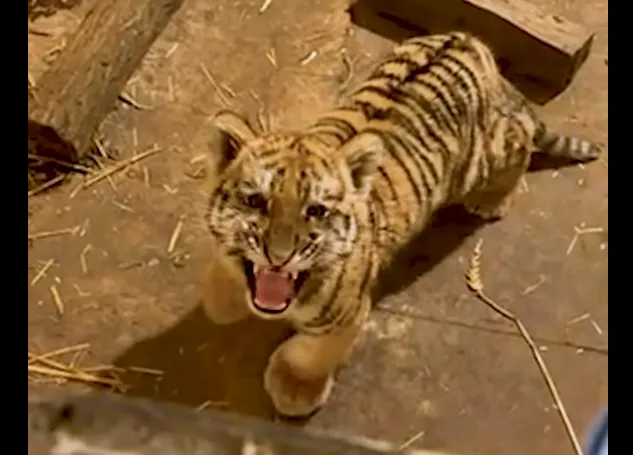
A routine drug raid in Hungary has exposed yet another disturbing pattern in the global misuse of tigers, as reported by Daily News Hungary. Officers did not expect to find a tiger cub tucked inside a property under investigation, yet this is exactly what they discovered: a nine kilogram male cub, alive, stressed and trapped within the fantasies of people who believe that owning a tiger is a symbol of prestige. The drug raid becomes more than a criminal investigation. It becomes a mirror exposing how tigers remain currency for individuals desperate to project power.
A Wildlife Crime Masked As Status After Drug Raid
The cub was quickly examined by Budapest zoo experts, who found him in good health. But health does not erase the conditions that brought him here. A tiger cub does not end up inside a criminal hideout by accident. This is not companionship. It is not affection. It is branding. Certain circles treat tigers as extensions of ego, props for lifestyle images and proof of influence, even in Europe, where strong laws should prevent these abuses. The line between organised crime and wildlife exploitation has long been blurred. Here, the drug raid simply pulled back the curtain.
Hungarian authorities arrested a forty-year-old man on-site and initiated criminal proceedings. The cub’s future will be determined after genetic analysis and formal evaluation. Yet the real question is how such an animal entered this space in the first place. Tigers are prohibited as private pets under Hungarian legislation. They belong only in accredited facilities. And still, enforcement encounters them in basements, garages and hideouts when criminal networks intersect with exotic animal trafficking.
A Global Pattern Of Power Games
This incident in Hungary is not isolated. Across continents, tiger cubs appear in drug dens, gang houses and private villas, reinforcing a troubling pattern where tigers function as symbols of dominance. They are used to signal money, danger, hierarchy and control. The presence of a tiger elevates the criminal’s self-image even when the animal itself is starving, stressed or injured. The Amur, Bengal, Sumatran and hybrid tigers that appear in these cases rarely survive beyond adolescence. Their lives are traded for reputation.
The drug raid simply reaffirmed a truth conservationists have warned for years: tigers are worshipped not because people care about them but because they amplify the owner’s perceived power. Even in countries with strict laws, loopholes and illegal networks allow cubs to be bought, moved and hidden. That a cub ended up in Tiszafüred should alarm anyone who believes Europe is immune to the wildlife trade. Tigers are not the pets of celebrities or traffickers. They are victims of a global system that treats wildlife as props.
A Species Reduced To An Accessory
What makes this case especially stark is the way officials described the cub as friendly and playful. These qualities often mislead the public into thinking the animal is manageable. Every tiger cub is playful until maturity transforms it into a powerful predator, one entirely unsuited for human environments. Criminals and wannabe influencers rarely consider this. They want the image, not the responsibility. They want the illusion of dominance, not the reality of an animal requiring space, safety and expertise.
Hungary’s laws are clear: no private citizen may keep a tiger. Yet clarity in legislation does not guarantee obedience. The criminal underworld thrives on symbols, and no symbol carries more weight than a tiger. The drug raid simply revealed what remains hidden behind closed doors elsewhere. The cub may be safe now after the drug raid, but countless others remain invisible within networks where status outweighs life.
The Responsibility To Confront The Myth
This tiger cub’s rescue demands more than prosecution. It demands dismantling the cultural myth that owning a tiger elevates an individual. Criminal networks and social media fantasies have shaped a dangerous perception that tigers represent power. But power comes from protecting them, not exploiting them. Tigers belong in forests, not in cages under the control of people seeking influence.
The Responsibility To Confront The Myth
This tiger cub’s rescue demands more than prosecution. It demands dismantling the cultural myth that owning a tiger elevates an individual. Criminal networks and social media fantasies have shaped a dangerous perception that tigers represent power. But power comes from protecting them, not exploiting them. Tigers belong in forests, not in cages under the control of people seeking influence.
The deeper threat is not a single drug raid but the narratives that celebrate the possession of wildlife. Until societies dismantle these narratives, tigers will continue to appear in criminal spaces far from their natural homes. The cub rescued after the drug raid in Hungary is fortunate. Many are not. Addressing this crisis requires challenging the public fascination with tiger ownership and exposing the reality that it is rooted in violence, fear and exploitation. These cultural perceptions shape how wildlife is treated, a pattern familiar. Tigers deserve more than to be props in someone else’s fantasy. They deserve a world where their worth is measured by survival, not by spectacle.
Source: Daily News Hungary, Hungary.
Photo: Daily News Hungary, Hungary.