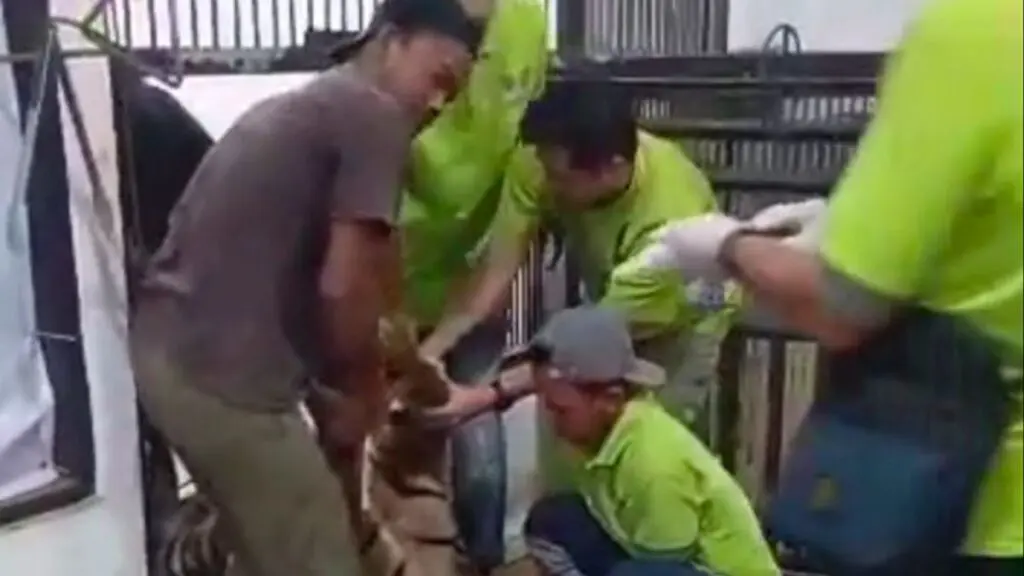
Report of a murder. On 9 November 2025, officials confirmed that a male Sumatran tiger coded 13 RL died inside the Lampung Green Valley Conservation Institute in Bandar Lampung. Necropsy results showed massive brain bleeding caused by blunt-force trauma after the tiger repeatedly struck the cage walls during transfer. The report described an incident during handling. That language is protective, not honest. When a critically endangered tiger dies inside a licensed conservation facility following approved protocols, this is not misfortune. It is Murder engineered by design—an outcome built into a system that confuses control with protection.
The tiger’s path to that cage began earlier in Talang Kali Pasir, West Lampung, a landscape stripped and fragmented by plantations and grazing. Instead of fixing coexistence, authorities removed the symptom. From that moment its survival depended on concrete, noise and lights. The decision was administrative, not ecological. As reported by VOI News, the official explanation cited “safety for the community.” Safety for whom?
Procedure as a weapon
BKSDA states that handling followed welfare standards. That is the indictment, not the defence. If a wild tiger can be captured, confined, shuttled between facilities and killed by impact without anyone breaking a rule, the rulebook itself is lethal. Steel walls, hard angles and echoing corridors convert stress into fatal impact. Calling the blows self-inflicted is theatre. Murder here is cumulative: policy, procurement, enclosure design and risk tolerance stacking until one animal pays in full.
Real conservation practices redesign weak systems; they do not hide behind them. Any enclosure for high-stress predators must remove lethal contact points and provide escape space. Those standards exist elsewhere. If Lampung Green Valley falls short, “according to procedure” becomes confession.
From conservation institute to quiet zoo
Lampung Green Valley presents itself as a conservation institute, not a zoo. The difference should be measurable: genetic planning, research output and pathways to the wild. Instead, conflict tigers vanish behind fences, rebranded as “rescued.” There is no forest here, only containment. A tiger pacing concrete no longer regulates prey or signals forest health—it is inventory.
Indonesia cannot keep laundering cages through conservation language. Real protection keeps tigers in forests with prey, cover and corridors, backed by patrols that remove snares and prosecute killers. Every rupiah spent on decorative enclosures while habitat erodes is an explicit choice against living landscapes. That choice, repeated, is Murder by omission.
Accountability without scapegoats
Blaming frontline vets or keepers for Lampung is a diversion. They work inside boxes others ordered. Responsibility sits higher: agencies that normalise captivity, companies that erase habitat, ministries that count confined tigers as success. When a stressed tiger can die legally inside “care,” authorship is bureaucratic Murder.
If this death closes as routine, nothing changes. There must be a full audit: design, materials, light, transfer systems, staffing, sedation protocols and independent review. Findings should be public. Facilities that fail to prevent predictable impact should not house tigers at all. Anything less is an official decision to accept more bodies.
What must change after Lampung
Alternatives exist. Corridor protection between forest blocks, early-warning systems near villages, livestock-guarding schemes, fair compensation and strong law enforcement all reduce the push to capture. Camera traps, satellite data and forensic work on snares already operate elsewhere; they need scale, not another branded cage.
Murder is the correct word because it rejects comfort. A critically endangered tiger died where the public is told it is safest. That is not a detail; it is a verdict on a model that still chooses concrete over canopy and containment over courage. Unless Lampung is treated as a turning point—with budgets, infrastructure and law shifted toward prevention, transparency and real habitat—another report will read the same.
Murder, in this context, does not mean a secret beating in the dark. It means designing, funding and defending a system where a Sumatran tiger’s final minutes unfold in a steel tunnel with no safe exit, then calling it procedure. Keeping that structure intact after 13 RL is a decision, not a mistake. A credible conservation state cannot accept that Murder and still claim to defend its last tigers.
Source: VOI, Indonesia.
Photo: VOI, Indonesia.