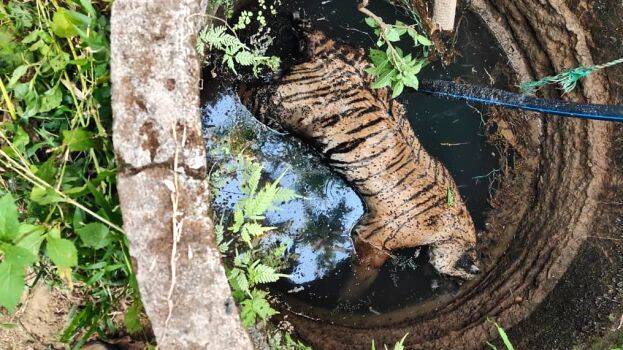
Wells have become one of the deadliest and most preventable threats to tigers in India, and the latest incident in the Nilgiris shows how this danger continues to be ignored. A seven-year-old tiger was found dead in an abandoned well on a private tea estate, near Kadasolai reserve forest area in the Kilkotagiri range of the Nilgiris. Its body discovered only after villagers noticed a foul smell, as reported by Times of India.
The well had been covered with a thin sheet of material, a trap waiting in silence. The tiger died trying to escape, its claws worn down by desperation. It is a scene repeated far too often, and the pattern is unmistakable: when wells intersect with tiger landscapes, the tiger always loses.
Wells Turn Forest Edges Into Death Traps
This incident is not an anomaly. Across India, tens of tigers have died in wells over the years. Many wells, dug for agriculture or domestic use, remain completely uncovered. Others are partially concealed under vegetation or debris, making them invisible to wildlife. For tigers, who move silently and often at night, these structures become lethal. Once inside, escape is nearly impossible. The walls are steep, the diameter narrow, and the panic immediate.
Wells represent a failure not just of physical infrastructure but of responsibility. India has invested in extensive guidelines for habitat protection, including contour mapping, village relocation frameworks and strategies for coexistence. Yet simple measures like fencing, covering or decommissioning wells in tiger landscapes receive far less attention than high-profile conservation programs.
The disconnect is stark: a tiger can be saved from poachers, survive a territorial clash, and adapt to shrinking forests, only to die in a hole in the ground.
Local forest departments frequently cite budget constraints, unclear land ownership or administrative delays as reasons for inaction. These excuses collapse under the weight of repeated deaths. A well in tiger habitat is not an accident; it is a predictable hazard.
Negligence At Every Level
The Nilgiris case exposes a chain of negligence. The well sat on private estate land, yet responsibility also extends to forest officials, district authorities and state-level oversight. The tiger’s body showed no external injuries beyond the damage to its claws and toes, evidence of its attempts to climb out. It died of exhaustion. This is cruelty by omission, not by intent, but the outcome is the same.
India’s landscapes are filled with tens of thousands of open wells, many within or adjoining tiger corridors. In western India, tigers have drowned in farm wells near sugarcane fields. In central India, big cats have been pulled out of irrigation pits hours from death. In the north, wells along riverine corridors have taken leopards, cubs and dispersing subadults. The problem is nationwide, not regional.
Local negligence persists because national enforcement is weak. Instructions alone do nothing unless they are implemented. And when implementation fails, tigers die.
The solutions are straightforward: cover abandoned wells, fence active ones, map every hazard within a reserve or buffer and assign accountability. These measures require coordination between departments, but they are neither expensive nor complex.
NTCA Must Act Beyond Guidelines
The Indian tiger authority (NTCA) has issued advisories on mitigating physical hazards, but advisories are not enough. NTCA has the mandate to standardise practices, but it also has the responsibility to enforce them. Without monitoring, follow-up and clear consequences for negligence, states continue to ignore the simplest life-saving measures.
Wells are rarely treated as national-level threats, yet they kill tigers more reliably than poaching in many regions. Every uncovered well is a structural failure, not a natural event. NTCA must require states to inventory all wells within tiger landscapes, publish the data, and certify the completion of mitigation work.
Conservation practices demand more than documents; they require implementation in the field, where a tiger’s survival depends on practical action.
Efforts that improve habitat connectivity, restore degraded areas and strengthen coexistence — such as those discussed through conservation practices for tigers — must integrate well-management obligations. A corridor is worthless if it funnels a tiger into a trap.
Ending Avoidable Deaths
The Nilgiris incident will fade from headlines, but the pattern will continue unless India confronts the problem head-on. Tiger dispersal is expanding in several states, meaning more animals will encounter human-made hazards like wells, trenches and pits. A tiger cannot distinguish an open hole from solid ground. Humans can, and therefore humans bear the responsibility.
Tigers are endangered. People are not. The sacrifices required to protect tigers are small compared to the cost of losing them. Covering wells is one of the simplest and most effective interventions available. It requires no new technology, no complex coordination and no prolonged negotiations. It requires only the will to act.
Until every well in tiger country is secured, India will continue to lose tigers not to poachers or conflict, but to preventable neglect. The tiger’s strength is no defence against a hole in the ground. Only our choices can fill that gap.
Source: Times of India, India.
Photo: Kerala Mudi, India