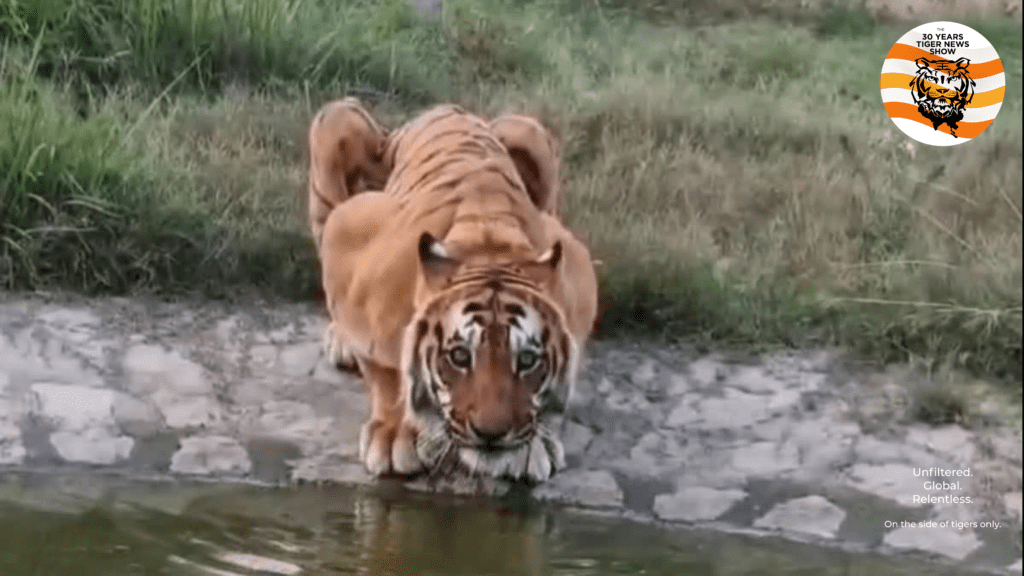
Vikram survived nearly 21 years, but almost 40 percent of that life was spent behind bars after humans abducted him from the forests where he belonged, as reported by ETV Bharat. The tiger died on May 3 at the Dhela rescue centre in Ramnagar after spending his final years moving between enclosures, veterinary procedures, and controlled confinement. Officials called him a man-eater. Yet the deeper tragedy is how quickly India accepts captivity as the answer whenever conflict emerges between humans and tigers.
Vikram Lost His Freedom In 2019
Vikram became infamous in 2019 after being linked to the deaths of three forest personnel inside Corbett’s Dhikala range. Forest officials tracked him through movement patterns before tranquilising and capturing him. From that moment onward, his life in the wild ended permanently.
Authorities argued that releasing him back into the forest was impossible because a tiger once habituated to hunting humans could remain dangerous. Officials also pointed to his age and worn teeth, claiming his ability to hunt natural prey had weakened. Those concerns may have been genuine, but they still led to a brutal reality: a wild tiger was removed from his territory forever and confined inside captivity for the remaining years of his life.
Vikram spent nearly eight years imprisoned in facilities including Nainital zoo before being transferred to Corbett’s Dhela rescue centre in 2021. That means close to 40 percent of his total lifespan unfolded inside human-controlled spaces rather than the forests he evolved to dominate.
Vikram Became A Symbol Of Human Failure
Vikram was repeatedly described as a feared predator, but his story reflects a larger pattern of shrinking habitat, increasing human pressure, and collapsing coexistence systems. Tigers do not suddenly wake up wanting conflict with humans. Conflict grows when forests shrink, prey declines, tourism expands, roads divide habitat, and humans move deeper into tiger territory.
India often celebrates itself as the world’s leading tiger nation, yet it still struggles to deal with conflict without resorting to long-term captivity. That contradiction remains deeply uncomfortable. A country capable of protecting vast tiger landscapes should also be capable of developing better coexistence systems, advanced monitoring, rapid-response infrastructure, and community protection measures that reduce the need for permanent confinement.
Instead, tigers like Vikram are removed from the wild and placed into controlled environments where survival replaces freedom.
Vikram Lived His Final Years In Confinement
Vikram spent his later years inside a 600-square-metre enclosure designed to imitate natural conditions. Officials installed a water pool and maintained intensive care routines including vitamin supplements, fresh meat, regular monitoring, and veterinary treatment. In 2025, he developed an age-related tumour and underwent surgery before his condition temporarily stabilised.
Yet no enclosure can replicate what a tiger truly needs. A simulated environment remains a prison regardless of how carefully designed it appears. Vikram once moved across forests, controlled territory, hunted independently, and lived according to instincts shaped by evolution. His final years reduced that existence to controlled feeding schedules and managed observation.
The public is often encouraged to see this as compassionate care. But captivity always carries another reality underneath: the tiger loses choice, movement, territory, and freedom while humans decide what remains of its life.
Vikram’s Death Should Force Reflection
Vikram may have lived longer than many wild tigers, but longevity alone does not define a good life. Survival inside captivity is not the same as living where a tiger belongs. India should reflect carefully on why one of its most famous tigers spent nearly half his existence imprisoned after conflict emerged between humans and wildlife.
The growing crisis surrounding tiger deaths cannot be separated from habitat pressure, tourism expansion, fragmented forests, and human encroachment. Tigers like Vikram become symbols of a conservation system constantly reacting after conflict rather than preventing it earlier.
On May 3, officials completed the final procedures around Vikram’s death. Another tiger entered the records of Corbett history. But behind the statistics remains a harder truth: a powerful wild predator spent almost half his life confined by the same species that keeps claiming it wants to save him.
Source: ETV Bharat, India
Photo: ETV Bharat, India