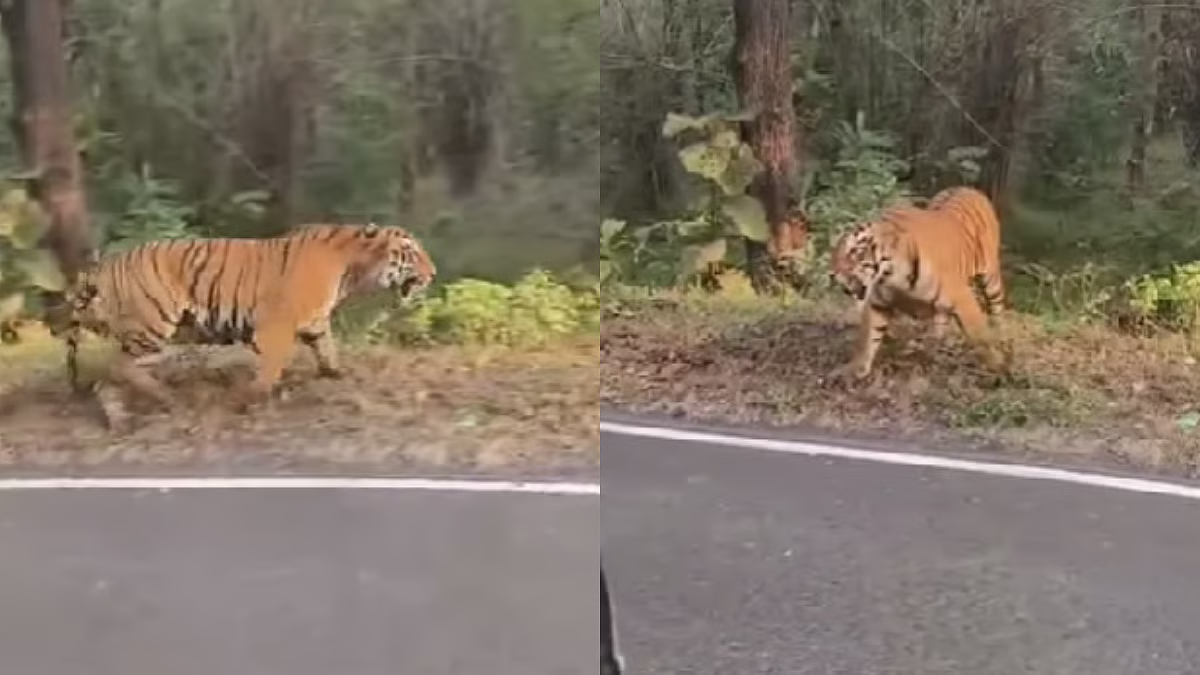
Some idiots rise early. It happened at 6:45 a.m. near the Keslaghat Gate of Tadoba Andhari Tiger Reserve in Maharashtra. A female tiger—known as the K-mark tigress for the distinctive pattern on her flank—emerged from the forest, startled by commuters who had stopped on the Chichpalli Road to film her. Within seconds she charged, sending motorcyclists and drivers scrambling for safety. No one was hurt. But the real damage came later, when the video went viral and the world applauded its “thrill.”
The anatomy of stupidity: idiots in action
Two men in the clip stand out: one on a motorcycle filming, another leaning from a car window to get a closer shot. Both freeze as the tigress approaches, engines revving too late. They had turned a predator’s warning into a selfie opportunity. The video was posted online as “chilling footage” by the Free Press Journal, feeding the same addiction to spectacle that drives people to risk their lives for clicks.
The outlet described it as a “deadly attack narrowly escaped,” ignoring that the aggression was provoked. The tigress was doing what any mother would—defend her space, possibly her cubs. The idiots made her the villain.
From journalism to voyeurism
This is not news; it is voyeurism disguised as reporting. Media houses know what panic sells: fear of the wild. The media industry partly thrives on portraying tigers as unpredictable monsters because danger keeps audiences hooked. Each headline that screams “attack” erases the real context—fragmented habitats, encroached roads, endless intrusion.
The idiots who stopped to film and the outlet that glorified them are two sides of the same coin: one creates the chaos, the other cashes in on it. Both reduce the tigress to a prop in a human drama she never asked to star in.
The real story is the road
The Chichpalli route cuts through a buffer where heavy traffic mixes with forest silence. Early morning commuters pass through daily, honking, stopping, even parking for photos. Officials have repeatedly warned the public to avoid these roads at dawn and dusk, but warnings mean little when there’s a chance to “go viral.” The tigress’s charge at the two idiots was not random—it was reaction. Noise, light, and intrusion build cumulative stress.
For every video that circulates online, dozens of other animals quietly alter their behaviour, retreating deeper into shrinking forests. The so-called “attack” is what coexistence failure looks like on camera.
When stupidity becomes contagious
The viral clip has now reached millions. Comment sections cheer the drivers’ “luck” and joke about how close they came to being eaten. This is how irresponsibility multiplies. The more views a video gets, the more people attempt the same stunt. Already, tourists in Tadoba and Pench mimic viral behaviour—stopping near tigers for selfies, revving engines to make them move, treating predators like mascots of adrenaline.
The result is predictable: the next tiger that lunges will be tranquilised, relocated, or shot under the excuse of “public safety.” Humans keep the video; the tiger loses her home.
The illusion of bravery
The two idiots in that video are being called brave online. But courage is not staring at a tiger from a few metres—it’s staying far enough away that she never notices you. Real courage belongs to the forest guards who patrol on foot without cameras, without applause, and often without backup. The commuters are not brave; they are reckless. The media outlet is not informing; it is enabling. And every share, like, or retweet is complicity in the slow erosion of respect for wildlife.
The price of provocation
If the K-mark tigress had attacked, the story would have shifted instantly: she’d be labelled aggressive, tranquilised, and relocated—another “problem animal” manufactured by human behaviour. This is the cruel pattern across India’s reserves. A single human misstep becomes an animal’s death warrant. What happened near Keslaghat Gate is therefore not an isolated “incident” but a symptom of cultural rot: the worship of virality over understanding.
The idiots who provoked her walked away; the tigress remains trapped in a narrative she never chose.
Respect is the real safety
Forests don’t need more rules—they need common sense. Stay in your vehicle, move slowly, don’t block paths, and don’t treat predators like performers. Conservation isn’t measured by how close we can get to wildlife but by how well we stay out of their way. The K-mark tigress reminded everyone of that truth. She charged not to kill but to warn those idiots, and her restraint was remarkable. It’s the humans who lacked control.
This wasn’t a near-death story. It was a near-miss for humanity’s dignity. Until we stop mistaking idiocy for adventure and outrage for awareness, the only thing endangered will be respect itself.
Source: Free Press Journal, India
Photo: Free Press Journal, India