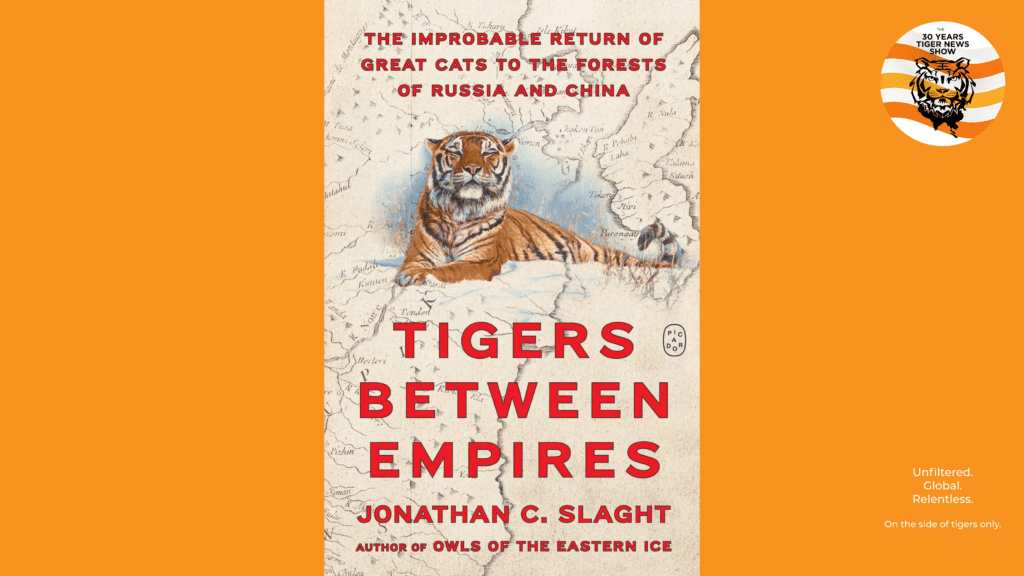
Tigers Between Empires is one of those rare tiger books worth slowing down for because it refuses to romanticise conservation while still showing why the struggle matters, as reviewed by SEJournal. “Tigers Between Empires: The Improbable Return of Great Cats to the Forests of Russia and China” by Jonathan C. Slaght explores the brutal reality of protecting Amur tigers across the frozen forests of Russia and China after the collapse of the Soviet Union nearly pushed the subspecies toward disaster.
Tigers Between Empires Reveals A Different Tiger World
Tigers Between Empires immediately breaks one of the biggest public misconceptions about tigers. Most people imagine them only inside tropical jungles, but Amur tigers evolved in snow-covered forests where winter temperatures can become deadly even for humans. Today only around 450 Amur tigers survive across Russia and China, making them the world’s second-largest tiger subspecies after Bengal tigers.
The book follows the Siberian Tiger Project, launched during the early 1990s after the Soviet Union collapsed and economic chaos triggered rising poaching and trafficking. Suddenly, tigers became vulnerable to illegal hunting and traditional medicine markets while law enforcement systems weakened dramatically.
What makes the book powerful is that it does not present conservation as glamorous heroism. Instead, it reveals exhausting fieldwork, dangerous weather, failing equipment, isolation, political instability, and the psychological strain of working in remote wilderness for years.
Tigers Between Empires Shows What Real Conservation Looks Like
Tigers Between Empires spends considerable time showing the realities of tiger monitoring and research. Scientists and conservationists tracked tigers through forests using primitive radio telemetry systems long before GPS collars simplified some of the work. Researchers walked trap lines in deep snow, flew inside old aircraft searching for radio signals, crossed freezing rivers, and spent months inside rough camps far from cities.
The book also shows how collaboration between Russian and American researchers became essential. Russian scientists brought decades of local knowledge and field experience. American researchers introduced technologies like radio collars and satellite tracking systems. Together they slowly built one of the world’s most important tiger conservation projects.
That cooperation mattered because understanding tiger behavior became essential for survival. Tracking territory, prey, cub production, dispersal patterns, and conflict behavior helped governments understand how to protect habitat more effectively.
Tigers Between Empires Does Not Hide Failure
Tigers Between Empires also deserves credit because it refuses to pretend conservation always succeeds. Tigers are poached. Some die from disease. Others are killed by vehicles or conflict situations involving humans. Even successful conservation landscapes remain fragile under economic pressure, political instability, and illegal trade.
One especially important section involves tigers that attacked humans and were relocated using modern tracking technology. The project recognised that coexistence requires maintaining local support. If rural communities stop tolerating tigers, conservation collapses quickly regardless of scientific success.
The book therefore treats tiger conservation not simply as wildlife protection, but as diplomacy between ecosystems, politics, economics, and human fear. That broader perspective makes the story especially valuable today while tiger landscapes across Asia continue facing fragmentation and expanding human pressure.
Tigers Between Empires Offers Hope Without Fantasy
Tigers Between Empires ultimately succeeds because it offers cautious hope without falling into comforting fantasy. The Amur tiger population survived partly because governments, researchers, NGOs, and local systems cooperated across borders for decades. The work was slow, exhausting, and imperfect, but it proved recovery remains possible when political will actually exists.
Jonathan Slaght’s conclusion feels especially relevant now. Wildlife populations can recover, but only when governments treat conservation as something more important than short-term economics and national ego. Tigers do not care about borders between Russia and China. They move according to forests, prey, safety, and survival.
The deeper lessons surrounding media and perception matter enormously because public understanding of tigers is often trapped in simplistic imagery and tourism mythology. “Tigers Between Emppires” instead presents tigers as political, ecological, and deeply vulnerable animals surviving inside landscapes shaped by history, collapse, and human ambition.
Once in a while, a tiger book deserves attention because it explains conservation honestly. Tigers Between Empires is one of them.
Source: SEJournal, United States
Photo: SEJournal, United States