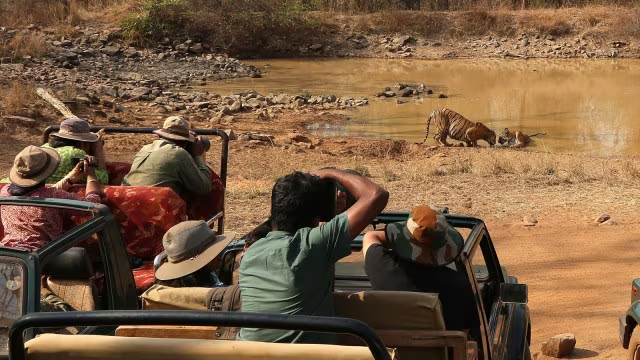
A tiger crossed the border not with a roar but with a swim. Late in October, as central India’s breeding season began, a male tiger left Maharashtra’s Kanhargaon Wildlife Sanctuary, entered the cold current of the Pranahita River, and reached the Kagaznagar forest corridor in Telangana. His reason was instinctive—he was looking for a mate—but his act carried a larger meaning. In a subcontinent where infrastructure severs what the wild once joined, this swimmer became proof that connection still exists. The movement was short in distance but immense in implication: a corridor works only when an animal decides to trust it.
A journey written in water
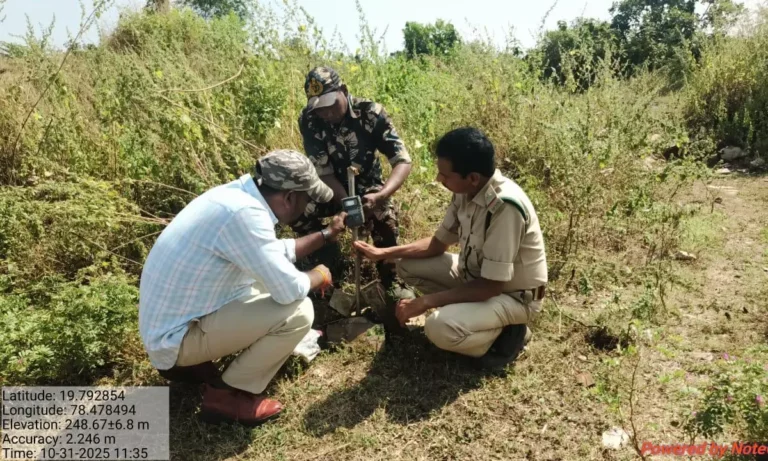
Officials traced the tiger’s path using camera traps in Mancherial division. The animal swam through the Itykhal Pahad forest belt, a known gateway for big cats moving from Maharashtra reserves. From there he roamed 40–50 kilometres south, establishing temporary territory along the Kagaznagar corridor. According to the New Indian Express, this same stretch had only recently been reclaimed from encroachment: 2,200 acres of farmland were restored and replanted with native species. The swimmer’s arrival became the forest’s first independent audit. A decade of paperwork and patrols found its validation not in reports but in a single tiger willing to cross a state line and survive.
When instinct redraws boundaries
Tigers do not know the language of jurisdiction, yet they are fluent in geography. For this individual, the Pranahita was not a barrier; it was a bridge of chance. Breeding season from October to December compels males to expand their range in search of partners, a natural drive that shapes dispersal patterns across India’s central belt. Each time a tiger moves, it rewrites the limits that humans set. This swimmer has now linked two administrative regimes—Maharashtra’s Chandrapur district and Telangana’s Komaram Bheem Asifabad—into a single ecological reality. The forest departments have responded with unusual coordination, sharing field data and camera evidence. For once, a tiger’s itinerary has forced bureaucracy to keep up.
Corridors that hold a continent together
The Kagaznagar stretch forms part of the broader Tadoba–Kawal landscape, one of India’s most critical tiger arteries. These narrow green bands are the lifelines of genetic health. When they remain open, tigers disperse naturally, preventing inbreeding and territorial conflict; when blocked, entire populations collapse within decades. The swimmer’s crossing confirms that the corridor is still alive, but barely. Villages press against its edges, quarries operate illegally nearby, and highways hum just beyond the tree line. The fact that this swimmer managed to traverse it this year should not be mistaken for permanence—it is an exception that proves fragility.
The human edge of the corridor
In Kagaznagar, coexistence depends on reaction time. Officials have adopted a system that compensates farmers within a week for cattle losses verified by veterinarians. Payments move through Telangana’s Mee Seva digital platform, reducing delays that once led to retaliation. Quick compensation is quiet diplomacy—it buys tolerance long enough for science to do its work. The swimmer’s arrival tested that process; so far, no revenge poisoning or snare has followed. People are learning that sharing space can be transactional without being cruel. The policy lesson is clear: corridors succeed only when the people inside them are not made to choose between compassion and survival.
A success that shames the system
This tiger’s journey is cause for celebration but also embarrassment. Governments spend millions drafting corridor management plans that remain unapproved for years. Fencing, mining, and road expansion keep slicing habitats faster than they can be restored. Yet a single wild animal achieved in days what departments debate for budgets: functional connectivity. The swimmer’s crossing is both triumph and indictment. It shows what nature accomplishes when left alone—and how little human governance adds besides delay. The Kagaznagar case should now force a formal corridor notification, permanent protection of reclaimed acres, and joint patrolling between Maharashtra and Telangana. A biological event has handed bureaucrats their to-do list.
Lessons for a fragmented future
Climate change will make such dispersals harder. Rivers that once ran seasonally now flood violently or dry into pits; crop fields push closer to banks; sand mining erodes natural ramps tigers use to climb out of water. Protecting corridors means protecting rivers, vegetation buffers, and silence. The swimmer’s passage reminds conservationists that connectivity is not an abstract line on a map but a living continuum of scent, shadow, and cover. When one tiger swims successfully, it renews the template for many. It also demonstrates that rewilding is not about relocating tigers but about reconnecting land.
The wider geography of hope
Every successful crossing re-stitches the continent’s torn ecology—from Bhutan’s foothills to the forests of Kerala, corridors remain the difference between population and extinction. The Kagaznagar link now joins that chain of possibility. The swimmer’s trail may soon vanish under rain or wind, but its meaning stays: India’s forest mosaic still holds enough integrity for a tiger to move from one protected zone to another. That is the benchmark every state should measure itself against. If a tiger can trust a corridor enough to swim, people can trust each other enough to keep it open.
He will likely return to Maharashtra once breeding ends, retracing the same current that carried him here. But for a season, this swimmer bridged two states, dozens of bureaucratic divisions, and one very simple truth—wildlife does not need our permission to survive, only the space to try. The least we can do is ensure the river remains crossable, the forest continuous, and the story repeatable.
Source: New Indian Express, India
Photo: New Indian Express, India