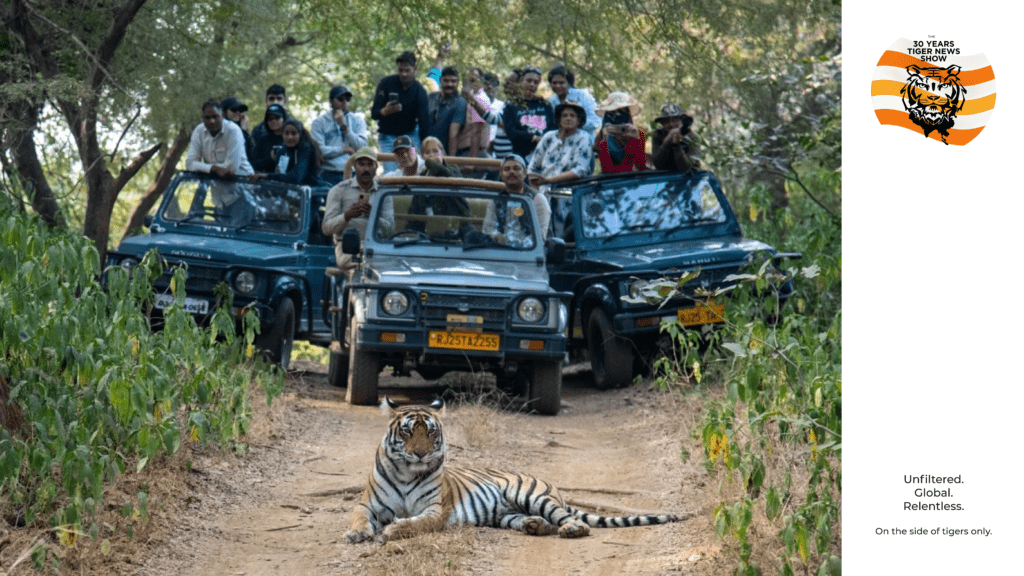
Stress Inside India’s Tiger Reserves Is Being Fueled By Tourism
Stress inside India’s tiger reserves is no longer anecdotal suspicion but scientifically measured reality, as reported by Telugu360. A major multi-reserve study by scientists from the CSIR-Centre for Cellular and Molecular Biology found that tourism pressure and human activity are increasing stress levels in tigers while directly affecting breeding behaviour. The findings should force serious scrutiny on India’s wildlife tourism industry, which too often prioritises profit, vehicle numbers, and tiger sightings over animal welfare and ecological stability.
Stress Levels Rise Around Tourism Pressure
Stress was measured scientifically through 610 genetically confirmed tiger scat samples collected between 2020 and 2023 across Corbett, Tadoba-Andhari, Kanha, Bandhavgarh, and Periyar tiger reserves. Researchers analysed reproductive and stress hormones from hundreds of tigers to understand how human disturbance influences physiology and behaviour.
The results were deeply concerning. Tigers living near tourism routes and areas with heavy human presence consistently showed higher stress levels. Tigresses increasingly avoided disturbed areas for breeding because peaceful forest zones are shrinking under expanding tourism activity.
This directly challenges the polished tourism narrative promoted around tiger reserves. Safari industries often market themselves as conservation allies while simultaneously placing constant pressure on the very animals they claim to protect. Tigers become attractions first and wildlife second.
Stress Is Worst Inside Core Tiger Areas
Stress responses were found to be especially severe inside core forest areas, particularly in reserves like Tadoba and Bandhavgarh. Scientists believe tigers in buffer zones may have partially adapted to constant human disturbance, while tigers inside supposedly protected core areas react sharply when seasonal tourism surges suddenly invade quieter habitat.
That detail is devastating because core zones are meant to function as safe ecological refuge areas. Instead, tourism expansion is increasingly pushing vehicles, noise, crowding, and human movement deeper into spaces tigresses depend on for breeding and raising cubs.
The tourism industry rarely discusses this openly because the business model depends on maximizing sightings, safari demand, resort occupancy, and visitor satisfaction. Quiet forests do not generate profit as effectively as guaranteed tiger encounters. The animal welfare consequences become secondary once wildlife turns into commercial spectacle.
Stress Threatens Breeding And Cub Development
Stress does not simply make tigers uncomfortable. The study warns that prolonged stress can influence reproductive success and even affect cub development. Lead researcher Dr. G. Umapathy explained that tigresses are struggling to locate sufficiently peaceful breeding areas inside reserves increasingly shaped around tourism infrastructure and human presence.
This is where the conservation contradiction becomes impossible to ignore. India celebrates itself globally as the leading tiger nation while simultaneously building tourism systems that biologically pressure breeding females inside protected landscapes.
Researchers recommended stricter limits on tourist vehicles, reducing crowding around sightings, shortening safari duration, strengthening buffer-zone management, and creating water sources away from tourism roads. These are not anti-tourism demands. They are basic animal welfare measures grounded in scientific evidence.
Yet implementing such restrictions would likely reduce tourism revenue and commercial opportunities around reserves. That economic conflict explains why regulation often remains weak despite growing evidence of harm.
Stress Reveals The Hidden Cost Of Wildlife Tourism
Stress inside tiger reserves exposes the uncomfortable reality behind much of India’s wildlife tourism economy. Tigers are promoted endlessly through luxury resorts, safari marketing, social media photography, influencer culture, and government branding campaigns. The animal becomes a product whose visibility drives revenue across entire regional economies.
But tigers are not tourist infrastructure. They are apex predators requiring quiet territory, predictable breeding conditions, and ecological stability. Constant human intrusion inside sensitive habitat inevitably changes behaviour, movement, stress physiology, and reproductive patterns.
The hidden pressures surrounding tigers and tourism become dangerous when the industry starts believing that wildlife exists primarily to be seen. Conservation should protect tigers from human pressure, not reorganise forests around human entertainment.
The CCMB study deserves serious attention because it confirms scientifically what many conservationists have warned for years. Tigers are adapting to a tourism economy built around their visibility, but adaptation does not mean welfare. Stress is still stress, even when the industry learns to market it as conservation success.
Photo: via tigerwatch.net