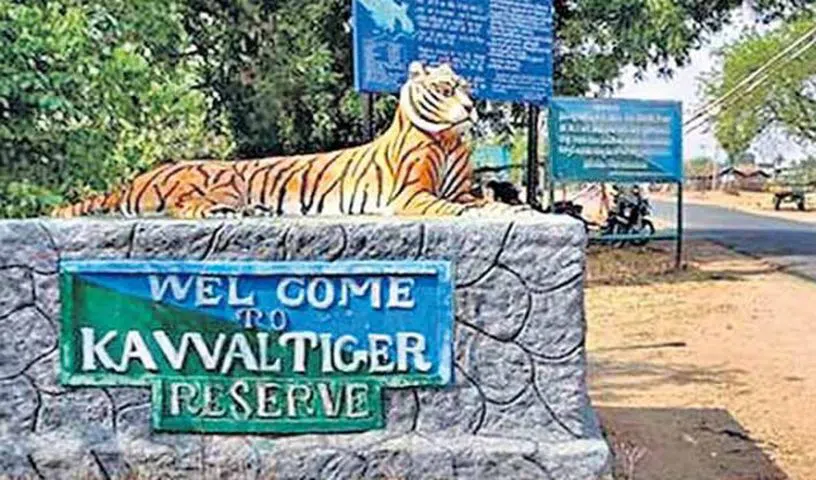
Kawal has waited five long years for a tiger to step inside its core, and that wait finally ended this week, as reported by Telangana Today. But the arrival of a single tiger, marked by a cattle kill on revenue land near Indanpalli village, is not the triumph officials want it to be. Instead, the return of a lone tiger exposes both the fragile gains and the long-ignored vulnerabilities inside the Kawal landscape. One tiger entering Kawal is good news; the reasons it stayed away for half a decade are not.
A Lone Visitor In A Reserve Built For Many
The tiger’s trail reportedly began in Jodeghat village in Kumram Bheem Asifabad district before it moved into the core of Kawal. Trackers, drones and village-level awareness campaigns were immediately activated. The excitement among forest staff is understandable: the last time Kawal recorded a tiger inside its core was nearly four-and-a-half years ago. Yet multiple tigers have been moving around the buffer zone for years without stepping inside. The distinction matters. A tiger reserve is not defined by occasional visitors; it must be shaped by stable occupancy, breeding females and natural dispersal.
To attract tigers from Maharashtra, the department created around 800 hectares of grassland. These engineered landscapes, however well intentioned, raise an uncomfortable question: why must Kawal manufacture habitat instead of restoring what was already there? Real resilience comes from ecological repair, not construction projects. Kawal must become a place tigers choose naturally, not a site coaxed into temporary use.
The Investments Are Impressive, But The Outcomes Still Lag
Officials have installed 600 CCTV cameras across 1,760 square kilometres, forming an elaborate grid intended to detect intruders, monitor wildlife and intercept poaching threats. Solar-powered bore wells now provide year-round water at percolation tanks to stabilise prey movement. Two core villages, Maisampet and Rampur, were relocated with compensation, a difficult but essential step to reduce conflict and extend habitat security. On paper, Kawal is being fortified. On the ground, results remain mixed.
The prey base — sambar, nilgai, wild boar and gazelle — is in place, yet tigers have not responded with long-term occupation. The National Tiger Conservation Authority’s 2022 assessment found no tigers inside Kawal, only scattered individuals in Kaghaznagar division to the north. For a reserve notified in 2012 with 892 square kilometres of potential habitat, the absence of resident tigers for years is a warning sign, not an administrative footnote.
A Tiger’s Arrival Should Be A Beginning, Not A Celebration
Kawal’s managers are eager to frame this tiger’s arrival as a turning point, but the deeper truth is harder to ignore. A single tiger entering Kawal after five silent years highlights the instability of the corridor linkages between Maharashtra and Telangana. Any disruption — road expansion, mining proposals, uncontrolled grazing, or human encroachment — can break the chain of dispersal that tiger recovery depends on. If Kawal hopes to keep this tiger, let alone host breeding females, these pathways must be defended with far more urgency.
Cattle kill incidents, like the one that revealed the tiger’s presence, will always trigger anxiety among residents. Awareness campaigns are necessary, but they are not sufficient. Compensation must be immediate, fencing must be strategic, and conflict-prevention systems must work without relying on chance sightings. If communities feel abandoned in moments of fear, their tolerance collapses — and so does the future of the reserve.
Kawal deserves a real chance at becoming a functioning tiger landscape, not a symbolic one. That requires long-term land protection, continuous monitoring, and the courage to say no to political projects that erode habitat under the banner of development. The return of a tiger should push Telangana to confront every structural weakness that kept Kawal empty for half a decade. If officials act, this tiger may be the first of many. If they lapse into celebration and forget the hard work ahead, Kawal will return to silence once again.
The path forward is clear: protect corridors, repair habitat, strengthen enforcement and place local communities at the centre of decision-making. These are not new ideas; they are the foundation of conservation practices for tigers. Kawal’s future depends on whether the state finally decides to follow them.
Source: Telangana Today, India.
Photo: Telangana Today, India.