
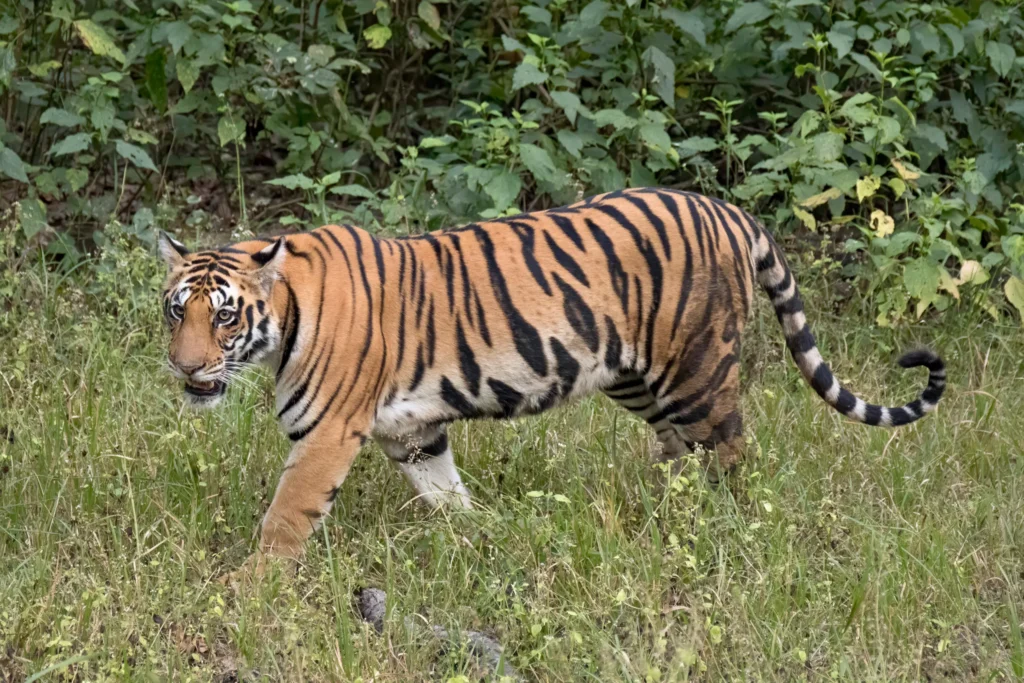
Nepal census preparations begin on December 16, marking a nationwide attempt to assess the true condition of the country’s tiger populations, as reported by Khabarhub. For years, Nepal has celebrated rising tiger numbers as a national achievement, yet a census is more than an exercise in counting animals. It is a test of political commitment, ecological planning and the integrity of systems meant to protect a species that still faces poaching pressure and shrinking habitat. This Nepal census will determine whether progress made since 2010 is durable or fragile, exposing whether Nepal’s protected areas can truly sustain their gains.
Chitwan–Parsa Begins A Demanding Three-Month Operation
The Nepal census starts in the Chitwan–Parsa complex, divided into three blocks that will each receive dense camera-trap grids spaced at two-square-kilometre intervals. Around 1,100 cameras will be deployed, many reused to reduce costs. Each grid remains active for 15 nights before shifting, creating a rolling map of tiger movement that allows researchers to identify individuals by stripe pattern. The Nepal census follows a standard four-year interval, though enforcement challenges, infrastructure expansion and shifting prey populations make today’s assessment more urgent than past counts. Nepal needs clarity, not celebration, and this census promises to bring the truth into focus.
Further west, Banke and Bardiya will be surveyed as a paired unit. Their combined landscape is essential for sustaining dispersing tigers from central Nepal, yet the Nepal census must also detect gaps in connectivity, especially where roads, fences or agricultural expansion may restrict movement. Tiger numbers here improved after 2010, but stability is far from guaranteed. If the Nepal census reveals declining prey or narrowing corridors, emergency measures will be required to prevent isolation and long-term genetic loss.
Shuklaphanta, Laljhadi And The Fragile Edges Of Nepal’s Tiger Range
In the far west, Shuklaphanta and Laljhadi will be counted together as a single block. This region, once depleted by hunting and encroachment, has made strong gains, but its future remains vulnerable. The Nepal census in these blocks must confirm whether tigers have enough viable territory or whether they are merely filling the last pockets of functional habitat. The cost of the Nepal census, around Rs 25 million, is small next to the national budget, yet the ecological cost of complacency is far greater. Every tiger detected here reveals not just survival, but the remaining strength of an ecosystem under pressure.
The Nepal census will also guide the timing of the postponed rhino census, another four-year cycle disrupted by budget delays. Conducting both counts within a coherent planning framework is essential; fragmented monitoring leads to fragmented policy. A census is not a ritual—it is a diagnosis. The Nepal census will show where habitat is eroding, where conflict risk is increasing and where enforcement must intensify to stay ahead of organised wildlife crime networks that still operate along Nepal’s borders.
A Census That Must Lead To Decisions, Not Speeches
Nepal routinely presents itself as a global conservation leader, yet leadership is not measured by announcement but by action. The Nepal census, running through Poush, Magh and Falgun, offers a rare opportunity for the government to translate data into governance. If results show saturation in core areas, Nepal must expand habitat. If results show weakened dispersal routes, Nepal must restore them. If results show poaching persistence, Nepal must strengthen intelligence-led enforcement rather than rely on ceremonial patrols.
At its best, the Nepal census can force leaders to confront realities that festive speeches avoid. The success of Nepal’s tigers depends on policy that moves beyond symbolic protection toward long-term conservation strategy. If this census pushes the government to act on what it learns rather than what it wishes to believe, Nepal may again prove that small nations can deliver big victories for the future of tigers.
Source: Khabarhub, Nepal.
Photo: Khabarhub, Nepal.


