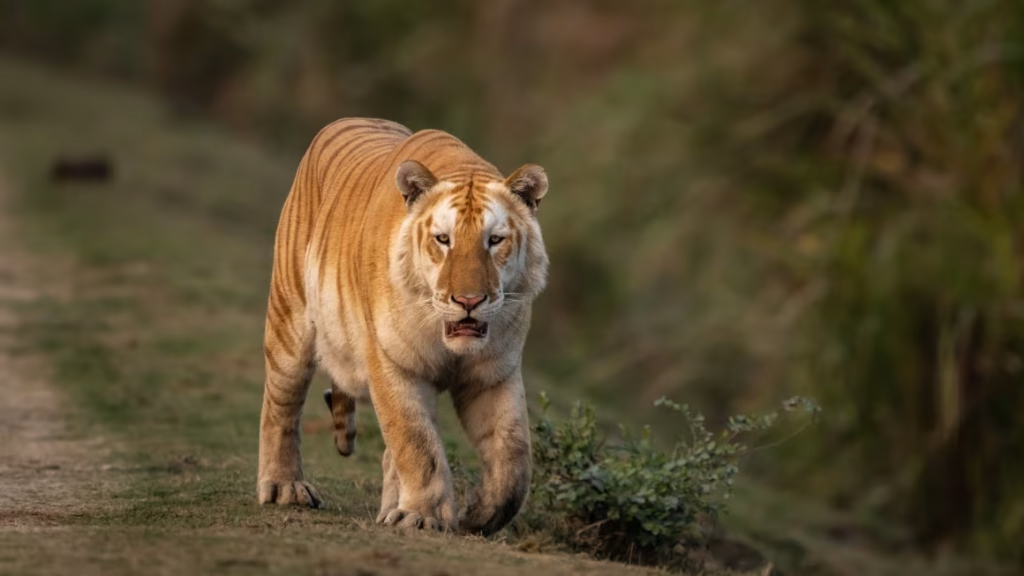
When a rare golden tiger appeared on a safari track inside Kaziranga National Park in Assam, India, the world reacted with pure wonder. A private jeep, a startled guide, one camera shutter—and suddenly the photograph travelled the world. The image, first reported by CNN and later echoed by IFLScience, showed a pale, honey-striped tiger walking through the elephant grass. Within hours, admiration turned into frenzy. Social feeds called it “divine,” “magical,” “the rarest big cat on Earth.” Yet beneath the gold lay something less heavenly. The golden tiger is not a new species. It is a genetic alarm: a recessive coat variation that appears when populations lose genetic variety—often because they can no longer roam freely.
Kaziranga’s forest guards, biologists, and local guides know the pattern well. The park shelters the densest tiger population in Northeast India, surrounded by highways, tea estates, and growing villages. That isolation makes chance mutations more likely to appear. But where science sees a signal, the media sees a spectacle. The sighting fits perfectly into the mythic image of the tiger as a flawless, cinematic creature—an illusion we have unpacked before in our cornerstone on public perception. Each time news outlets glorify “special” tigers, public curiosity rises while ecological awareness falls. The animal becomes a symbol, not a story of pressure.
Golden Tiger Hype And Public Perception
The golden tiger photographed by naturalist Gaurav Ramnarayanan was real, wild, and magnificent. He described how the cat appeared suddenly at dusk, its coat glowing as if lit from within. He did what any photographer would do—captured the moment and shared it. But what followed was a master class in how beauty replaces biology. Online reactions worshipped the coat, not the context. The world celebrated a miracle; scientists quietly worried about its cause.
Uma Ramakrishnan of India’s National Center for Biological Sciences compared the mutation to “spelling errors in DNA.” It is harmless in itself, but its emergence in a free-ranging population suggests narrowing genetic corridors. When two carriers of a rare recessive gene mate—more likely in an isolated population—the visual trait surfaces. In captive tigers, breeders have deliberately inbred for such traits, producing white or golden offspring alongside severe deformities. In the wild, these colors should remain vanishingly rare. Their reappearance in Kaziranga signals that the population is drifting toward isolation.
Yet public perception, fed by social media algorithms, turns every oddity into spectacle. The story circulates without its science. What should raise alarm ends up soothing the global conscience: if the forest can produce something this beautiful, surely it must be safe. It isn’t. It is suffocating in silence.
How Media Fixation Hides Tiger Habitat Pressure
Kaziranga is rightly praised as one of India’s strongest conservation successes. Its floodplains, rhinos, and tigers symbolize protection done well. But even success can rot from the edges. Nearly seventy percent of Assam’s wild tigers live within this one reserve. Around it, corridors to Karbi Anglong and Nameri have narrowed under road construction, tea-estate expansion, and human settlement. Each lost corridor trims the gene flow that sustains long-term health.
The golden tiger therefore tells a structural story, not a spiritual one. It says: your map is broken. Yet national headlines stopped at marvel. The emotional grammar of wildlife journalism rarely tolerates complexity. A beautiful tiger goes viral; a blocked corridor does not. A golden coat generates tourism revenue; fragmented landscapes generate lawsuits. The imbalance is built into the system.
By amplifying rarity without cause, the media reinforces ignorance. People believe India’s tiger recovery is complete. Governments repeat that optimism to justify new infrastructure inside buffer zones. And when the next unusual tiger appears, the cycle restarts—another photo, another round of digital applause, another inch of lost forest. The golden tiger’s true tragedy is not genetic; it is narrative.
Conservation Reality Behind The Golden Tiger Myth
Wildlife scientists in India insist that Kaziranga’s tigers remain healthy, but they warn that early genetic signs deserve attention. The park’s isolation is increasing as industrial projects reshape surrounding land. Without deliberate connectivity—forest bridges, riverine corridors, and community-protected buffer belts—populations will fold inward. Genetic drift will intensify. And then one day, the miracle coat becomes commonplace. That would be the darkest irony: a world where golden tigers abound because the normal tiger has disappeared.
This isn’t theoretical. Captive breeding programs in the 1980s produced dozens of golden and white tigers through close inbreeding. Many developed deformities or immune weakness. The same principle, unchecked, could harm wild populations through reduced variability. Scientists stress that the Kaziranga individual itself is healthy; what matters is what its existence implies. Numbers alone don’t guarantee resilience. Growth inside a cage—whether steel or geographic—is still captivity.
Real conservation looks nothing like a viral image. It looks like survey teams sweating through monsoon grass, local communities negotiating coexistence, and bureaucrats willing to restrict projects that slice migration routes. These are stories that never trend, but they are the ones that keep ecosystems alive. The golden tiger’s fame should finance awareness for such work, not smother it under wonder.
Protecting Real Tigers Beyond Golden Tiger Fascination
Admire the golden tiger—but understand it. Its radiance is not nature’s trophy; it is nature’s caution sign. Kaziranga’s future depends on what happens beyond its boundaries: how farmland edges are managed, how roads are designed, how forest guards are funded, how long-delayed corridor restoration plans are executed. Assam’s wildlife managers have proposed bridges, underpasses, and cooperative land-use models to reconnect habitats. These efforts deserve headlines. Instead, attention drifts to color.
In the end, the golden tiger is neither curse nor blessing. It is simply evidence that every ecosystem speaks—if we bother to listen beyond beauty. The world must stop rewarding spectacle and start demanding substance: better ecological planning, better transparency in environmental clearances, and honest funding for anti-poaching intelligence networks.
If media and policymakers keep chasing anomalies, they will miss the steady disintegration of what makes a tiger wild: its right to roam. The golden tiger’s story should teach humility, not pride. Beauty means nothing without freedom, and freedom cannot survive on fragments of land. The next time a golden tiger goes viral, remember that its coat is only the surface of a deeper crisis — one that still can be reversed if India protects the roads that tigers walk, not the myths that people share.
Source: CNN