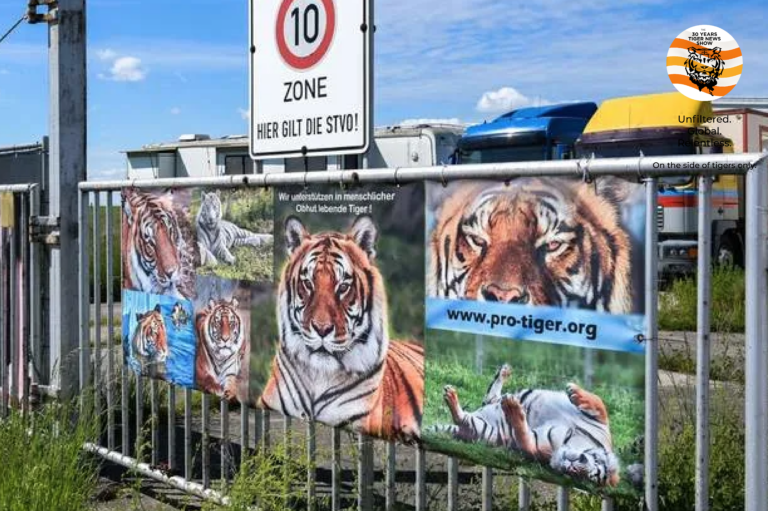
Carmen Zander is now at the centre of Germany’s private tiger scandal after officials moved to shut down her enclosure following an escape, an injured keeper and a police killing, as reported by Indian Express. The former circus tiger tamer kept eight tigers at a facility in an industrial zone in Schkeuditz. One captive tiger escaped after attacking a 72-year-old keeper, was tracked to a nearby allotment complex and shot by police within about 30 minutes. Police said they acted to prevent danger. The deeper danger was allowed to exist for years under human ownership.
The injured man remains in hospital with severe scratches and bites. That suffering should not be dismissed. But Carmen Zander’s operation also turned a tiger into the final victim of private ownership, failed enclosure standards and regulatory hesitation. Prosecutors are investigating suspected negligent bodily harm and possible safety breaches. Officials are also examining how the tiger escaped. No inquiry is planned against the officers who fired the shots. That may satisfy emergency logic, but it leaves the larger question intact: why was a private tiger facility able to create this emergency at all, and why did authorities wait for disaster before moving seriously?
The article also says scrutiny over animal living conditions existed earlier, which makes official delay harder to defend now.
Carmen Zander Built Risk Into Captivity
Reports say the facility of Carmen Zander had already faced scrutiny over living conditions. Authorities had instructed her either to meet required indoor and outdoor space standards for all animals or reduce the number of tigers to fit the space available. That is not a small administrative detail. It means the problem existed before the escape, before the attack and before the killing. Animal protection groups say veterinary authorities share responsibility because they failed to act sooner. They are right. Oversight that waits until blood is spilled and a tiger is dead is not oversight. For Carmen Zander, it is delay with official stationery and a predictable corpse at the end.
PETA described the big cats as kept in tiny space, bare metal cages and deprived of what would constitute a species-appropriate life for a tiger. The owner insisted her enclosure offered better conditions than many captive settings and claimed the animals would become apathetic, refuse food and die if removed from her. That argument is emotional blackmail wrapped around captivity. If animals are so dependent on one owner that removal becomes a welfare threat, that is not proof of love. It is proof of a system that should never have been created, licensed or tolerated by anyone serious about animal welfare.
Carmen Zander Case Exposes Weak Oversight
The police killed the escaped tiger to protect people nearby. That was the immediate crisis. But the animal did not invent the cage, the circus legacy, the industrial-site enclosure or the weak response from authorities. Humans built every part of the failure, then used bullets to end the danger once it moved outside the fence. The owner’s public shock may be real, but shock after predictable risk is not innocence. Private tiger keeping always carries public consequences when the enclosure fails, and the tiger is usually the one forced to pay.
The mayor of Dölzig has called for immediate removal of the enclosure. Animal protection groups have demanded stronger legal protections, confiscation of remaining animals and stricter rules or bans on private wild animal keeping. Those demands are not extreme. They are overdue. Carmen Zander still has eight tigers reportedly remaining at the site. Germany cannot wait for another escape, another injured person or another dead tiger before admitting that private ownership of big cats is a public safety and animal welfare failure. This case should end this tolerance.
This case belongs inside the wider cruelty of captive tiger breeding, where humans call confinement affection until confinement produces disaster. The surviving tigers must be removed to proper specialist care, the enclosure should be shut, and officials who allowed inadequate conditions to continue must face scrutiny. The tiger was not killed by freedom. The tiger was killed by captivity, weak enforcement and a private-tiger culture Germany should finally end.
Source: Indian Express, India.
Photo: Indian Express, India.