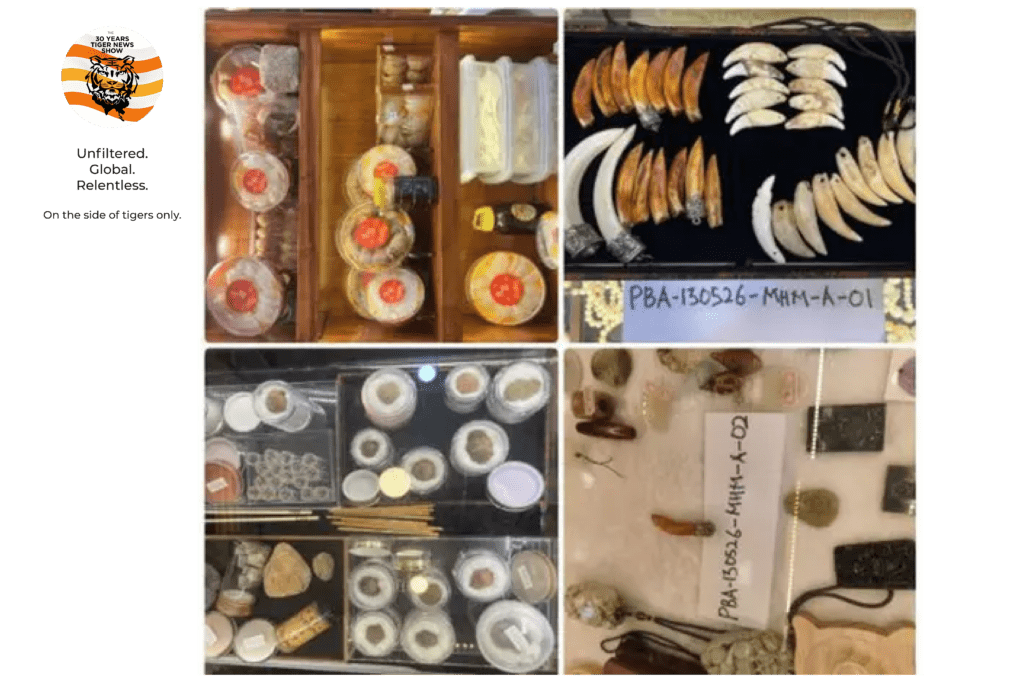
Kota Kinabalu, a city in Malaysia, exposed a wildlife trafficking case Malaysia should have stopped before tiger teeth reached an antique shop, as reported by Malay Mail. Sabah wildlife authorities raided premises along Jalan Gaya and seized protected wildlife parts valued at RM5.32 million (about US$1.13 mln). The haul included nine teeth believed to be from tigers, 10 suspected bear teeth, 16 tusks believed to be from wild boars, edible bird’s nest products and 13 stones believed to be from porcupines. A 52-year-old local man, believed to own Antique Shop Sdn Bhd, was detained.
This is not a small shop problem. It is a market problem.
The operation was conducted by the Sabah Wildlife Department with the Royal Malaysia Police through Bukit Aman’s Wildlife Crime Bureau and Special Investigation Intelligence unit, after intelligence gathering and surveillance. That coordination deserves credit, but Kota Kinabalu cannot be treated as a shocking exception. Malaysia has heard warnings for years about wildlife trafficking, weak deterrence, porous supply chains and disappearing species. One raid proves enforcement capacity exists. It also proves the trade was comfortable enough to sit inside a city business until intelligence finally arrived. That is not the protection Malayan wildlife needs from its government. It is delayed reaction after protected animals have already been cut into evidence.
Kota Kinabalu Is Not An Isolated Market
Preliminary interviews reportedly found that the suspect admitted buying bird’s nests and porcupine stones from suppliers in the Lintas area without valid licences or permits. Officials said protected wildlife parts were believed to have been obtained from villagers in Tawau at low prices before resale in the local market around Kota Kinabalu. That detail shows the chain clearly: rural extraction, urban resale, buyers, storage, display and profit. Poor suppliers receive little, while traders convert animal bodies into inventory. Wildlife crime survives because each link expects the state to remain late, soft or distracted. The Malaysian government is still not doing what it should.
Tiger teeth appearing in Malaysia should disturb everyone because the Malayan tiger is already close to collapse. A country with so few wild tigers left cannot tolerate a market where tiger parts still retain commercial value. If teeth can be held, stored or displayed without permits, enforcement is not deep enough, frequent enough or frightening enough. Kota Kinabalu shows why raids alone cannot be sold as victory. Tigers do not need authorities to discover crime after the chain is already active. They need governance that makes possession, storage, trade and resale too dangerous for anyone to attempt.
Penalties Must Match The Trade
The case is being investigated under Sections 41(1) and 41(2) of the Wildlife Conservation Enactment 1997 for alleged possession, storage and display of wildlife parts without valid permits. Offenders can face fines between RM30,000 and RM100,000, imprisonment from six months to five years, or both. For a seizure valued at RM5.32 million, those penalties look dangerously small. Even the highest fine is less than two percent of the estimated haul value. Kota Kinabalu should force Malaysia to admit the obvious: weak financial punishment does not scare a million-ringgit wildlife market. It teaches traffickers to price risk into business.
Every supplier, buyer, handler, transporter, financier and protector must be traced. Authorities must establish whether the tiger teeth came from Malaysia, another range country or captive sources. Each possibility points to failure. Wild origin means extinction machinery is active. Cross-border origin means Malaysia remains weak in transit or consumption. Captive origin still feeds demand and normalises possession of tiger parts. The government cannot hide behind one detention when the value, species mix and supply details point to a wider network. Kota Kinabalu should bring market sweeps, asset seizures, stronger sentencing and public accountability.
The seized teeth are fragments of animals that should never have entered commerce. This case belongs inside the global machinery of tiger trafficking, where teeth, skins and bones move because governments fail to make possession terrifying. Malaysia is still not doing enough while tiger parts retain value. Until the state makes wildlife crime financially ruinous and legally frightening, every raid is not victory. It is evidence of a system still losing to the trade.
Source: Malay Mail, Malaysia
Photo: The Star, Malaysia