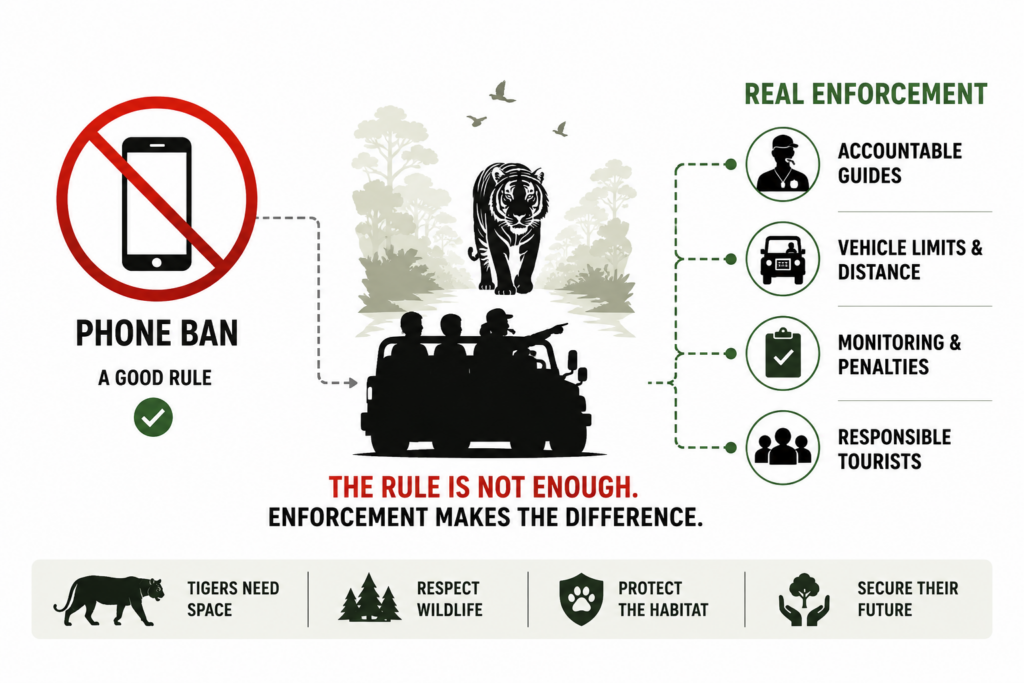
The ban on mobiles in India’s tiger reserves began after a 2025 Supreme Court ruling pushed authorities to restrict phone use inside core tourism zones, as reported by PetaPixel. Visitors in several reserves are now being asked to store phones before entry, or keep them switched off and packed away during safaris. The decision follows years of overcrowding, unsafe tourist behaviour and social media pressure around tiger sightings. It is a good restriction. But if guides, drivers and operators keep bending rules when a tiger appears, the policy will become another clean announcement that dies at the forest gate.
This ban on mobiles did not come from nowhere. A viral Ranthambore video showed a tiger boxed in by multiple safari vehicles while tourists shouted, photographed and filmed from close range. The animal appeared stressed while trying to return to the forest through the crowd. Safari jams are fuelled by instant messages between guides and drivers, with sightings passed around in real time. Geotagged posts then make specific routes, waterholes and tiger paths attractive to the next wave of visitors chasing the same frame.
The phone is not the tiger’s enemy. The behaviour it rewards is.
Ban On Mobiles Must Reach The Guides
A ban on mobiles can reduce livestreaming, selfies, geotagging and the instant spread of tiger locations, but only if enforcement reaches the people managing the safari. Tourists may carry the phones, but guides and drivers control distance, speed, positioning and crowding. Reports describe tourists leaning dangerously out of vehicles, dropping phones near wildlife, stepping off vehicles to retrieve devices and even a child falling from a jeep while relatives tried to photograph a nearby tiger. These are not small etiquette failures. They are safety failures, tourism failures and conservation failures around an animal that asked for none of it.
The uncomfortable truth is that some guides already ignore rules. They know which visitors want the closest angle, which drivers will push forward, and which sightings can become reputation, tips or repeat business. If phones are stored but guide networks still exchange sightings, crowd roads and pressure animals, Ban on mobiles becomes a visible gesture hiding the same old pressure.
Tigers do not need a rule that sounds tough in court and soft in practice. They need penalties, suspension systems, blacklisted vehicles, surprise checks and managers willing to punish operators who sell proximity as premium access.
Photography Is Not The Real Enemy
Dedicated cameras, DSLRs and video equipment are still generally allowed, often with registration. That distinction matters. Wildlife photography is not automatically abuse. Long lenses can keep respectful distance when photographers behave properly. Smartphones, however, encourage a faster culture: selfies, short clips, instant uploads and the belief that every sighting must prove personal closeness. Ban on mobiles should therefore reset social behaviour around tiger viewing, not create a loophole where professional-looking gear excuses the same crowding and intrusion.
The standard must be distance, silence, patience and withdrawal when a tiger shows stress.
The Supreme Court-linked restrictions also limit road access between dusk and dawn, restrict certain development near tiger reserves and place greater emphasis on sustainable tourism connected to local communities and conservation. That wider package matters because tiger reserves cannot be run like content factories. India’s rising tiger visibility has increased demand for safari tourism, but more sightings should not mean more vehicles, more waterhole pressure and more tourists behaving as if a tiger owes them performance. Ban on mobiles will mean little unless the entire tourism model stops rewarding disturbance.
The best wildlife encounter is not possession of a tiger moment. It is permission to witness a wild animal without forcing that animal into human theatre. India should enforce phone storage, guide discipline, vehicle spacing and operator penalties with the same seriousness it gives visitor numbers.
The ban on mobiles is also a question of cultural restraint, because the tiger has become spectacle in too many human imaginations. Without enforcement, forests will still hear shouting, engines and vanity. The road must become quieter, or the policy is nothing.
Source: PetaPixel, United States
Photo: PetaPixel, United States