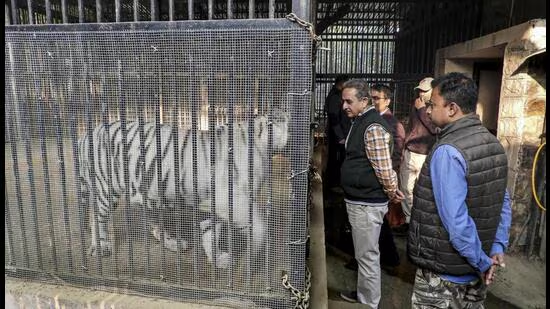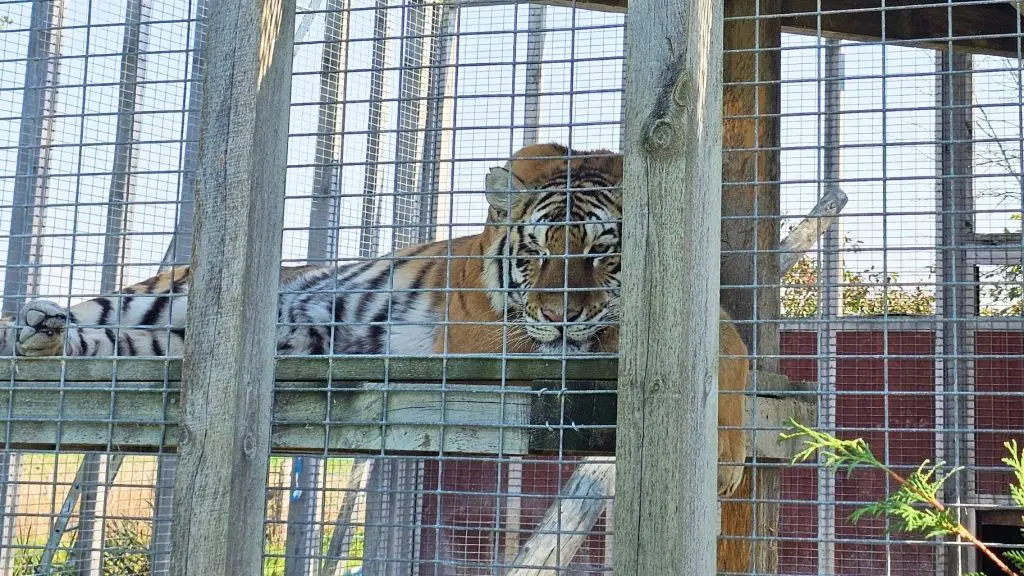
Bervie zoo in Kincardine, Ontario, is once again proving how captivity breaks a tiger long before the body gives up. Footage released this week shows tigers trapped in cramped, barren cages, pacing in tight circles that reveal deep psychological distress. These are not harmless displays. They are visible symptoms of captivity-induced trauma, as reported by Animal Justice. For tigers—solitary predators built for vast landscapes—Bervie zoo is not a refuge. It is a cage that strips away everything wild.
Bervie zoo’s Cages Reduce Tigers To Repetitive Movements
The enclosures at Bervie zoo are small and devoid of meaningful enrichment. In the footage, tigers walk the same path over and over, tails low, bodies tense. These repetitive pacing loops are called stereotypies, and they occur when an animal is denied space, stimulation and autonomy. A tiger’s natural territory spans hundreds of kilometres. At Bervie zoo, all it has is a few metres of concrete. Even so-called enrichment cannot compensate for confinement. Throwing in toys or logs does not turn captivity into habitat.
The truth is simple: tigers are apex predators engineered for silent forests, complex terrain and endless movement. Bervie zoo’s cages erase every part of that. Facilities often claim they educate the public, but what they actually teach is that tigers exist for display. The bars become part of the spectacle, not part of the lesson.
This cruelty reflects the larger pattern of zoos and captivity, where wild animals are marketed as conservation props while their lives shrink behind fences.
A Long History Of Neglect, And Tigers Still Suffer
This is not the first time Bervie zoo has been exposed. Inspectors previously found animals living in barns so filthy the air burned with ammonia. Dozens were seized, and charges were laid. Yet the facility was allowed to stay open—and to continue keeping tigers. Ontario has some of the weakest zoo regulations in Canada. Zoos do not even need licences to operate. That loophole allows roadside operations to keep acquiring animals while avoiding meaningful scrutiny.
For tigers, this regulatory failure becomes a lifetime sentence. Tigers at Bervie zoo have no chance to hide, rest, stalk, swim or control their environment. Their world is reduced to the edges of their cage. Their behaviour shows it: pacing, staring, collapsing into stillness, then pacing again. This is not enrichment. This is resignation.
Tigers are enduring creatures—they survive as long as their hearts keep beating. But survival is not proof of welfare. It is evidence that the animal has no alternative.
Tigers Cannot Live In Places Built For Tourists
The core problem is not Bervie zoo alone—it is the belief that a tiger can be fitted into a cage for the sake of entertainment. Tigers need darkness, distance and complexity. Captivity gives them crowds, noise and confinement. When visitors stand a few metres away from a tiger behind a fence, the setting feels safe. But safety for humans does not equal safety for the tiger. Every time the public points a camera at a caged tiger, the animal is reminded of its powerlessness.
Roadside zoos exploit that illusion. They offer “close encounters,” “rare sightings” and “educational displays,” all while hiding the truth: a tiger whose territory once spanned rivers and ridges now paces the same concrete square endlessly. Captivity does not protect tigers; it protects humans from grappling with the truth about what real conservation requires.
Ontario’s System Enables Tiger Suffering
Bervie zoo continues to operate because Ontario’s enforcement system is built on gaps and silence. Animal Welfare Services, the agency now responsible for investigations, rarely uses its authority to shut down chronic offenders. Complaints can take years to resolve. Inspections are not transparent. Decisions rarely lead to permanent closures. And while the system stalls, tigers in places like Bervie zoo remain trapped.
Tigers already face shrinking habitat, poaching pressure and collapsing prey bases across their wild range. They should not also be condemned to cages in roadside attractions. If Ontario wants to claim any commitment to animal protection, closing Bervie zoo would be the bare minimum. Anything less means choosing neglect over accountability.
Tigers do not belong in cages, and Bervie zoo is proof. Until facilities like this are shut down permanently, suffering will continue—quietly, constantly, behind metal bars.
Source: Animal Justice, Canada.
Photo: Animal Justice, Canada.