Conservation stories often pretend to be neutral, but few are. Behind every field expedition and grant lies a geopolitical shadow. Jonathan Slaght’s new book, Tigers Between Empires, reviewed by the Financial Times, shows how the struggle to protect the Amur tiger became a mirror for the ambitions of Russia, China, and the West. The phrase tigers between empires fits with chilling accuracy—these animals have survived wars, revolutions, and ideologies, but not without being drafted into them.
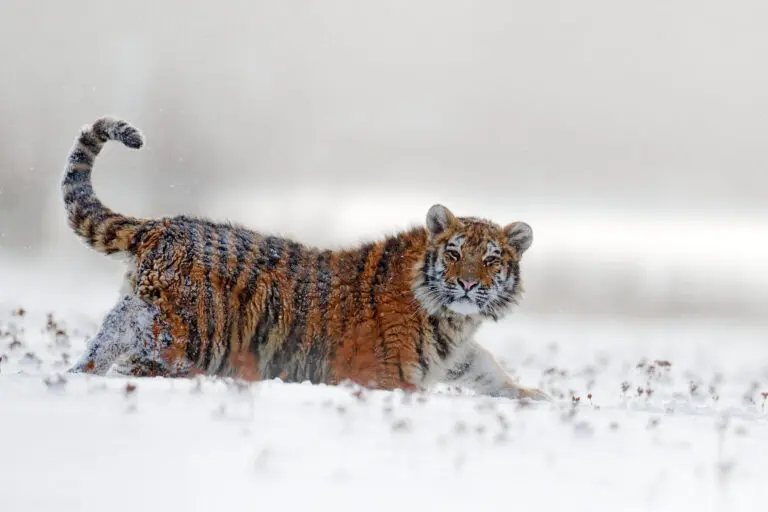
The Amur tiger’s story in Tigers Between Empires,begins in the snowy forests of Russia’s Far East, near the border with China. These cats live in one of the harshest habitats on Earth, feeding on deer and boar across territories stretching hundreds of kilometres. Their endurance is biological, but their vulnerability is political. Each shift in power redraws the boundaries of what conservation can mean.
Tigers as symbols of power
In the 1990s, the collapse of the Soviet Union created a brief vacuum in which Western scientists and donors poured into Russia with optimism and dollars. Among them was biologist Dale Miquelle, who became the central figure in Slaght’s narrative. His Siberian Tiger Project, supported by US institutions, operated under the assumption that collaboration could transcend politics. It did not. As Moscow’s nationalism hardened under Vladimir Putin, foreign conservationists found themselves rebranded from partners to outsiders.
What was once a field mission became a diplomatic experiment—tigers between empires, caught in a tug-of-war between research and sovereignty. Science was filtered through suspicion. Each radio collar, each funding agreement, carried the scent of control. The cats’ survival was measured not just by prey density but by which flag flew over the next forest checkpoint.
The cost of intrusion
Slaght acknowledges that conservation is not free of consequence. Capturing tigers for study—snaring, sedating, collaring—has its casualties. Olga, one of the best-known Amur tigresses, produced thirteen cubs before being killed by poachers in 2005. Her life tells a familiar story: tracked, tagged, celebrated, then erased. Research can illuminate behaviour, but it can also inflict damage in the name of protection.
This tension exposes the arrogance embedded in modern conservation. Governments praise scientists when results look good and disown them when accidents occur. The Russian authorities later banned spring-loaded snares after reports of tiger deaths. Slaght calls the ban overreaction; others call it justice. Either way, the line between study and exploitation remains as blurred as the pawprints left in snow.
Media, myth, and motive
The book Tigers Between Empires is also about storytelling—how every empire shapes the tiger’s image to suit its politics. Western media highlight heroic scientists and tragic beasts, projecting virtue onto the frontier. Russian outlets stress national pride and independence, portraying the tiger as a symbol of resilience and control. Each version is a form of media manipulation: the same animal, edited to serve different masters.
What disappears in this exchange is the tiger itself. The Amur cat is not an emblem of statesmanship; it is a living creature, navigating disappearing wilderness. But empires—old and new—need icons. Tigers between empires become useful instruments, their images traded for grants, soft power, and legitimacy.
Lessons from survival
Despite this human noise, the Amur population has endured. From a nadir of around 250 in the mid-20th century, numbers have risen to roughly 500. This rebound, while often cited as proof of global cooperation, hides the uneven ground it rests upon. Russia’s vastness and its secrecy make data difficult to verify. Conservation there survives on momentum, not transparency.
Even so, the persistence of these tigers is remarkable. It proves that resilience can exist amid interference—that a species can outlast propaganda, paperwork, and human pride. Yet optimism remains fragile. Every new road, every logging concession, eats into the last connected habitat. The frontier is shrinking faster than any recovery rate can compensate.
Between empires and illusions
The deeper tragedy in Tigers Between Empires is not only what happens to the cats but what they reveal about us. Empires come and go; conservation programmes become ideological trophies. The tiger remains an unwilling diplomat—its body politicized, its biology weaponised. For Russia, it is national heritage. For the West, moral leverage. For the tiger, it is exhaustion.
In the end, Slaght’s account stands as both tribute and warning. Science may describe the tiger’s movements, but politics decides its fate. The Amur tiger survives today not because of human wisdom, but in spite of it. Each time nations claim to “save” it, they merely rebrand their own reflection.
In Tigers Between Empires, we realize even more that the tiger’s fight is not for territory, but for truth.
Source: Financial Times, UK
Photo: Financial Times, UK