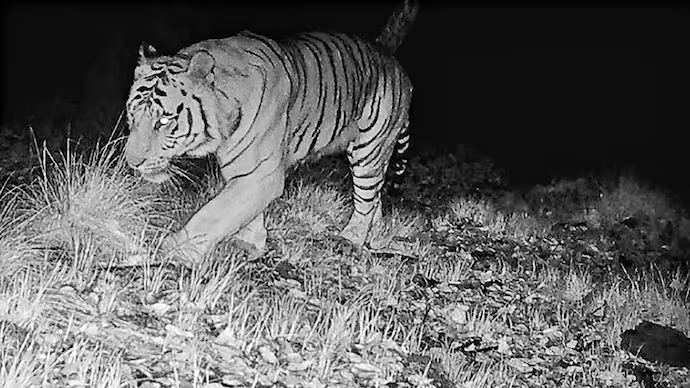
Malaysia’s tiger crisis has become a theatre of illusions — illusions of progress, of protection, of political will. Ministers speak proudly of AI surveillance, smart patrols, and “zero tolerance” for poaching, while the reality beneath the canopy grows quieter each year. Less than 150 Malayan tigers remain in the wild — down from 3,000 in the 1950s. Yet, government press releases still use the word “stability.” It is not stability. It is extinction slowed down just enough to look like management.
These illusions sustain comfort. They create the appearance of momentum in a crisis that is largely unaddressed. A dozen photo ops, a hundred awareness campaigns, and one televised drone launch — all while the jungle shrinks, the poachers multiply, and the tiger becomes more legend than life.
Bulan, the tigress tracked for two years by conservationists, carried that legend in her stripes. She raised four cubs amid logging trucks, roadside snares, and the unending hum of highways. Then one night, a truck on the East–West Highway struck her down. Poachers arrived before the authorities, removing her teeth, claws, and bones — worth roughly US$60,000. She was not just a victim of poaching, but of the illusion that modern tools could save an animal trapped in a dying ecosystem.
The illusion of control
Malaysia’s enforcement numbers tell a story that comforts bureaucrats but fools no one on the ground. In the first six months of 2025, 201 wildlife smuggling arrests were made, and illegal assets worth US$30.5 million were seized. Those figures sound impressive, but each arrest hides a larger network untouched. The illusion of control depends on counting victories instead of confronting systems. For every trafficker caught, several more operate freely across porous borders, using drug and gun routes to move tiger parts.
A single pelt sells for RM100,000 (≈US$24,000). Bones reach US$1,186 per kilo, and whiskers — absurdly — are traded for acupuncture at US$118 each. Poaching has become organized commerce, and its profits dwarf the budgets of most anti-wildlife-crime divisions. It’s an illusion to think that enforcement alone can fight an industry with deeper pockets and international reach. The real power lies not with rangers in the forest but in the money changers who clean the profits in plain sight.
Behind the illusion of progress stands the shadow of complicity. Some traffickers are arrested; others are protected. Malaysia’s laws are not weak — they are selectively strong. Syndicates know this, and so do those who fund them. The investigation by Sinar Daily / AFP laid it bare: the same year Malaysia celebrated record seizures, at least six tigers vanished from known territories.
The illusion of coexistence
The Malaysian government continues to promote its palm oil empire under banners of “eco-certification” and “sustainable growth.” These words form the most dangerous illusion of all: that conservation and industrial expansion can coexist without consequence. Every hectare cleared for palm oil strips away another fragment of tiger range. Each plantation invites roads, workers, vehicles, and noise — the very ingredients that drive predators into conflict zones.
Bulan’s death on the East–West Highway was not an accident. It was the predictable outcome of unchecked infrastructure in core tiger habitat. The highway itself, celebrated as a corridor of progress, has become a corridor of extinction. Palm oil profits make governments cautious; criticizing the industry risks headlines, lobbying, and trade backlash. So they build the illusion of coexistence — eco-corridors, community projects, paper pledges — while silently conceding that habitat loss is the price of economic stability.
This illusion extends far beyond Malaysia. It’s a Southeast Asian strategy: greenwash destruction with keywords like “balance,” “sustainability,” and “resilience.” But the forest does not understand those words. It only knows whether the trees still stand — and they don’t. They are being sacrified for palm oil.
The illusion of progress
Malaysia often celebrates its community ranger programs, such as RIMAU and WWF-Malaysia, which engage over 1,000 locals as forest guardians. These initiatives work — within limits. But they are underfunded, under-equipped, and overextended. According to the Wildlife Conservation Society, at least 5,000 active rangers are needed to patrol tiger territories effectively. There are fewer than 1,000. This gap between need and reality defines the illusion of progress: strong intentions, weak execution.
Officials insist the issue is not commitment but “capacity.” Yet, capacity does not build itself. The same ministries that can approve multimillion-dollar infrastructure budgets struggle to finance ranger training or drone maintenance. It is easier to claim success in numbers — 200 arrests here, 300 cameras there — than to admit that the system still bleeds. Even community rangers face danger: confronting poachers armed with rifles and syndicates backed by political patrons.
The illusion of progress is a comfort for the public and a shield for the powerful. It buys time, delays blame, and keeps foreign donors satisfied. But illusions don’t rebuild ecosystems.
The illusion of time
Perhaps the most perilous illusion of all is that Malaysia still has time. “No overnight success,” officials say. But extinction does not wait for progress reports. Every mating season without protection, every cub born in a fragmented forest, every month of logging — they all cut the countdown shorter.
In truth, Malaysia’s tiger population could reach functional extinction within a decade. That means no breeding pairs, no viable recovery. Yet, policies move slower than politics, and funding moves slower still. Each passing year widens the gap between rhetoric and survival.
Ten years from now, Malaysia may still issue glossy reports about awareness campaigns and camera traps. But without radical shifts in land use, enforcement, and transparency, those documents will become the obituary of a species.
Breaking the illusion
To save the Malayan tiger, Malaysia must break its dependence on illusions. It must stop confusing activity with achievement and slogans with survival. That means halting new plantations in remaining forest reserves, prosecuting syndicates at financial levels, and protecting whistleblowers who expose corruption. It also means facing the uncomfortable truth: palm oil expansion and tiger conservation cannot coexist at current scales. One must give way to the other.
Real leadership will not look like optimism — it will look like confrontation. The end of the tiger will not come from poachers alone but from every official who hides behind data instead of duty.
If Malaysia truly wants to bring back the roar, it must silence the illusion first. The jungle does not respond to policy statements. It listens to what humans leave standing — or destroy. And right now, the forest is listening to promises it has heard too many times before.
Source: AFP / Sinar Daily, Malaysia
Photo: AFP / Sinar Daily, Malaysia