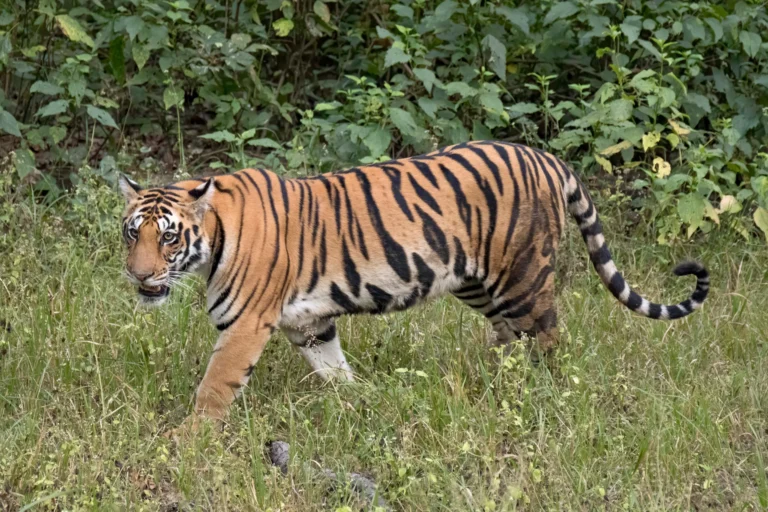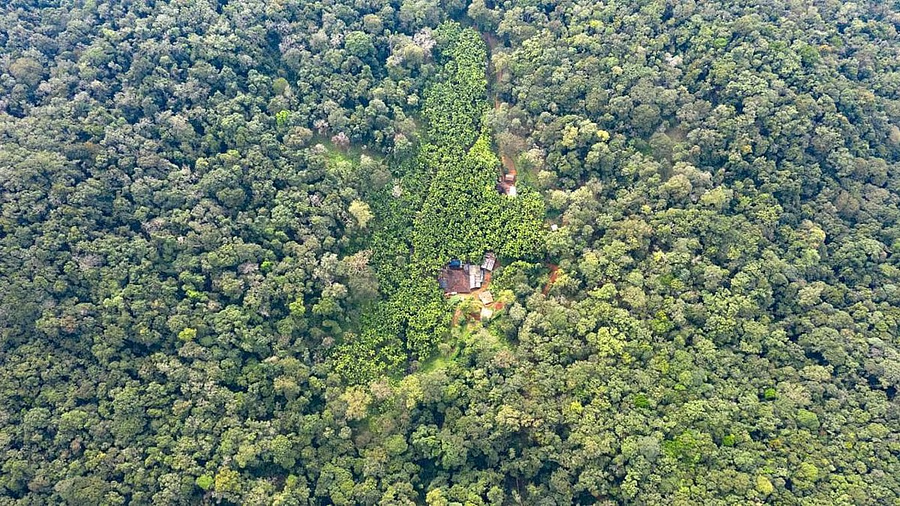
For decades, India’s tiger monitoring has stopped at the borders of its protected areas. The Jharkhand census of 2026 breaks that pattern — for the first time, the count will extend beyond the familiar corridors of sanctuaries into the everyday landscapes where forest edges meet villages, mines, and fragmented hills. It is a long-overdue step in a state where tigers have been ghosts on camera traps, and where the absence of data has allowed the illusion of safety to persist.
A wider search for invisible tigers
This year, the Indian tiger authority (NTCA) has asked every state to widen its scope ,as reported by ETC Bharat. In Jharkhand, that means extending surveys far beyond Palamu Tiger Reserve to include Ranchi, Hazaribagh, Dumka, Khunti, Simdega, and Jamshedpur. According to ETV Bharat, forest personnel trained in the Palamu landscape will carry out the first Jharkhand census that examines tiger movement outside protected zones — a reform that could expose the true condition of the state’s dwindling tiger population.
Deputy Director Prajeshkant Jena from Palamu confirmed that the 2026 effort will unfold in four stages, including assessments of leopards, hyenas, and other carnivores. For the first time, researchers will also map dispersal routes, identifying how tigers move between fragmented forest patches. This means the Jharkhand census will not only count tigers, but also test whether the landscape itself can still sustain them.
Lessons from the past, warnings for the future
The 2022 national count recorded an estimated 3,682 tigers across India, with a modest 6.1% growth rate from 2018. But that same report noted sharp declines in occupancy in Jharkhand, Odisha, and Chhattisgarh. Palamu Tiger Reserve — once one of India’s earliest tiger reserves — reported just one confirmed tiger in 2022, up from zero in 2018. Despite recent signs of movement, including seven tiger sightings within its 1,129 square kilometres, no breeding population has re-established itself.
The Jharkhand census therefore comes at a critical juncture. It may reveal how far tiger dispersal has advanced — or retreated — across landscapes reshaped by mining, roads, and human settlement. According to NTCA guidelines, data from outside reserves could reshape conservation boundaries, forcing governments to acknowledge tiger presence beyond their administrative comfort zones.
Technology and accountability
New methods are central to the 2026 Jharkhand census. High-resolution camera traps now line strategic corridors between Palamu, Simdega, and the forests that spill into Odisha. Officials are also experimenting with digital databases and satellite tagging to improve accuracy. These advances could close long-standing gaps that once allowed both undercounting and bureaucratic denial.
But technology is only as effective as the system behind it. Past surveys have shown that weak coordination between the NTCA, state forest departments, and local enforcement units has led to duplicate counts and delayed reports. Without data transparency and real-time access, tigers become statistics delayed by paperwork. As the Jharkhand census unfolds, the real test will be whether its data remains open, verifiable, and immune to political editing.
Conservation practices on trial
India’s conservation machinery has often been accused of counting tigers without counting threats. Extending the Jharkhand census into human-dominated areas challenges that approach. It forces conservationists to confront mining concessions, unplanned roads, and community displacement that push wildlife into conflict zones. The methodology itself reflects an evolving mindset — one closer to the recommendations outlined in Conservation Practices, which argues that protection must adapt to where tigers actually live, not where management plans say they should.
This shift is more than symbolic. Jharkhand’s forests sit within India’s eastern corridor network, a chain linking Palamu and Simdega to Odisha’s Similipal and Chhattisgarh’s Achanakmar landscapes. The Jharkhand census could establish whether these links still function as corridors or have collapsed into isolated fragments. Such findings could guide where to restore habitat, which concessions to regulate, and how to reorient patrols.
The price of incomplete data
Incomplete monitoring has real-world consequences. When corridors disappear from maps, they disappear from budgets too. Without reliable Jharkhand census data, funding for anti-poaching patrols, compensation schemes, and habitat restoration often dries up. This creates a feedback loop of neglect: no data means no priority, and no priority means no tigers.
Conservation scientists warn that counting outside sanctuaries is not a luxury but a necessity. Many tigers today live beyond protected boundaries — in sugarcane fields, forest edges, and buffer zones where protection is thin. Ignoring these territories is effectively ignoring the animals themselves. The 2026 Jharkhand census is thus a small but decisive test of political will, measuring whether India can acknowledge its tigers beyond tourism zones and government PR campaigns.
Hope through transparency
Jharkhand’s forests have been written off before, yet tiger signs continue to reappear. This year’s extended Jharkhand census gives the state a chance to prove that its forest system can still hold life — if the right lessons are learned. Data collection must translate into reform: stronger patrol networks, regulated mining boundaries, and community-driven monitoring that gives locals a stake in protection.
If done honestly, the Jharkhand census can redefine how conservation is measured — not by numbers alone, but by credibility. The exercise must signal the end of political tokenism and the beginning of scientific accountability. When that happens, counting tigers may finally count for something.
Source: ETV Bharat, India
Photo: ETV Bharat, India