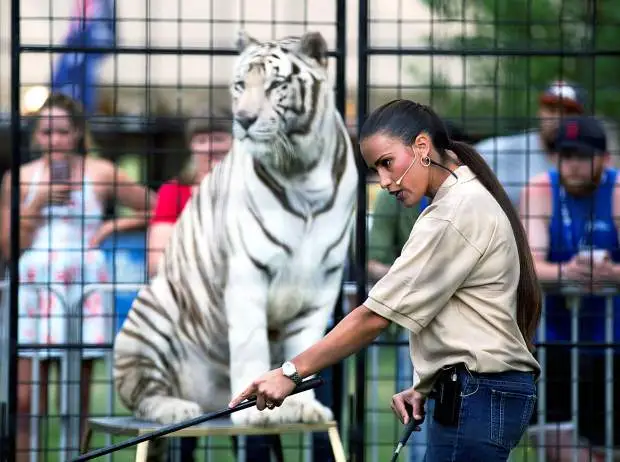
The United States calls itself a nation of animal lovers. Yet its fairs, circuses, and roadside attractions prove otherwise. When trainer Vicenta Pages was mauled by her own white tiger in Pensacola, Florida, the scene tore open a truth America keeps hiding: captivity is not conservation, it’s a performance of control. The tiger attack didn’t come from chaos—it came from obedience finally breaking.
The illusion of American control
At the Pensacola Interstate Fair, Vicenta Pages was bitten and dragged during a live show before an audience that included schoolchildren. Her fiancé rushed in and struck the tiger until it released her. The video, reported by ABC 6 News, shredded the fair’s first statement and exposed the violence behind America’s idea of entertainment. The United States loves to condemn cruelty abroad but tolerates it at home. Freedom is its national myth—except for the animals forced to perform it on cue.
The country that claims to lead in wildlife protection still licenses private menageries and traveling circuses. Thousands of captive tigers exist in American backyards and roadside cages, far outnumbering the wild populations across Asia. Vicenta Pages became part of that contradiction—the illusion that danger can be trained away while the cage remains locked.
The white-tiger industry America refuses to regulate
White tigers like the one that mauled Vicenta Pages are not natural wonders; they are genetic mistakes deliberately multiplied for profit. Decades of inbreeding produce blindness, cleft palates, and twisted spines—sold as “rare.” The suffering hides beneath the fur pattern that sells tickets. U.S. exhibition law makes it possible because profit always outruns enforcement.
This cruelty mirrors what happens inside many captive-breeding programs. The same formula repeats from Florida to Texas: breed, display, discard. When the animal rebels, the show blames the tiger, never the trainer, never the system. The audience sees a mishap; in reality, it’s the animal’s only form of protest.
Families still line up for photo ops with cubs, convinced it supports conservation. It doesn’t. Those cubs are removed from their mothers, handled for a few weeks, then vanish into the trade that supplies circuses, zoos, and private owners. America’s cruelty thrives on sentimentality—it looks like compassion, but it’s commerce. Even Vicenta Pages’ act was sold as “education.”
America’s circus democracy
Officials claimed the crowd was never in danger. That’s the official definition of safety: people unharmed, animals irrelevant. The footage told a different story—a gate left open, another tiger in the background, chaos disguised as order. The Florida Fish and Wildlife Commission defended the act instead of questioning why it existed. Regulation here protects revenue, not life.
PETA condemned the beating that followed, calling it evidence of a tiger pushed beyond endurance. The tiger’s response was not savagery but logic. America punishes the instinct it creates, then markets the aftermath as discipline. Every strike that night was a reassurance to the audience that control had been restored. Vicenta Pages was treated as the victim; the tiger as the threat. In truth, both were casualties of the same business.
The psychology runs deep. Americans are raised on the myth that mastery equals virtue. From Hollywood’s trained predators to circus nostalgia, domination is framed as destiny. Children clap for power long before they learn its price.
The axis of tiger evil
After the Pensacola attack, organizers banned “dangerous-animal acts.” But the same performances continue at fairs nationwide. The United States is the western pillar of the axis of tiger evil, joined by Thailand’s petting zoos and China’s tiger farm venues. America supplies the illusion of ethics; Asia supplies the industry. Together, they sustain a global network built on denial.
Even the Big Cat Public Safety Act—passed with great pride—barely functions. It limits cub petting but not ownership. Breeders rebrand as sanctuaries, nonprofits, or educational centers and continue unchanged. Paperwork replaces morality. The Animal Welfare Act, written in 1966, still governs this cruelty in 2025. Its weakness is deliberate policy, not oversight.
The question America keeps dodging
Why do trainers like Vicenta Pages keep being attacked by “their” tigers? Because captivity is violence disguised as care. The tiger that injured Vicenta Pages reacted to years of control, confinement, and command. Every incident like this is evidence that the system fails both human and animal. Authorities call it a freak occurrence; it is the routine result of arrogance.
Each time, the tiger is blamed, the show is suspended, and the next fair opens somewhere else under a new permit with another Vicenta Pages. The United States keeps repeating the pattern because denial is profitable. Until the country ends the breeding, trade, and exhibition of big cats, nothing will change. Pensacola was not an exception—it was confirmation. A nation that celebrates freedom still sells captivity as entertainment. The axis of tiger evil begins wherever governments mistake performance for protection, and America remains its most polished stage.
Source: ABC 6 News, USA
Photo: Greeley Tribune, USA