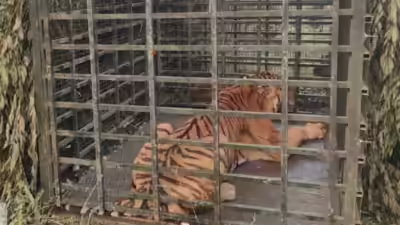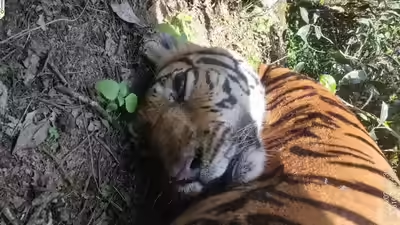
A tigress was found dead near the Villonie Tea Estate in the Valparai forest range of Tamil Nadu’s Anamalai Tiger Reserve. Forest staff discovered the carcass during a routine patrol, according to Times of India. Officials said there were no external injuries, the claws and teeth were intact, and “no suspicion” of foul play existed. The tigress, they claimed, appeared to have died of old age and weakness. It is a line that has become far too easy to repeat — and far too convenient to believe.
The pattern of unexplained deaths
Valparai, a town that advertises its “tea and tiger country,” hides a long list of similar cases. Over the past decade, several big cats — tigers, leopards, even elephants — have been found dead along the borders of plantations. The reports follow the same pattern: discovery, denial, disappearance. Postmortems are mentioned, but their results never reach the public. NTCA protocols demand necropsies, toxicology reports, and photographic evidence for every tiger death. Yet in Valparai and other plantation zones, these records rarely see daylight.
Behind every “natural death” is a fragile ecosystem where human activity is anything but natural. Tea estates stretch across what used to be contiguous rainforest corridors connecting Anamalai with Parambikulam and Eravikulam. Pesticides seep into runoff streams, power lines hum across ridges, and illegal electric fences guard vegetable patches within estate boundaries. The mix of chemicals and currents forms a silent trap for wildlife. And when a carcass is found, the official line of “old age” swiftly erases accountability.
The silence after the patrol
Frontline forest staff in Valparai know the risks of speaking openly. Some have witnessed carcasses being shifted before higher officers arrive, while others have been instructed to file reports using cautious language — “no suspicion,” “appears old,” “awaiting postmortem.” Once the NTCA format is ticked off, the file closes. It is compliance without truth. The NTCA’s guideline was meant to ensure transparency and traceability; instead, it has become a bureaucratic ritual.
Estate workers, who often discover the bodies first, are reluctant to talk. Many depend on the same plantation management for housing and wages. “We see the forest staff come, take photos, and leave. Then silence,” one worker from the Villonie estate told a local reporter last year after another carcass was found near Puthuthottam. Nothing followed. The next headline appeared months later — another tiger, another “natural death.”
Weakness, or a symptom of exhaustion
The official statement described the Valparai tigress as “weak due to the age factor.” Yet weakness in such regions is rarely just biological. It is ecological — the product of shrinking prey, fragmented habitat, and constant human disturbance. When a tiger walks from hilltop to waterbody and collapses, it is not simply because her body gave out. It is because the landscape stopped sustaining her long before that.
In Valparai, forest fragments are now islands surrounded by human activity. Tea estates dominate nearly 220 square kilometres of the plateau, bordered by tribal settlements and hydropower lines. Tigers, which once roamed freely between Tamil Nadu and Kerala, now cross through narrow green corridors riddled with traps and chemical residues. Studies by the Anamalai Tiger Reserve show traces of pesticide compounds in water samples taken from forest streams. Livestock carcasses dumped near estate boundaries draw scavengers and big cats alike, creating both exposure and suspicion.
Each such death should trigger a full-spectrum toxicology test and public disclosure — exactly what the NTCA framework was designed for. Yet these cases remain locked behind departmental reports, available only to committees that never meet in public view. The promise of transparency collapses into the comfort of secrecy.
Valparai’s dangerous illusion of coexistence
Plantation brochures describe Valparai as a model of coexistence — where tea, elephants, and tigers supposedly share space. The truth is less idyllic. Every estate holds a boundary lined with live electric fencing, meant for wild boar but lethal to anything that touches it. These fences, often connected directly to high-voltage lines without regulators, violate the Indian Electricity Act and Forest Conservation rules. Still, enforcement is minimal because the estates are powerful employers and taxpayers.
Tea companies in Valparai like to fund token conservation drives — green campaigns, school events, or donations to rescue centres. But their profit margins depend on squeezing every hectare of land. When a tiger dies, they issue condolences. When enforcement officers demand inspection, they plead compliance. And when journalists ask questions, they refer to “ongoing investigations.” The outcome is predictable: nothing changes.
The anatomy of an official narrative
How do these deaths become invisible? The process is clinical. Once a carcass is found, an on-site inspection team photographs it, checks for missing parts, and records details. If teeth and claws are intact, the death is labelled “non-poaching.” The carcass is buried after postmortem. Toxicology samples are “sent for testing” but almost never published. By the time the official cause is “natural,” public attention has already shifted elsewhere.
Veterinarians involved in necropsies admit, off record, that establishing cause of death requires specialized labs and funding — both scarce. “We collect samples, but they often sit for weeks before reaching Chennai or Dehradun,” said a retired forest officer who worked in the region. “By then, decomposition makes it hard to tell anything.” The system hides behind delay and decay.
A wider pattern across Tamil Nadu
Valparai is not alone. From Mudumalai to Sathyamangalam, tiger carcasses have surfaced in areas bordering human settlements. In March 2024, two tigers were found dead near Hasanur with “no signs of external injury.” In September, a tigress in Nilgiris was declared to have died “of weakness.” The repetition of language is striking — as if tigers everywhere suddenly succumb to fatigue. The consistency of explanation defies logic.
Tamil Nadu has strong laws on paper, but implementation weakens under local pressure. Estate owners are influential; every case risks political friction. The line between negligence and complicity blurs. No wonder so many tigers die “without suspicion.”
What real accountability would look like
True accountability would start with data transparency. Every NTCA-registered tiger death should have its necropsy report, lab results, and photographs made public within 30 days. Independent panels, including non-government scientists and forensic experts, should audit the findings. Electric fencing audits must be mandatory for all estate perimeters adjoining reserve forest boundaries. Penalties should extend beyond fines — including temporary closure of noncompliant operations.
Valparai’s forest staff need more than sympathy. They need legal protection to report irregularities without fear of transfer. Local NGOs should be granted observer access during postmortems, ensuring public oversight. Only then can “no suspicion” truly mean innocence rather than convenience.
The price of silence
The Valparai tigress will be logged as another natural death. No suspects. No evidence of poisoning. No reason for outrage. But behind the official calm lies an old truth: every time the forest loses a tiger, someone gains from the silence. Whether it is estate profit, administrative comfort, or political peace, the benefit never belongs to the tiger.
In the end, her body will nourish the soil, and the forest will move on. But the system that failed her — the secrecy, the routine denials, the industrial complacency — remains untouched. If conservation means hiding causes, if investigation means filing closure reports, then the future of tigers in Valparai is already written in the stillness of her final path to water.
What kills tigers in these hills is not only poison or current — it is the human instinct to protect profit over truth. And in that quiet calculation, Valparai’s forest becomes less of a sanctuary and more of a cover story.
Source: Times of India, India
Photo: Times of India, India