Urban tigers move through Bhopal’s fringes with a confidence that should unsettle every government still clinging to outdated conflict models. In a city where tigers appear on camera traps just three kilometres from dense residential zones, people have chosen understanding over panic, as reported by The Better India. This quiet acceptance is not accidental. It is the result of years of community effort, youth engagement and a refusal to demonise wildlife for simply existing. Across India, removals, captures and fear campaigns dominate policy. Bhopal, instead, has built an unexpected blueprint for living with tigers without pretending danger does not exist.
A Landscape Where Urban Tigers And People Cross Paths
The Kerwa-Kaliyasot forest complex does not behave like an edge habitat. Tigers breed, patrol and raise cubs within sight of city boundaries, proof that prey base and cover still remain. Camera-trap compilations from 2022 revealed eighty-three tigers using the wider landscape, with the All India Tiger Estimation reporting ninety-six adults across Ratapani-Bhopal-Dewas. These numbers are extraordinary for a non-protected region. They also dismantle the idea that urban tigers are anomalies. Instead, they show that connectivity rules everything. When corridors remain intact and human behaviour stays predictable, tigers adapt more easily than officials admit.
These connections mirror the principles seen in conservation practices that emphasise stable habitats and community reliability, illustrated through work on conservation practices for tigers. Bhopal’s surroundings demonstrate that coexistence emerges when landscapes are respected, not controlled through fear.
Volunteers Protect What Policy Often Undermines
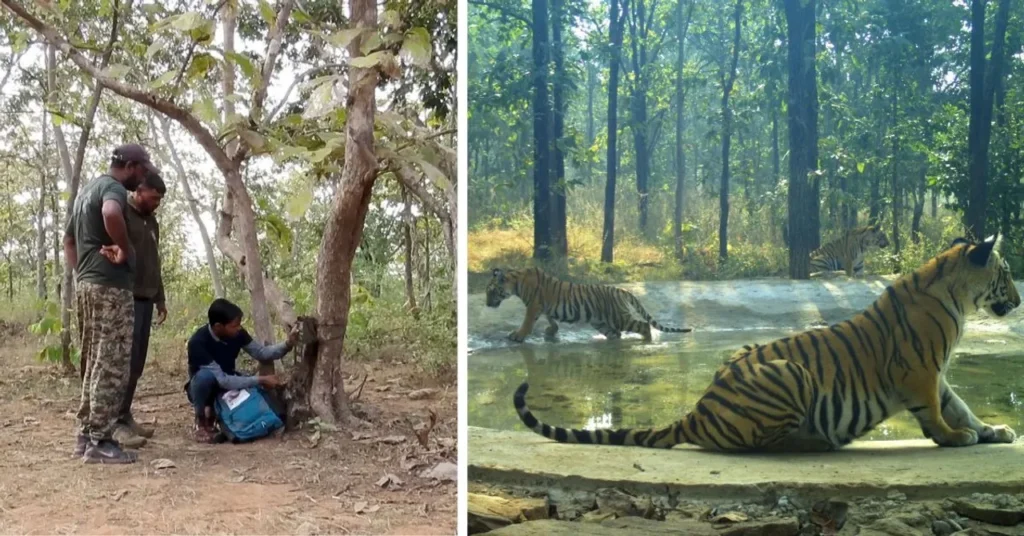
The Urban Tiger Volunteer Program is the backbone of this coexistence. Run by TINSA Ecological Foundation with the Madhya Pradesh Forest Department, it recruits local youth and trains them in skills normally limited to field biologists. They install and check camera traps, identify pugmarks, interpret scratch marks and track movement without disturbing animals. Pugmark impression pads, measuring four by six metres, let them assess age and size with accuracy. This is not feel-good community engagement. It is structured monitoring that fills the gaps left by limited departmental staff.
These volunteers become interpreters between tigers and residents. When cattle herders worry, they explain behaviour patterns. When rumours spread, they correct misinformation. Their presence reduces conflict without ever resorting to the destructive idea that urban tigers should be captured simply because they exist near humans.
The Culture That Refuses To Fear Its Tigers
Cities across India panic when a tiger strays near a settlement. Bhopal does not. That difference is cultural, not accidental. Residents have lived with tigers long enough to understand their rhythms. They know urban tigers avoid unnecessary confrontation and take predictable movement routes. They also know fear-driven policies—capture orders, tranquilisation rushes and relocation demands—shatter stability faster than any tiger ever could.
The deeper truth remains unchanged: humans are not endangered. Tigers are. Yet in many landscapes, conflict is weaponised to justify removals that serve convenience rather than safety. Bhopal’s people have rejected that impulse, proving that coexistence is not idealism but a choice informed by knowledge.
A Model That India Still Refuses To Study Properly
Urban tigers should have pushed India into new policy territory. Instead, Bhopal remains treated as a curiosity. But nothing about its success is mysterious. It is built on communication networks, youth-led monitoring, and a Forest Department willing to rely on communities rather than alienate them. The volunteers have not mythologised the animals. They have normalised their presence and protected the landscape long before any national guideline told them to.
This stands in stark contrast to regions where officials prioritise optics over science and respond to conflict with hurried captures that only create new problems. Bhopal’s model forces a simple question: why do other states refuse to invest in the same slow, community-driven trust-building? Urban tigers are not a crisis. They are a measure of how seriously a city takes its ecological responsibility.
A Future Where Tigers Survive Because People Choose To Adapt
Urban tigers move through Bhopal not in defiance of the city, but because the city has not pushed them out. That fragile balance demands more than celebration. It demands vigilance. Volunteers can only do so much if infrastructure expands recklessly or corridors narrow under pressure. The future of this landscape depends on continued humility: a willingness to listen to the forest before shaping it.
Urban tigers do not need admiration. They need space, continuity and a community that refuses to fear them into extinction. Bhopal has chosen that path. The rest of India must decide whether it wants to follow or keep repeating the old mistakes of removal, panic and loss.
Source: The Better India, India.
Photo: The Better India, India.