Tiger trafficking continues to grow at a staggering pace, as reported by TRAFFIC. A new 25-year analysis exposes how illegal trade has expanded, adapted and become more ruthless, pushing tigers closer to disappearance despite decades of global promises. When a criminal economy can run this openly and this aggressively for so long, it becomes clear that the systems meant to protect tigers are failing everywhere.
Covering seizure data from 2000 to June 2025, the report documents 2,551 incidents involving the equivalent of at least 3,808 tigers. But the numbers alone do not show the full scale of the crisis. The trends regarding tiger trafficking reveal a collapse in international willpower, the rise of profit-driven brutality, and the increasing dominance of whole-animal trafficking — a shift that exposes how tiger trafficking is no longer an underground trade, but an industrialised extraction.
Global Tiger Trafficking That Refuses To Slow
The report shows that 2023 became one of the worst years ever recorded, with 139 seizure incidents — second only to 2019. Over 75% of these occurred in Tiger Range Countries, the very nations that pledged to reverse the species’ decline. India, Indonesia and Viet Nam topped the list for recent seizures, revealing two contrasting realities: stronger enforcement in some regions, and a growing tide of criminal activity that outpaces it.
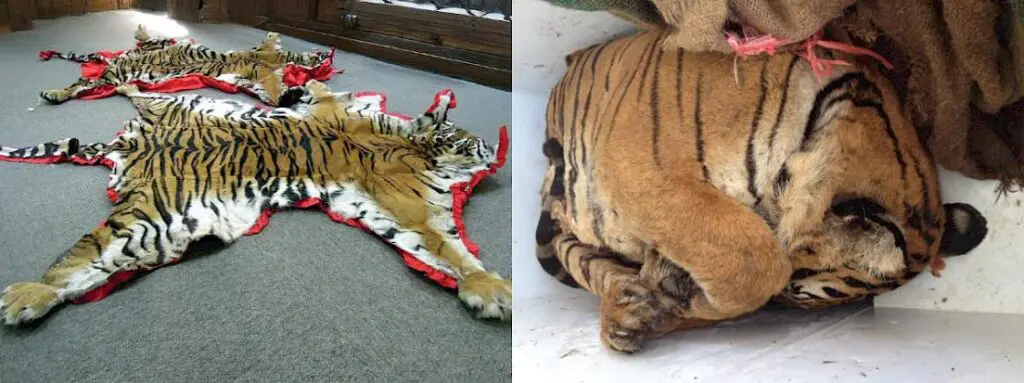
What is especially alarming is the rapid shift in what is being trafficked. In the early 2000s, tiger parts accounted for 90% of seizures. But from 2020 onward, whole tigers — dead or alive — rose sharply, dropping the share of parts to around 60%. This signals a transition from opportunistic poaching to systematic sourcing, where traffickers treat tigers as high-value units rather than fragmented commodities.
Among whole-animal seizures in the last five years, 65% took place in Tiger Range Countries. But a shocking number also occurred in nations without viable wild populations. These cases point to the darkest supply lines: captive-bred tigers leaking into illegal trade, cross-border smuggling that avoids detection and unregulated private ownership.
Tiger Trafficking Multiplies As Captive Loopholes And Weak Policies Collide
The emerging picture is stark. Wild populations are under attack, but captive facilities — especially in parts of Southeast Asia — are now feeding the market in parallel. Whole tigers moved across borders, tigers bred for slaughter and tigers kept as pets all contribute to a trafficking web too large for current enforcement structures.
This dual pipeline allows criminal networks to hide origins, launder animals and bypass genetic scrutiny. Captive-sourced trade also undermines every international agreement made since tigers received the highest level of protection under CITES five decades ago.
Tiger trafficking thrives because loopholes remain unclosed. Many countries still allow private ownership. Others lack DNA registration for captive tigers, enabling illegal substitution. Some maintain facilities under the guise of tourism or conservation while quietly feeding demand. The combined effect is devastating: the illegal tiger economy now spans wild poaching, captive exploitation, cross-border smuggling and online marketplaces.
A Crisis That Demands Immediate, Coordinated Action
The report’s authors warn that without urgent collective intervention — stronger enforcement, greater transparency, better data sharing and consumer demand reduction — decades of conservation gains could unravel completely. Hotspots remain entrenched: reserves in India and Bangladesh, Aceh in Indonesia, Viet Nam–Lao PDR border corridors and multiple urban demand centres in Viet Nam.
Even more disturbing is the convergence of species in trafficking events. Nearly one-fifth of tiger seizures involved leopards, bears or pangolins. This reveals a criminal landscape not focused on single species, but on extracting value from entire ecosystems.
Tiger trafficking is no longer just a conservation challenge; it is a global crisis powered by greed, impunity and weak governance. The world has known the solutions for years — tighten captive systems, expand cross-border operations, confront demand economies and eliminate legal grey areas — yet the political courage to implement them remains absent.
The illegal trade in tigers will not slow until nations stop pretending that incremental adjustments can defeat organised criminal markets. The world is running out of time, and the tiger is running out of chances. Protecting this species requires confronting the full scale of the global crime that thrives in the shadows while governments continue to respond in half-measures.
Source: TRAFFIC.org
Photo: TRAFFIC.org