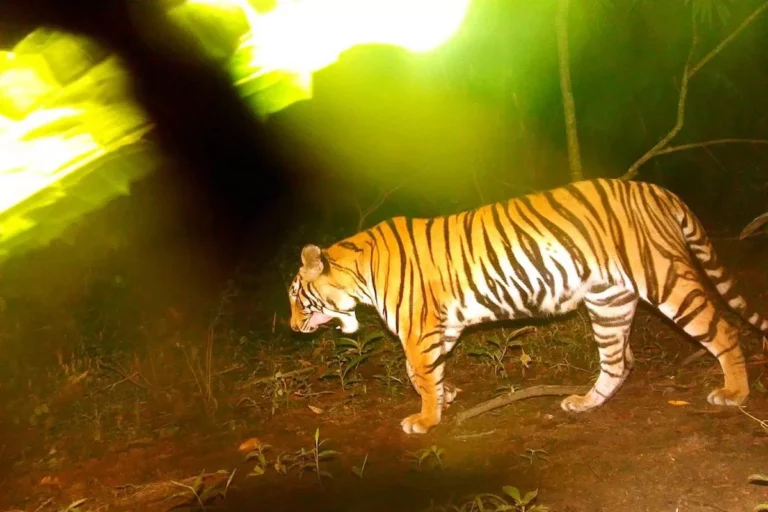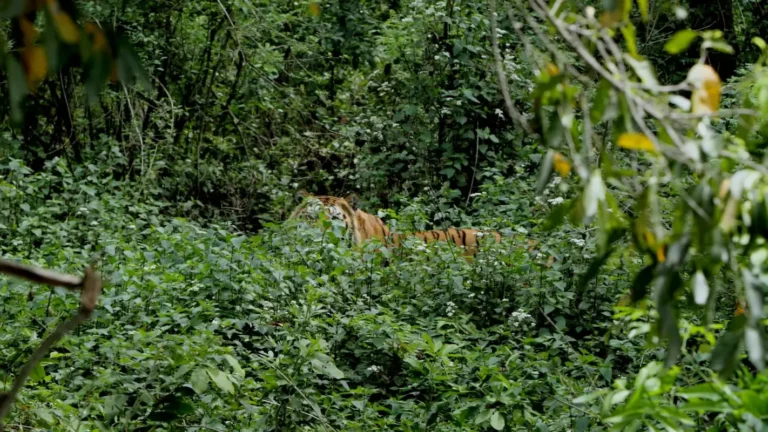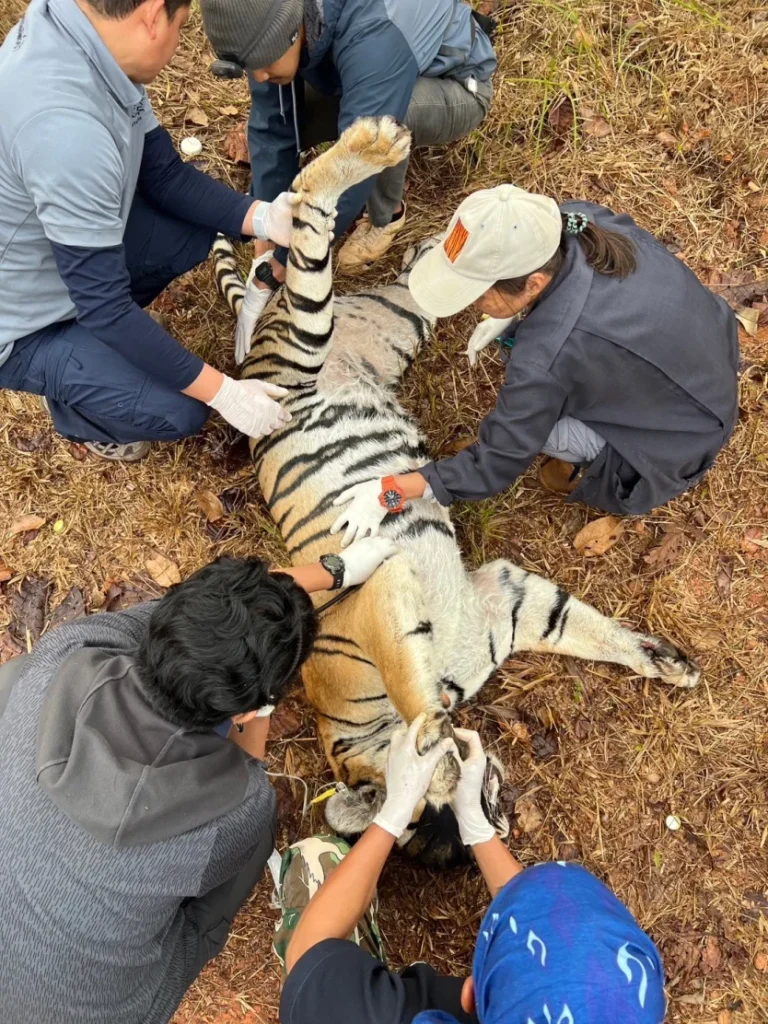
Tiger food choices in Thailand’s Dong Phayayen–Khao Yai Forest Complex are exposing a crisis conservationists have warned about for years, as reported by CNN. Deep inside this forest system, where 20 to 30 Indochinese tigers still hold on, new GPS-collar data now confirms that the prey base is collapsing quietly beneath them.
A Landscape That Should Support Tigers, But Doesn’t
The Dong Phayayen–Khao Yai landscape spans more than 6,000 square kilometres, a scale large enough to sustain a thriving tiger population. Yet entire sections of this forest are empty of tiger food. Conservationists placed GPS collars on three tigers earlier this year to understand why the population is not growing despite adequate space. The location data allowed researchers to identify home ranges, kill sites and movement patterns, giving a clearer picture of how these cats survive and what kind of tiger food they eat.
What they found was troubling. Instead of hunting large prey such as sambar, gaur or banteng, the tigers repeatedly killed much smaller animals. Wild pigs, muntjac and even prey as light as ten kilograms showed up at kill sites. These are not the feeding patterns of a healthy tiger landscape. These patterns reveal a forest where large herbivores have been depleted and where tigers must consume whatever is left simply to survive.
Evidence Of Shrinking Prey And Rising Biological Pressure
The tiger food problem was most evident in the case of Chantra, a (collared – see photo) subadult female whose monitoring data showed an unusual diet dominated by hog badgers. Researchers also documented her eating soft-shell turtles and water monitors, a behaviour not previously recorded in Thailand’s wild tigers. Her home range was smaller than her sister’s, and physical measurements indicated she was undersized. She also carries a kink in her tail, something that may hint at inbreeding within such a small population.
The data points to a forest being drained of its ecological strength. When a top predator begins relying heavily on minor prey, it signals a deeper collapse of the systems that once supported it. Chantra’s behaviour, along with the patterns seen in the other collared tigers, reflects a landscape under intense pressure from poaching, fragmentation and shrinking prey availability.
A Forest That Looks Intact But Functions Poorly
From above, Dong Phayayen–Khao Yai appears to be a stronghold. It is thickly forested, legally protected and part of a globally important conservation network. But internal ecological indicators tell a different story reagrding tiger food. Rangers describe one part of the forest as “the empty forest” because tigers do not use it at all. The absence is not caused by territorial disputes or natural shifts. It is caused by human disruption that has quietly drained the forest of the large mammals tigers depend on.
Infrastructure projects, such as Highway 304 and proposed dams, further fracture the habitat and create new access routes for hunters. Prey species cannot recover under this combination of pressure. And without prey, tigers cannot thrive, regardless of how much forest remains on paper.
Tracking Tigers To Understand How To Protect Them
The GPS-collar project is the first major effort to track tigers in this landscape in real time. Each collar stores hourly coordinates, revealing ranges, dispersal patterns and feeding areas. These insights help conservationists identify the exact points where threats are highest. Poaching hotspots, degraded areas, and dangerous access corridors can now be addressed directly.
The initiative also highlights how close this population is to genetic and demographic danger. With only a few dozen tigers remaining, every loss matters. And when prey declines force tigers to rely on marginal food sources, survival becomes a matter of chance rather than ecological stability.
The Future Depends On Prey Recovery, Better Tiger Food
Thailand has already demonstrated that tiger recovery is possible; its Western Forest Complex saw numbers triple over the past decade. A similar revival can occur in the east — but only if prey populations are restored and the forest is fully protected from poaching and encroachment.
Tiger food patterns in this landscape are not just dietary observations. They are an ecological alarm. When tigers start eating small prey, the system around them is failing. If Thailand acts now to rebuild prey density, reduce human access and enforce protections with urgency, the remaining tigers in this forest could still recover.
But without decisive intervention, Dong Phayayen–Khao Yai could become another protected area with trees, laws and boundaries, but without tiger food — and no more tigers left to defend.
Source: CNN, USA
Photo: CNN, USA