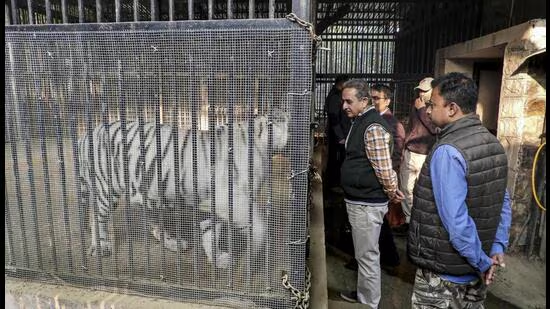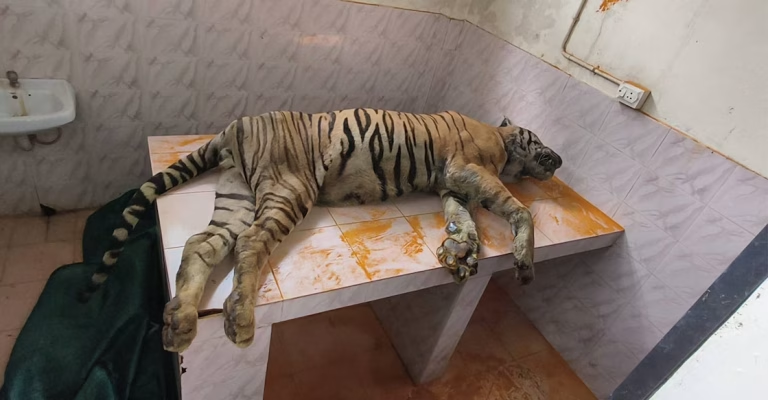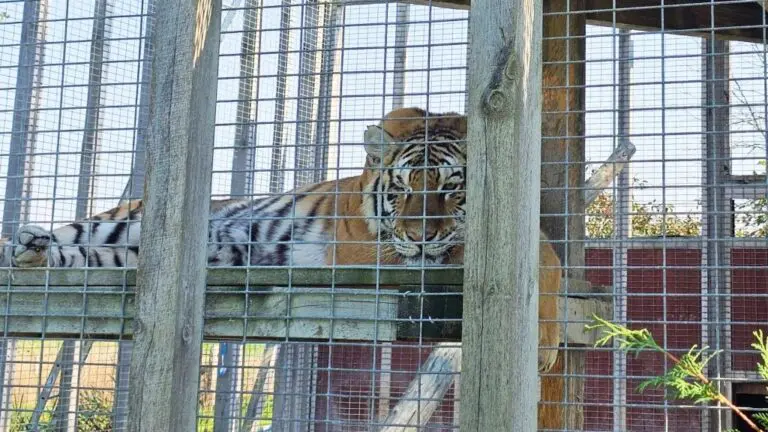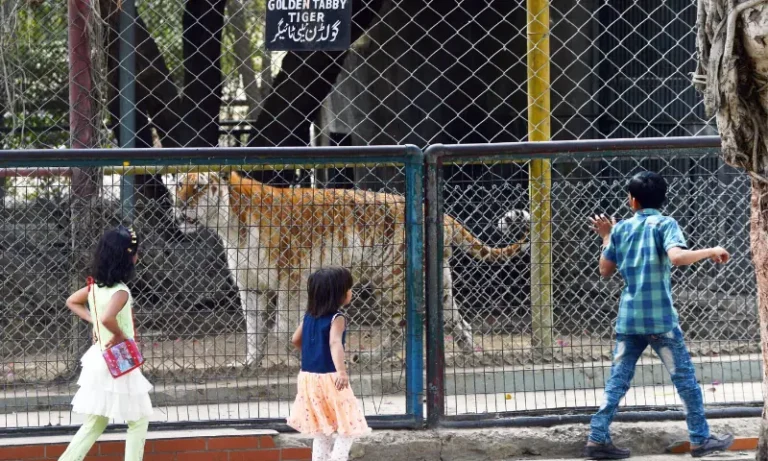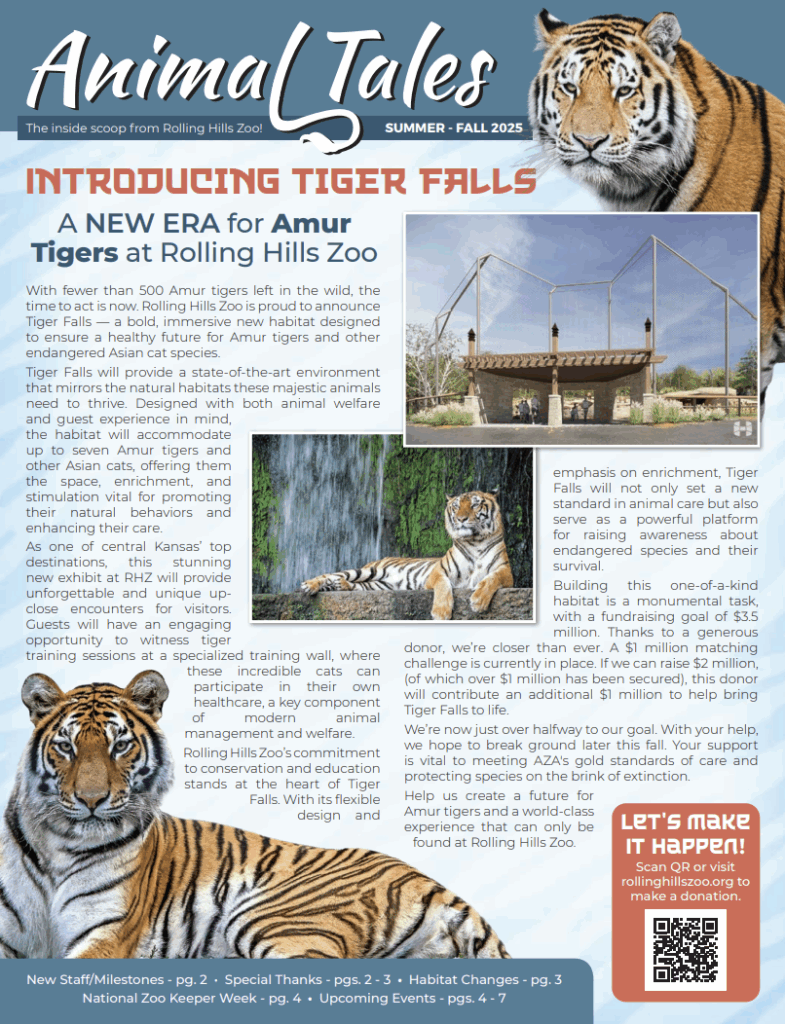
Tiger Falls is being promoted as a breakthrough in conservation, according to Salina Post, but the announcement reveals a familiar pattern of exaggeration, misinformation, and polished marketing language designed to make captivity look noble. Rolling Hills zoo claims a new exhibit will “ensure a healthy future for Amur tigers,” despite the fact that wild Amur populations have already surpassed 750 according to Russian authorities, not the outdated “fewer than 500” figure repeated in this release.
By beginning with a falsehood, Tiger Falls immediately exposes how zoos distort reality to justify expansion.
Marketing Disguised As Conservation
The zoo describes Tiger Falls as a state-of-the-art habitat that “mirrors natural environments,” a claim that does not withstand even basic scrutiny. An enclosure in Kansas cannot replicate the vast, frigid, forested landscapes of the Russian Far East where temperatures drop to 50 minus zero in winters and rise to 30 in the summers. Tigers evolved to roam territories that stretch across tens or hundreds of square kilometres. No exhibit—no matter how polished—can approximate the spatial complexity, prey dynamics, or climatic extremes of the taiga. So, what they are building is not a natural environment, it is a visitor attraction dressed in conservation language. But don’t call it different. It’s a lie.
Rolling Hills zoo proudly states that Tiger Falls will offer “space, enrichment, and stimulation” to promote natural behaviour. But space in a zoo is always a fraction of what tigers require. Enrichment exists only because captivity deprives animals of the natural challenges that shape their lives in the wild. A tiger in a zoo receives toys, feeding puzzles, and scent trails- but that’s not natural. They get this because it cannot hunt, pray, or live freely. Enrichment is not a gift—it is a crutch for a system that suppresses normal behaviour until artificial stimulation becomes necessary to prevent psychological collapse.
The repeated use of Tiger Falls throughout the zoo’s announcement reflects how central branding is to the message. Visitors are meant to associate the name with care, innovation, and conservation, rather than confinement, display, physical and mental struggles and financial strategy.
A Facility Built For Visitors, Not Tigers
The zoo frames Tiger Falls as an immersive platform for “raising awareness,” with guests encouraged to observe training sessions at a specialised “training wall.” But such demonstrations do not educate the public about real tiger ecology, behaviour, or threats. Instead, they show tigers performing controlled movements in exchange for food, reinforcing captivity, not conservation. These sessions are designed for visitor excitement, not animal welfare or scientific understanding.
The statement that tigers “participate in their own healthcare” is another crafted phrase that hides reality. Training for veterinary procedures is not empowerment as it is a necessity created by captivity. Tigers in zoos must be trained because captivity causes stress, illness, and behavioural issues that require constant management. A wild tiger has no need to present its paw or press its flank against a wall for inspection. These are responses to confinement, not examples of improved welfare.
Tiger Falls also emphasises that the exhibit will “set a new standard in animal care.” Even if that were true, it misses the larger issue: millions of dollars are being wasted to refine captivity rather than to protect wild habitats, support anti-poaching patrols, or strengthen coexistence strategies. The financial priorities of zoos rarely align with genuine conservation. They build exhibits because exhibits generate revenue.
Misleading Conservation Claims
The zoo highlights the Species Survival Plan, implying that breeding Amur tigers in U.S. zoos is vital. What they omit is that thousands of Amur tigers already exist in Chinese breeding facilities, many living in far worse conditions but demonstrating that the species is not in immediate genetic danger. What matters for conservation is habitat, not breeding more captive tigers that will never return to the wild. Breeding programmes inside zoos serve the population of zoos—not the population of forests.
Tiger Falls is presented as a community-driven, donor-supported milestone. But the fundraising target of 3.5 million USD hides the true cost: the lifetime confinement of more tigers. The exhibit will attract visitors, sell tickets, and reinforce the illusion that proximity to captive animals equals conservation.
It does not.
If communities want to help endangered species, the money spent on exhibits like Tiger Falls should be redirected toward preserving wild landscapes, not building new enclosures. This distinction lies at the heart of how society misunderstands wildlife protection, a pattern reflected in discussions of zoo practices. The real future of tigers depends on forests, not on attractions built to simulate them.
Source: Salina Post, USA
Photo: Rollins zoo, USA