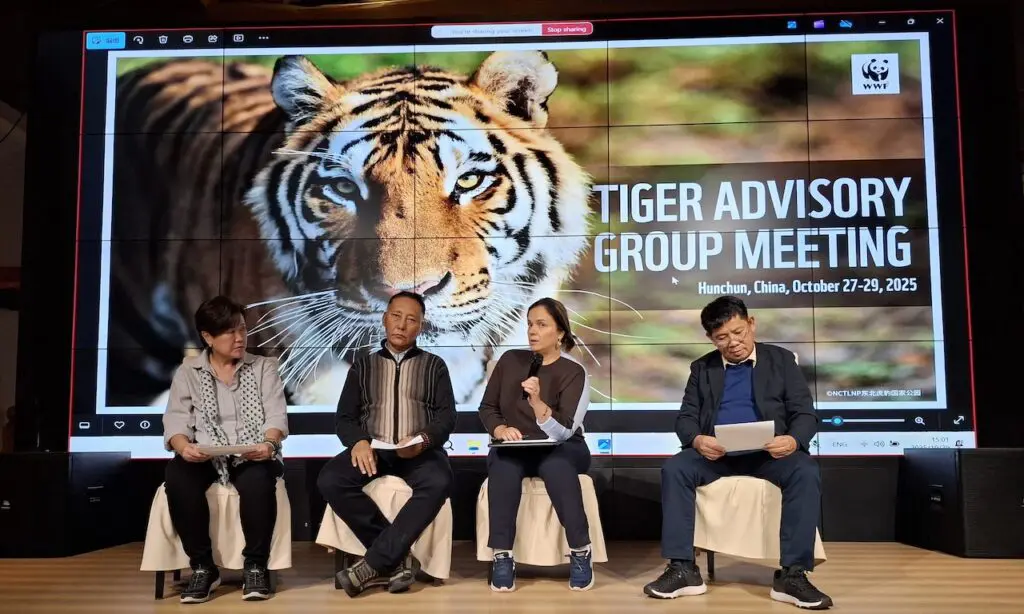
In late October, officials, conservationists, and global NGO executives gathered in the Chinese city of Hunchun to discuss the “future of tigers,” as reported by DKNews.kz. It sounded noble, looked expensive, and achieved nothing new. Another round of speeches, photo sessions, and forecasts filled the program. They called it cooperation. The rest of us, especially our show, might call it what it is — Tiger BlaBla.
The endless cycle of conservation theater
WWF Central Asia presented what it called a milestone update: the continued reintroduction of Amur tigers into Kazakhstan. The story of the pair, Bogdana and Kuma, has been told for years. They came from the Netherlands in 2024, now live in a secure enclosure in the Ili-Balkhash Reserve, and may one day produce offspring for release into the wild. But that “one day” has been coming since 2010. Fifteen years later, there is still no wild tiger in Kazakhstan. What exists instead is a perfectly managed narrative — designed, polished, and broadcast as Tiger BlaBla.
Meetings like these are framed as breakthroughs, yet their rhythm rarely changes: big gatherings, soft promises, and the final group photo. The budgets are substantial, the press releases flawless, and the outcomes almost invisible. This is how Tiger BlaBla keeps itself alive — by holding conferences about what it hasn’t done.
The illusion of progress
WWF’s work across the world has protected forests, strengthened patrols, and reduced poaching in key regions. Those achievements are real. But this particular storyline — the reintroduction of tigers into Kazakhstan — is not. Rewilding a top predator requires prey, habitat, and enforcement, not PowerPoint slides. The Ili-Balkhash landscape is still fragmented by mining, livestock, and poaching risk. Bringing tigers back into that equation is less conservation than choreography, another layer of Tiger BlaBla dressed as success.
These high-profile campaigns echo the patterns. The image of progress often matters more than the progress itself. A tiger in a fenced reserve fits neatly into donor updates and glossy annual reports. It looks like a comeback. But without wild release, it’s a well-funded illusion.
The delegates spoke of “global leadership,” “shared responsibility,” and “restoring heritage.” None mentioned that the same international network failed to protect viable corridors in India, Sumatra, or Russia — places where tigers still live, unseen and uncelebrated. But when are these “leaders” call out on China with their tiger farming, or Malaysia with their constant BS-promises to protect tigers? Or what to think about the disappeared tigers from Vietnam, Cambodia and Laos? We suggest not talking about leadership until all problems have been solved.
When tigers become brands
Every few years, the global conservation circuit unveils a new “turning point.” It started a bit in 2010 in Russia with the Global Tiger Inititiative to double the amount of tigers. And since then we have seen many shows, like the one last year in Bhutan. Now, in 2025, the focus has shifted again to “returning” tigers to landscapes that cannot hold them. Each promise sustains the same pattern: meetings generate publicity; publicity secures funding; funding sustains the next meeting. Tiger BlaBla becomes the business model.
The language of success has been reduced to slogans. Words like “lifeline,” “turning point,” and “hope for the future” fill press releases while real enforcement budgets shrink. NGOs, under pressure to please donors, design projects that can be photographed. WWF, one of the world’s most powerful conservation organizations, knows how to save tigers — it just too often chooses how to market them instead.
The missing wilderness
Kazakhstan’s project could still succeed, but only if it moves from ceremony to science. That means restoring the prey base, enforcing anti-poaching law, and ensuring genetic resilience before any release. Without that groundwork, Bogdana and Kuma remain ambassadors, not ancestors. They symbolize intent, not achievement. The danger is that the world stops demanding results once the headline sounds optimistic enough — the essence of Tiger BlaBla.
This version of conservation is not malicious; it is institutional. Success is measured by visibility, not wild births. People attending these conferences may care deeply about tigers, yet their structure rewards announcements over outcomes. Tiger BlaBla thrives in that system, feeding on attention while the forests stay empty.
Beyond the microphones
The future of tigers will not be decided in conference halls. It will be decided by rangers with low salaries, by courts that actually sentence poachers, and by governments willing to restrain industry. Until that shift happens, the world will keep producing more Tiger BlaBla — more meetings, more banners, more slogans — instead of more wild roars.
If Kazakhstan truly wants to bring back its tigers, it must do what these gatherings rarely do: stop performing progress and start building it. Conservation isn’t a brand. It’s a responsibility measured not in press releases but in living animals. The planet doesn’t need another round of Tiger BlaBla; it needs the silence of forests where tigers walk unseen and unannounced.
Source: DKNews.kz, Kazakhstan.
Photo: DKNews.kz, Kazakhstan.