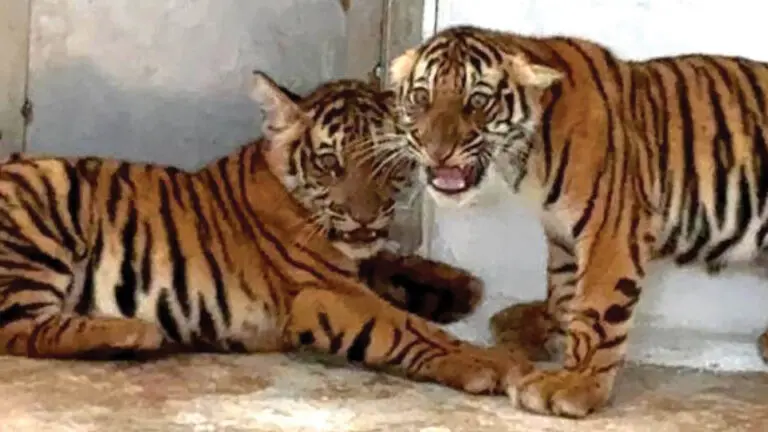
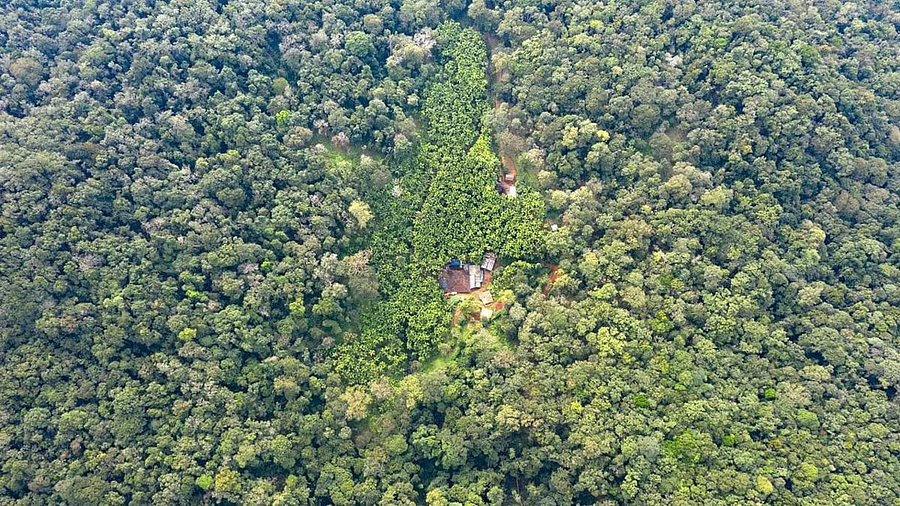
Three tiger cubs were pulled from the forests of Karnataka’s Biligiri Ranganatha Temple (BRT) Tiger Reserve this week. The three tiger cubs, found between Punajanuru and Beduguli, were discovered alone by a patrol team. Two were picked up on Sunday and another on Tuesday. Forest officials told Deccan Herald that the mother was “out of sight” and began a large-scale combing operation using elephants and drones. The cubs are now at the rehabilitation centre in Koorgalli, Mysuru, under veterinary care.
The rescue made headlines within hours. Yet no one is asking the harder question—why a tigress in one of Karnataka’s best-guarded reserves would leave her cubs in the first place. Forest officers say the “possibility of poaching is less” because the site lies eight kilometres from the nearest village. But that logic is hollow. Tigers are dying in core zones too. Proximity to people doesn’t decide safety—discipline and patrol strength do.
Three Tiger Cubs — another operation, same script
The department’s response followed the familiar pattern: set up a committee, call it a rescue, send press notes. The NTCA’s guidelines are being quoted as proof of competence. But committees don’t protect forests—field presence does. A mother tiger gone missing inside a reserve is not an “incident”; it’s a breach. Still, no inquiry has been announced. No independent investigation, no forensic check for traps or toxins.
If the mother died, how? If she’s alive, why did the patrol not detect her before? India’s wildlife bureaucracy often avoids those questions because answers might expose weak patrol coverage, broken corridors, or ignored local intelligence.
A rescue shaped for cameras
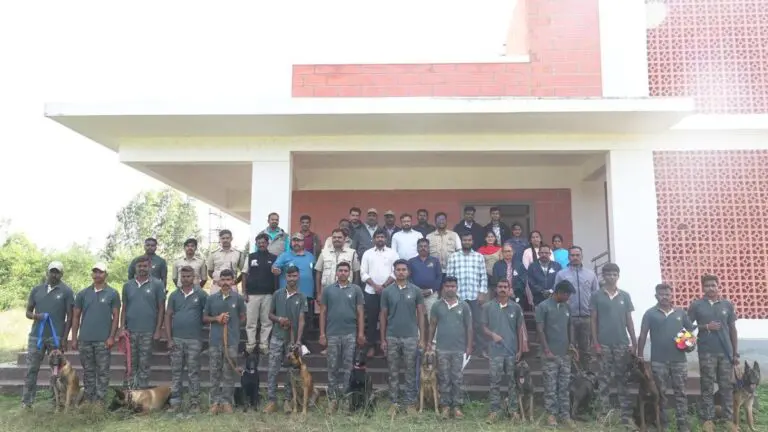
Camp elephants Bheema and Mahendra are leading the combing. Rangers and veterinarians are on site. It looks impressive—men, machines, and order. But these missions often turn into spectacles. Instead of discreet fieldwork, officials stage “operations” that attract crowds and attention. Drones fly. Statements follow. And the mother, if she’s nearby, stays hidden longer.
The three tiger cubs are safe for now. Yet the rescue that saves them could also destroy the chance of reunion. Few ask what happens next. If the tigress isn’t found, will the three tiger cubs be raised in captivity? Released later? Or will they vanish into the long list of animals that survive but never live wild again?
A pattern of reaction
This case comes just days after Bandipur’s four “abandoned” cubs were taken in by forest staff. Once again, the act of feeding young tigers is being portrayed as compassion. It’s not cruelty—but it is confusion. Each rescue tells the same story: intervention without accountability. India keeps repeating what fails in conservation practices—responding to visible crises instead of preventing them.
Officials say they follow NTCA norms. But those norms are meant for emergency care, not long-term dependence. When every “rescue” ends with captivity, something is deeply wrong in the chain of protection.
The missing accountability
BRT is supposed to be a fortress—dense forest, strong prey base, steady patrols. If a tigress can vanish here, what happens in smaller reserves? Every disappearance should trigger an internal review: patrol logs, camera trap data, witness mapping. None of that has been mentioned. Instead, the department declares “search on all fronts.” It’s the same phrase used after every unexplained tiger death.
A real investigation would ask: were there new encroachments? Were snare sweeps done that week? Was there a logging trail nearby? These questions don’t appear in press releases because they lead straight to oversight failures.
Numbers over knowledge
India’s forest administration is trapped between paperwork and perception. Rescue operations produce quick wins and national coverage. Audits and prosecutions don’t. So the structure rewards optics, not outcomes. The result is a steady cycle of disappearance, rescue, release, and repeat—each time applauded as success.
The department insists the three tiger cubs are “under observation” and “the mother will be traced soon.” That same sentence has been repeated in almost every missing-tigress report this decade. Sometimes the mother returns; more often, she doesn’t.
A simple truth
Saving three tiger cubs is not enough. Each cub pulled from the forest is a warning that the system is losing control of its space. Tigers are not orphans by choice. Somewhere between a patrol log, a camera feed, and a road that cuts too deep into the forest, their mothers disappear.
The rescue at BRT should have been treated as a signal to strengthen on-ground intelligence, not as another example of “efficient management.” It shows that India’s tiger reserves are better at reacting than anticipating. And until that changes, more cubs will end up in cages designed to look like sanctuaries.
The three tiger cubs of BRT will now live under lights and lenses while officials promise to find their mother. But the real search should be for something else: an honest system willing to admit its gaps. Only then can these forests belong to tigers again.
Source: Deccan Herald (India)
Photo: Deccan Herald (India)